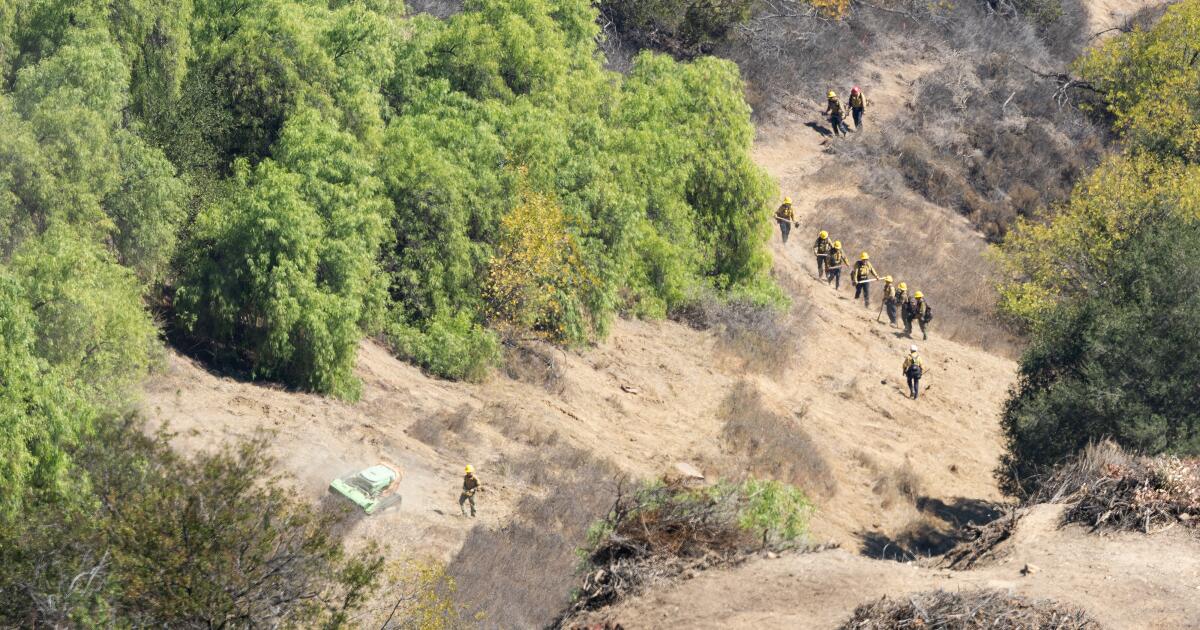
As California grapples with increasingly devastating wildfires, experts and officials have long called for the removal of dense, flammable vegetation that can ignite into destructive flames from lightning or a power line spark.
But after years of record state investment in reducing wildfire risk, two key sources of funding are disappearing, potentially reducing the annual vegetation removal budget by hundreds of millions of dollars.
Wildfire resilience advocates warn that the loss of these funds will leave the state vulnerable to devastation, and are calling on California’s next governor to take the threat seriously.
Currently, California relies heavily on two sources of funding for wildfire mitigation work: A state program that charges polluters for their emissions and a climate bond approved by voters in 2024.
However, late Friday, federal officials adopted a new draft of the emissions program, called cap-and-invest, which analysts say will reduce wildfire prevention funding by $200 million a year. At the same time, the governor’s latest budget proposal puts the state in a position to allocate most of the $1.5 billion climate bond to wildfire prevention funds in just three years.
As a result, California could go from regularly drawing more than $600 million a year from these sources, to just $150 million, according to an estimate from the Wildfire Solutions Coalition – a group of more than 80 organizations representing conservationists, business owners, fire officials and tribal leaders.
The coalition urges the government to find new sources of funding for this project.
“We have scientists, we have experts, we have lawyers,” said Michelle Decker, who is on the coalition’s executive committee and president and CEO of the Inland Empire Community Foundation. “We see this problem. We can get past this problem. It’s a matter of income.”
California’s wildfires have been on the rise. The 2025 LA fires alone caused an estimated $250 million in damages and economic losses. Insurance companies have paid $22.4 billion.
In an effort to reduce the risk of damage to communities and the environment, the state has used a variety of strategies. This includes fortifying homes against wildfires, replanting fire-ravaged forests and reducing vegetation through prescribed burning, grazing goats and manual felling with heavy machinery to reduce the intensity of potential fires.
Research suggests that wildfire mitigation efforts are paying off. A recent analysis of 285 wildfires in the western US found that every dollar spent on landscape programs saves about $3.75 in wildfire damage.
But as funding from cap-and-invest and climate bonds dwindles, the state must turn to Cal Fire, which devotes a smaller portion of its budget to mitigation work.
“This is not an issue that can be pushed back on a purely political timeline,” said Steve Frisch, a founding member of the coalition and president of the Sierra Business Council. “Fire happens whether we want it or not.”
After a series of devastating wildfires in Northern California and the 2017 Thomas fire in Southern California, the state legislature began to focus explicitly on funding for wildfire prevention.
In 2018, lawmakers directed $200 million in annual cap-and-investment for wildfire mitigation projects.
As the Woolsey fire in Southern California and the Camp Fire in Paradise raged on, Trump blamed the situation on “mismanagement” of forests and threatened to cut off federal funding unless it was fixed.
Gov. Gavin Newsom and the legislature, with a larger budget, began putting more money in, resulting in a record $1.1 billion in wildfire prevention investments during the 2021-2022 fiscal year.
After the deficit dwindled, the legislature chose in 2024 to put a $10 billion climate bond before voters — $1.5 billion of which was dedicated directly to wildfire mitigation work.
Newsom has since pointed to this higher funding to ask the federal government to increase its own investment in forest management.
The federal government manages 57% of all forests in the state. While the US Forest Service spent $3.1 billion to reduce wildfire conditions in the state over the past few years, California spent $4.3 billion, according to the California Forest Resilience and Wildfire Task Force.
However, the state has already set aside nearly $600 million for wildfire mitigation in the 2024-2025 and current fiscal years. The latest budget proposal would allocate more than $300 million this coming fiscal year. While many advocates support allocating money immediately, it leaves little room for future years.
Once that money is spent, California must pay off a $10 billion bond with interest. The result is a price tag of about $16 billion, paid out at about $400 million annually, for 40 years, according to the state Legislative Analyst’s Office.
As for limited funds and investment, a months-long debate at the California Air Resources Board on how to extend the program beyond 2030 led to a compromise that would cut the revenue it generates in half, estimates the Office of the Legislative Analyst.
With other projects taking priority — including a $1 billion annual California high-speed rail project — the new proposal “will likely leave no funding” for the wildfire and forest resilience line item, the Legislative Analyst’s Office found.
Cal Fire still maintains a limited annual budget for wildfire mitigation work. In the 2024-2025 fiscal year, the agency had $500 million for forest management and fire prevention that was not directly tied to an investment or bond — up from about $65 million two decades ago.

As for the federal government, an independent analysis by Grassroots Wildland Firefighters and NPR found that the Forest Service’s wildfire mitigation efforts are shrinking amid federal staffing cuts. The Forest Service says the decline in activity is due to poor weather for activities such as prescribed burns and busy firefighting crews.
Both the state and federal government investments are very small compared to the resources used by California investors. In 2025 alone, utilities plan to spend more than $9.2 billion to prevent their equipment from causing the next wildfire, largely funded by California’s electric bills.
Times staff writer Hayley Smith contributed to this report.