Understanding the Basics of Quantum Computing
Quantum computing currently offers no tangible advantages over traditional computing in either the commercial or scientific arenas. However, we are already seeing an increase in the number of qubits, the emergence of the first serious quantum projects from technology leaders, and an influx of investment.
According to Fortune, the global quantum computing market will grow from $1.16 billion to $12.62 billion by 2034, representing a 34.8% annual growth rate over the decade. Boston Consulting Group notes that the number of qubits—key indicators of quantum power—has doubled every 12 to 18 months over the past seven to eight years, a trend that will continue in the near future.
Furthermore, amid a general decline in investment in technology, quantum computing is demonstrating steady growth and continues to attract billions of dollars from venture capitalists.
Below, we’ll cover the basics of quantum computing to provide a general understanding of the technology, its impact on the computing market, and practical applications.
What is quantum computing? Key concepts explained
Quantum computing is a new computing paradigm that uses the laws of quantum mechanics to model and solve complex problems that are too difficult for today’s classical computers. Unlike classical computers, which use binary electrical signals representing ones and zeros (bits), quantum computers use quantum bits, or qubits.
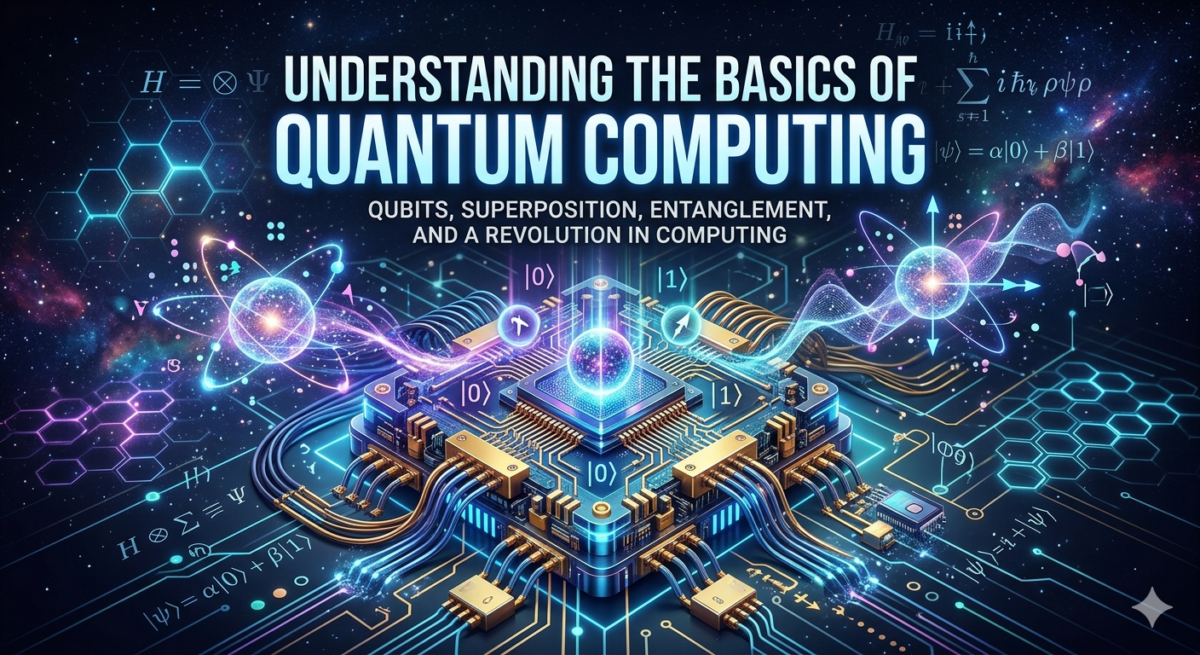
A qubit is a quantum analogue of a classical bit. Its unique feature is that it can exist not only in the 0 or 1 state, but also in a combination of both. Various physical systems are used to implement qubits: superconducting circuits, ion traps, photons, or neutral atoms.
Quantum computing is based on principles such as superposition and entanglement:
Superposition is the ability of a quantum system to exist in multiple states simultaneously. This means that a qubit can be both 0 and 1 simultaneously, with varying probabilities. This allows a quantum computer to process multiple solution options in parallel, rather than sequentially, as a classical computer would.
Entanglement is a quantum phenomenon in which the state of one qubit is directly linked to the state of another, even if they are separated by large distances. Entangled qubits operate in concert, enabling increased computing power and solving problems with highly interdependent data.
The more qubits a quantum computer has, the greater its potential for large-scale computation and problem-solving. Quantum computers offer a fundamentally different approach to computing, processing multiple possibilities simultaneously, potentially allowing them to solve certain problems exponentially (i.e., many times) faster than classical computers.
Quantum computing and traditional computing have several fundamental differences:
| Calculate using qubits, which can represent 0 and 1 simultaneously. | Calculated using transistors that can represent either 0 or 1 |
| Performance grows exponentially with the number of qubits. | Performance increases 1:1 with the number of transistors |
| Quantum computers have high error rates and must operate in extremely low temperatures. | Classic computers have low error rates and can operate at room temperature. |
| Best suited for tasks such as optimization, data analysis, and modeling | Most everyday calculations are better performed by classical computers. |
The birth and evolution of quantum technologies
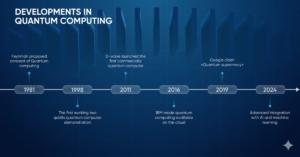
The idea of building a system capable of using the laws of quantum physics to solve complex problems arose in the 1980s. One of the first steps was the discovery of quantum algorithms, among which the work of Peter Shor of MIT in the 1990s stands out: his algorithm demonstrated that a quantum computer is theoretically capable of cracking modern cryptographic systems, sparking discussions of a “quantum apocalypse” in cybersecurity.
Since the early 2000s, the development of quantum computing has become a strategic focus for leading corporations and research centers. The prototypes of quantum processors based on various technologies, including superconductors, ion traps, photons, and neutral atoms, have emerged. This has sparked a race among the leaders in quantum computing—Google, IBM, Microsoft, Intel, IonQ, and others—each striving to create a robust system with hundreds of thousands of qubits.
Today, we are in a phase that experts call the “era of quantum utility.” This means that in several specialized tasks (e.g., molecular modeling, logistics optimization, quantum cryptography), quantum algorithms are beginning to outperform classical methods. Moreover, researchers are actively exploring the integration of quantum artificial intelligence (quantum AI), which can combine the capabilities of machine learning and quantum physics to solve problems of new complexity.
Thus, the future of quantum computing is associated not only with the growth of the power of quantum machines but also with their real-world application in science, industry, and information security.
Advantages and limitations of quantum computing
Quantum computers aren’t just faster versions of conventional computing systems. They operate on entirely different principles, which gives them unique advantages and, at the same time, imposes certain limitations.
Benefits of quantum computing
Quantum computers have the potential to fundamentally change the approach to solving complex problems thanks to a number of their properties.
- High computing speed. Quantum systems are capable of processing a huge number of possible solutions to a problem simultaneously, making it possible to solve problems previously considered intractable. For example, Google’s Sycamore quantum computer once solved a problem in seconds that would have taken the Frontier supercomputer 47 years to solve.
- A new level of data analysis. Quantum computers are capable of identifying subtle connections and patterns in vast amounts of information, whether it’s customer behavior data, medical research, or logistics.
- Incredible accuracy. Quantum computers promise more accurate calculations than classical computing systems, which is critically important, for example, for financial forecasting or scientific research. And the combination of quantum and classical methods already allows for more accurate forecasts.
- Accelerating AI development. Artificial intelligence, including large language models (LLMs), requires enormous amounts of data and massive computing power for training. Quantum computing can significantly reduce the time and cost of this process. It can quickly generate high-quality synthetic data and accelerate complex calculations, enabling the development of more sophisticated and efficient AI models.
Limitations of quantum computing
Despite their advantages, quantum computers face serious challenges that are currently preventing them from becoming widespread.
- Manufacturing complexity. This remains a highly complex technological process, not yet established on an industrial scale. And programming requires fundamentally new approaches and programming languages.
- Quantum noise. This term refers to any external disturbances—from temperature fluctuations to vibrations and electromagnetic fields—that can disrupt the fragile quantum state of qubits. Even minor disturbances lead to calculation errors. To minimize noise, quantum computers are stored under special conditions: cooled to temperatures close to absolute zero (−273.15°C) and placed in special shielding units. Creating such an environment makes quantum computers bulky and very expensive.
These factors, along with high costs, are slowing the adoption of quantum computing in everyday life. And although we are talking about a technology of the future, its widespread adoption directly depends on how successfully scientists can address these two global challenges.
Key players driving innovation in quantum computing
The global quantum technology market is in an active development phase, and market leaders are already demonstrating concrete achievements.
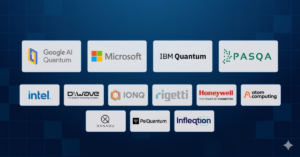
Google Quantum AI
Here, they’re focused on creating quantum systems to solve problems beyond the capabilities of classical supercomputers. Two years ago, the company unveiled its new 105-qubit Willow processor and announced plans to build a million-qubit system by the end of the decade. Google is currently developing quantum error correction methods that should provide a “useful quantum advantage” in chemistry, materials science, and machine learning.
Microsoft
The company is relying on a fundamentally new architecture—Majorana fermions—as the basis for topological qubits. Last year, it introduced the Majorana 1 chip, which uses the Topological Core concept, where information is stored non-locally, theoretically increasing the system’s resilience to noise. The company plans to create a million qubits on a compact platform to more effectively use quantum computing in cryptography, logistics, and pharmaceuticals.
IBM Quantum
This division is moving toward scaling proven superconducting qubit technology. It previously unveiled the Osprey (433 qubits) and Heron (133 qubits) quantum processors, which significantly outperform their predecessors in error rates. IBM’s long-term plan is to build a 100,000-qubit quantum supercomputer within the next ten years and integrate it with classical HPC systems. IBM recently announced cloud access to its quantum processors through the IBM Quantum Experience platform. By 2029, the company expects to create a system that controls 100 million gates across 200 logical qubits.
Pascal
A French startup is actively developing quantum computing technology based on neutral atoms. This architecture is considered more scalable than superconducting qubits and is suitable for tasks in physics modeling and optimization. The company recently raised $100 million in funding and later announced plans to pool quantum computing power in the cloud for industrial clients.
Other notable players in the quantum computing market include Intel, D-Wave Systems, IonQ, Rigetti Computing, Honeywell Quantum Solutions, PsiQuantum, Atom Computing, Xanadu, and Infleqtion. The US and China lead in quantum computing development and investment, with the former leading in the number of startups and private investment, and the latter in the number of patents in this field.
Overview of quantum hardware and software
Quantum computing systems include both specialized hardware and software components. Regarding quantum hardware, various qubit technologies exist. These systems often require cryogenic environments with extremely low temperatures and specialized hardware. For example, IBM is developing a 4K cryo-CMOS qubit controller to control qubits from within a refrigerator. Microsoft’s qubit topological architecture includes aluminum nanowires connected in an H-shaped pattern, where each H contains four controllable Majoranas and forms one qubit.
Software tools and platforms are key for interacting with quantum hardware. Google offers Cirq documentation and open-source tools. IBM provides the Qiskit SDK for useful quantum computing and Qiskit Serverless for running workloads on quantum and classical resources. Google Quantum AI also highlights standard software tools such as Stim and Crumble.
Potential applications of quantum computing
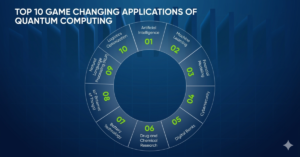
Quantum computing enables solutions to problems that are impossible with other technologies. We’ll hear about high-profile real-world use cases very soon, but for now, we’ve compiled a list of areas where the use of quantum computers could radically change the situation.
- Drug discovery and materials science. Quantum models allow for more accurate simulation of molecules and accelerate the search for new drugs or materials, especially using the capabilities of quantum qubits.
- Financial modeling and risk management. A quantum computer can optimize portfolios, assess risks, and improve operational efficiency.
- Optimization and supply chains. Problems with many variables, such as resource allocation or logistics, can be solved faster thanks to quantum acceleration, especially using hybrid algorithms.
- Quantum AI. The integration of quantum computing and AI opens up opportunities to accelerate neural network training and improve pattern detection in big data.
- Quantum cryptography and security. Technologies such as quantum key distribution create robust protection against threats posed by future quantum computers.
- Climate modeling and forecasting. Quantum systems can more accurately model dynamic natural processes, which is especially important for climate and meteorological problems.
- Automotive and mobility. Quantum computing is used in traffic optimization, battery design, and autonomous systems.
Initial results are already in hand. For example, Honda, in collaboration with quantum software developer BlueQubit, successfully classified road images, achieving very high accuracy—up to 94%. IBM is promoting the Quantum Safe platform to protect data from the risks associated with the development of quantum technologies. And the American biotech company Moderna, in collaboration with IBM, is already testing quantum algorithms (VQA) to accelerate the development of mRNA vaccines.
Current state of the quantum industry and challenges
The quantum computing industry is still in its early stages of maturity, but it is developing rapidly. While quantum computers are making headlines for solving specific problems, the current state of quantum computing shows that they are not yet ready to run large-scale AI models or process the massive amounts of data required by many machine learning/AI algorithms. Some experts predict that it may take another 15-20 years before quantum artificial intelligence becomes mainstream. But the industry faces other challenges as well.
- Quantum Security. The potential of quantum computers to break existing encryption underscores the critical need to transition to quantum-resistant cryptography standards. This transition is essential for preserving the integrity of digital trust mechanisms. Experts expect the full integration of quantum-safe standards to take 12 years.
- Qubit scaling and error management. Companies are still working on scaling the number of physical qubits and optimizing their interactions. The main goal is to reduce noise and heat sensitivity to move toward more fault-tolerant quantum computers.
- Hardware stability and control. The issue of its precision and potential scalability remains. Engineers still need to address challenges such as precisely controlling qubits at scale and cooling millions of qubits simultaneously.
- The immaturity of quantum algorithms and quantum software. Most quantum algorithms exist only in theory and have not been implemented on quantum computers. Today’s quantum computing still relies on classical computing networks and protocols for functions and error mitigation. The complexity of control and the number of areas that need to be addressed for the economic viability of quantum computing are still being considered.
- Talent shortage. The market remains acutely short of qualified personnel, and it’s unlikely that even half of the vacancies in the quantum field will be filled anytime soon. Therefore, ensuring access to high-quality education in quantum computing is crucial.
Despite these challenges, quantum technologies continue to advance. There have already been small breakthroughs in error mitigation and correction. And the development of the quantum ecosystem and the emergence of new use cases could soon bring tangible value to a wide range of economic sectors. Therefore, it is crucial to invest in quantum technologies today to stay at the forefront of innovation.
Quantum Computing Basics: The Essentials
- Quantum computing uses the laws of quantum mechanics to solve problems that classical computers cannot solve.
- The main element is a qubit, which can be in both 0 and 1 states simultaneously thanks to superposition.
- Entanglement allows qubits to work in concert, dramatically increasing computing power.
- The performance of quantum computing grows exponentially with the number of qubits.
- Qubit technologies include superconductors, ion traps, photons, and neutral atoms.
- The main differences with classical systems are the high level of errors and the need for extremely low temperatures.
- Quantum computers are particularly promising for optimization, modeling, big data analysis, and quantum AI.
- Prototypes with hundreds of qubits are already being created, and the transition to millions of qubits is expected in the coming decades.
- Quantum technologies can provide a rapid increase in the speed of problem-solving in science, business, and cybersecurity.
Get advice on choosing the best IT solution for your business – contact Colobridge specialists to prepare your infrastructure for future challenges, including those associated with the development of quantum computing.