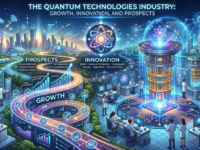
The Quantum Technologies Industry: Growth, Innovation, and Prospects
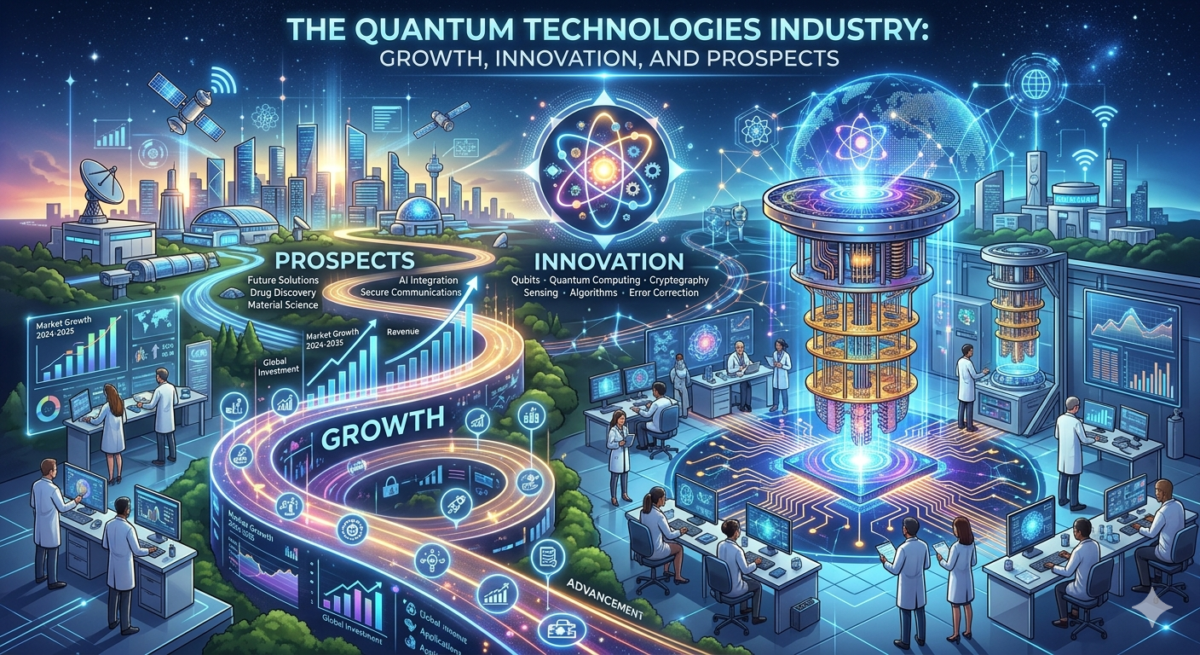
What is quantum computing and quantum technology?
- Quantum computing is the creation of computers that use qubits to solve problems that are inaccessible to classical systems.
- quantum communications – development of absolutely secure communication networks based on quantum key distribution and quantum teleportation;
- Quantum sensors – the creation of ultra-precise sensors for medicine, navigation, archeology, and scientific research.
How much is being invested in quantum technologies, and how quickly is the market growing?
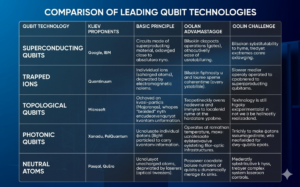
Who is leading the quantum technology industry?
World centers of quantum technologies
- The United States leads individual countries in the number of quantum computing patents issued, as well as in private funding and the number of quantum computing startups. Key innovation hubs include the Boston Area Quantum Network, the Chicago Quantum Exchange, and the Mid-Atlantic Quantum Alliance.
- China boasts significant public investment (over $15 billion ), specialized research institutes, and growing patent activity, particularly in quantum communications. Hefei is noted as a key innovation cluster.
- India has launched the National Quantum Mission with $730 million in funding and plans to establish 21 quantum hubs and 4 quantum research parks.
- Israel has a quantum computing consortium researching various qubit technologies, backed by $368 million in government funding.
- European countries such as France, Germany, the UK, and the Netherlands also have significant public funding and research centers. The European Union and the UK lead in the number and density of QT graduates. Notable clusters include Paris (France), Delft (Netherlands), and Munich Quantum Valley (Germany).
Challenges of the quantum technology industry
- Technological immaturity and cost: Quantum technologies are still in the early stages of development, which is associated with high costs for complex cooling technologies and specialized equipment for the systems.
- The Difficulty of Scaling and Error Correction: Qubits are inherently fragile and error-prone, requiring advanced error-correction techniques. While breakthroughs like Google’s Willow chip demonstrate exponential reductions in below-threshold errors, and Microsoft’s Majorana 1 aims for hardware-level error tolerance, reducing the overhead of quantum error correction remains a practical challenge for large-scale, fault-tolerant quantum computers.
- Significant talent shortage: One of the most serious challenges is the shortage of qualified specialists. McKinsey predicts that by 2025, less than half of the available quantum jobs could be filled, creating a significant barrier to adoption. This underscores the ongoing need for extensive educational initiatives, such as those offered by IBM, which have reached over 5.4 million learners, and Google’s Coursera course on quantum error correction.
- Lack of standardized benchmarks and algorithms: Although various performance benchmarks exist, a clear, industry-wide standard is still under development, making it difficult to consistently evaluate performance in real-world applications and compare different qubit technologies. Most quantum algorithms are still theoretical and not fully implemented on quantum computers, limiting immediate high-speed operations.
Prospects of Quantum Technologies: When Will Quantum Computing Become Massive?
Resources for studying quantum technologies
- The long-term outlook remains positive, bolstered by the continued growth of job openings in technology trends and increased interest in leveraging these technologies for future growth. Quantum computing is projected to revolutionize a variety of industries over the next two decades, including medicine, finance, automotive, engineering, and cybersecurity. Initiatives such as DARPA’s US2QC program are actively working to create robust, utility-scale quantum computers, emphasizing that the horizon for transformative, real-world solutions is years, not decades.
- Educational Resources: Platforms such as Google’s Coursera offer free introductory courses on quantum error correction. IBM Quantum Learning also offers extensive educational initiatives, including the “Understanding Quantum Information and Computation” series, designed to teach the fundamentals of quantum computing at the university level.
- Open-source tools: Access to tools like Google Quantum AI’s Cirq and IBM’s Qiskit SDK allows developers to gain hands-on experience and contribute to the quantum ecosystem.
- Research and Publications: Stay up-to-date by reading research publications from leading quantum AI teams, which can often be found on their corporate websites or in academic archives such as arXiv.
Quantum technologies are moving from the lab to real-world businesses, meaning that individual companies will be able to realize commercial benefits from quantum computing as early as this decade. This creates a dual challenge for our clients: protecting existing data by transitioning to post-quantum cryptography and preparing infrastructure for integration with future quantum platforms via cloud services. A new ecosystem is already emerging, where quantum computing will become part of hybrid IT solutions alongside AI and high-performance classical systems. Our role as an infrastructure partner is to help companies prepare for these changes today. Then, tomorrow, they will be able to leverage quantum advantages to solve their business problems.”
What’s Important About the Quantum Computing Industry in 2025?
- The UN has declared 2025 the International Year of Quantum Science and Technology.
- Google Willow completes tasks in 5 minutes instead of 10 septillion years for supercomputers.
- IBM plans to launch a 200-qubit Starling quantum computer by 2029.
- Microsoft Majorana 1 paves the way to a million qubits on a single chip.
- Quantum computing as a service (QCaaS) is now available in leading data centers.
- Mass distribution is expected by 2026-2030 through cloud platforms.