
With the advancement of robotics, a wide variety of robotic devices have entered our lives, from the familiar robotic vacuum cleaner to complex surgical systems. In this article, we’ll explore the definition of a “robot,” as well as the main components of smart machines, their applications, and the future of robotic technology.
What is a robot? Basic definitions
The word “robot” was first used by the artist Josef Čapek, brother of the Czech playwright Karel Čapek. The name was coined for a play called R.U.R. (Rossum’s Universal Robots), written in 1920. Interestingly, the first robotic device appeared in the real world more than 30 years later, in 1954.
Modern robots differ significantly from those imagined by science fiction writers. Therefore, to avoid misunderstandings, we suggest exploring the basic terms used in the field of robotics.
| Term | Definition |
| Robotics | A field of science responsible for the design, construction, and programming of robotic technology |
| Robot | Technology capable of performing certain tasks without human intervention or under the control of an operator. This technology can be either mechanical devices or virtual assistants. |
| Artificial Intelligence (AI) | A technology that enables robots to accurately simulate human intelligence. AI-powered machines or programs are capable of autonomous learning, problem-solving, and making informed decisions. |
| Programming | The process of writing code with algorithms for actions that a robot should perform, depending on the situation |
| Automaton | A doll or other mechanically powered device |
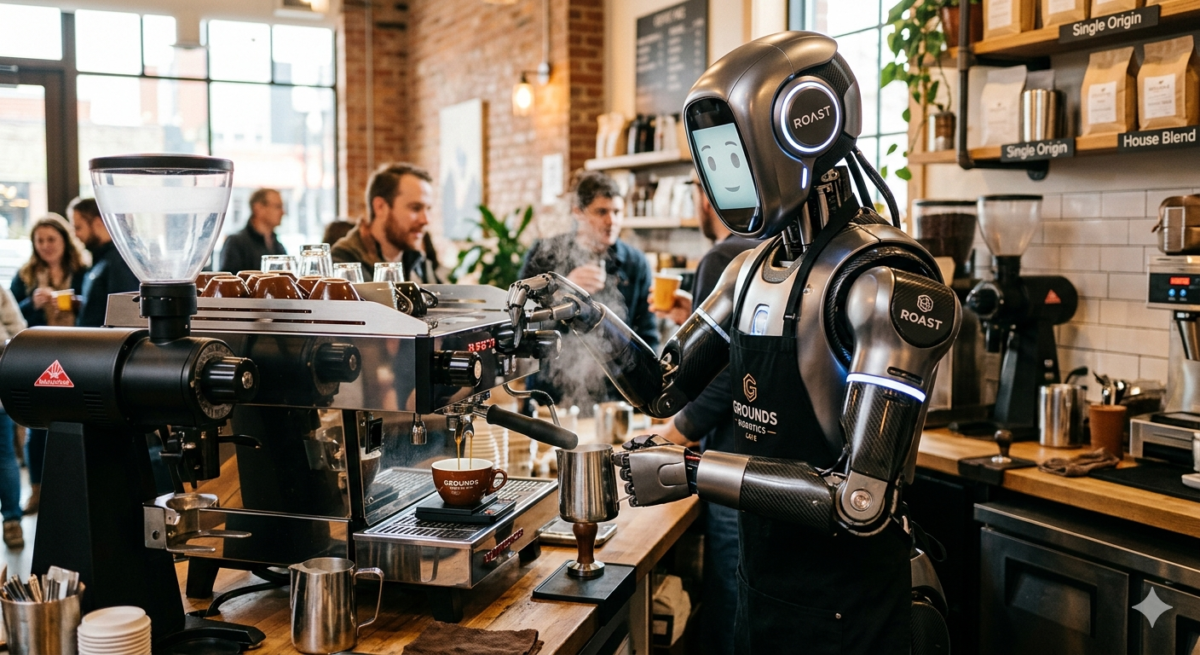
Books and films have shaped the general perception of robots, according to which AI machines should resemble humans. However, the vast majority of robotic technology is not humanoid. For example, in industry, developers prioritize speed and precision over appearance. Currently, devices with a pseudo-human appearance are primarily used in entertainment, rehabilitation, and education.
The history and development of robots
Surprisingly, the first robot prototypes appeared as early as Ancient Greece. For example, the Heracleidon Museum in Athens displays a moving automaton in the shape of a woman, designed to serve wine and dilute it with water. The device was recreated in 2017 based on ancient Greek designs.
According to some reports, people also created self-propelled devices in the Middle Ages. For example, according to one legend, the scientist Albertus Magnus created a mechanical servant who could move and even speak. But his student Thomas Aquinas considered the automaton to be the work of the devil and destroyed it. No drawings or records survive.
References to automata are found in the histories of ancient China, Baghdad, and the Ottoman Empire. For example, Abu al-Iz ibn Ismail ibn al-Razzaz al-Jazari, an inventor from Diyarbakir, described around 50 mechanisms in his treatise, including the water-powered Elephant Clock. Today, a replica of it is installed in Dubai at the Ibn Battuta Mall.
In 1560, Juanello Turriano created a mechanical monk capable of praying and kissing a crucifix. This mechanism has survived to this day and is housed in the Smithsonian Institution in the United States. Scientists such as Leonardo da Vinci and Galileo Galilei also dabbled in automata.
Despite all the advantages of automatons, they cannot be fully called robots. They are purely mechanical devices, while the achievements of modern robotics combine electronics, sensors, mechanics, and software.
The first robotic systems, which became a platform for the development of 21st-century technologies, appeared only in the 1940s. These were analog devices shaped like turtles. In 1978, the world saw the introduction of the digital industrial robotic arm PUMA. It used microcontrollers and digital signals instead of capacitors, photoresistors, and transistors. During the evolution of robotics during this same period, Japanese engineers developed the first robot remotely resembling a human.
Today, the robotics market offers a wide range of robots capable of processing massive amounts of data, performing dangerous tasks, and carrying out complex operations. Some modern machines bear no resemblance to humans, while others are designed in a humanoid form.
How does a robot work? Basic elements
Modern robots consist of four main components: a body, manipulators, a control system, and a chassis.
- The body can be of any size and shape. For example, androids have a body similar to a human torso, while transporters are based on a flat platform.
- Manipulators are designed to interact with various objects. Without them, tasks such as assembly or welding would be impossible. These components are often optional, meaning the robot may not come with manipulators in its default configuration.
- The control system is a complex system consisting of a central processor and numerous sensors. The sensors collect information about the environment, and the central processor processes and analyzes the data. Based on this information, the artificial intelligence makes decisions about which actions to take.
- Undercarriage. Most modern industrial robots, such as those used on automated assembly lines, do not have a traditional undercarriage. However, to perform many technological operations, the system must have a certain freedom of movement, which is provided by the undercarriage. Self-propelled devices are equipped with a wheeled or tracked base. Androids move like humans—on two legs, while robotic dogs move on four.
How the robot works
As mentioned, to enable robots to perceive information from the surrounding world, they are equipped with a variety of sensors—for example, lidars, cameras, and thermal imagers. Signals from these sensors are fed to electronic boards with microcontrollers or preprogrammed electronic systems. The task of these devices is to recognize the signal, process it according to a preprogrammed program, and then send commands to the appropriate actuators, motors, and hydraulic pistons.
Software—that is, code written by developers—is responsible for solving the problem of interaction between all mechanical elements, sensors, and electronic systems. Python and C++ are typically used for basic commands.
What functions does the robot perform? Capabilities and tasks
Modern robots powered by artificial intelligence assist humans in performing complex tasks, including life-threatening ones.
Industrial robotic systems are used in almost all manufacturing areas, for example:
- automotive,
- metalworking,
- food,
- aircraft manufacturing,
- railway,
- woodworking.
In healthcare, robots are capable of performing diagnostic tests, carrying out various types of complex surgeries, delivering medications to wards, and acting as consultants, administrators, and educational aids.
In the military sphere, advances in robotics have enabled the use of unmanned aerial vehicles. They are used for reconnaissance missions and precision strikes on targets. Research is also underway to create ground-based and underwater systems that can be used to neutralize explosive devices and for defensive purposes.
Robotic technologies have made their way into agriculture, education and services, the space industry, and logistics. Robots are increasingly being used in everyday life. Interactive toys, robotic vacuum cleaners, automatic coffee makers, smart home systems—all these and many other gadgets have become a familiar part of everyday life for many people.
Prospects for innovation development
Although many companies are actively implementing robotic systems and automating production, developers still have much work to do. Robotics is still in its infancy. The creation of humanoid robots is considered one of the most promising areas. Such systems have enormous programmability potential and can perform a variety of routine tasks, for example, in logistics, medicine, and various manufacturing operations.
One of the pressing challenges is reducing the cost of robotic systems and shortening their payback period. This will allow more companies to employ robots to perform routine tasks.
Questions regarding the morality and ethics of using robots also remain open; it is expected that these will be enshrined in legislation in the future.