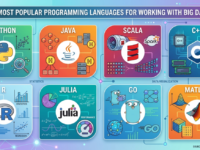
8 Most Popular Programming Languages for Working with Big Data
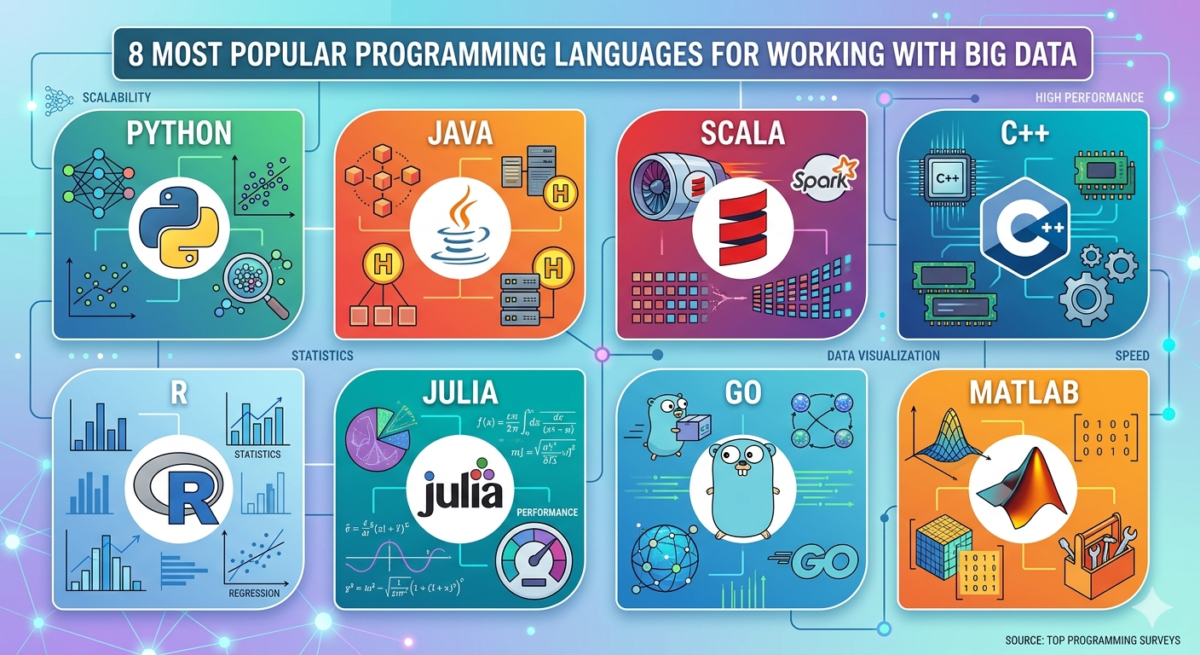
1. Python
The most popular programming language in the TIOBE ranking. It’s used for a variety of purposes, including web development, smart device programming, and API development. But Python is especially popular among those working with big data. It allows:● write artificial intelligence and machine learning programs;
● process big data using ready-made libraries and frameworks;
● extract and collect data from disparate sources;
● visualize the results of data analysis.
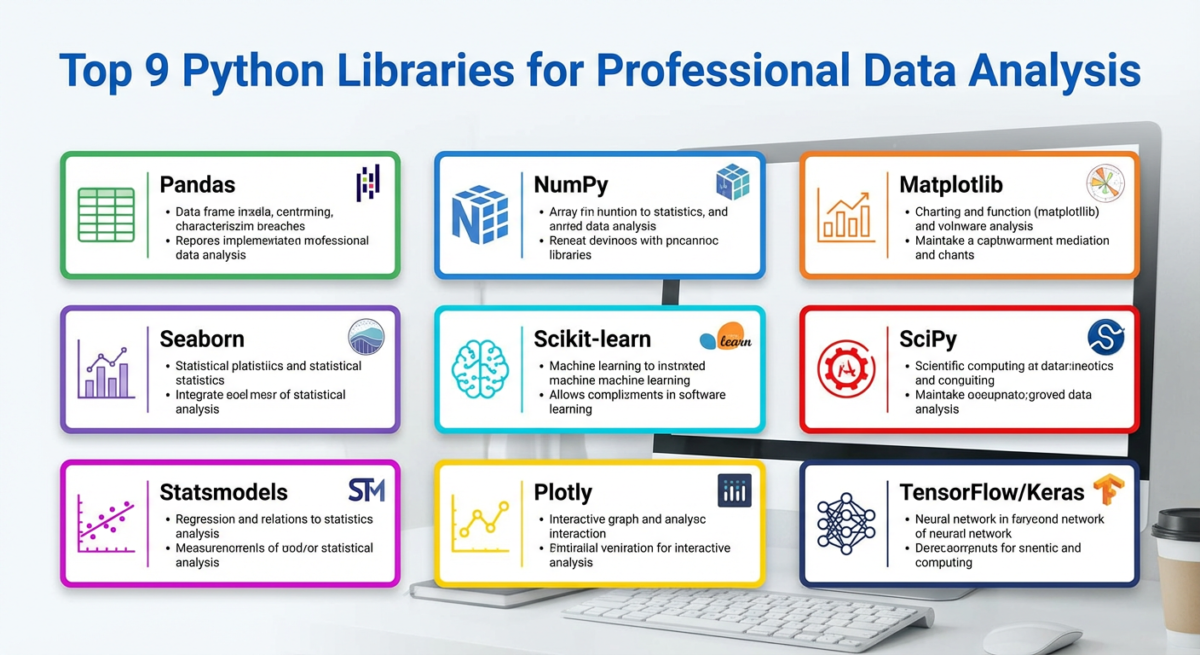
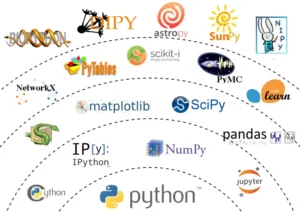
Python has specialized libraries for working with big data: NumPy for calculations, pandas for analyzing tabular data, Matplotlib and Seaborn for visualization, and Scrapy for data mining.
One of the oldest languages for data analysis and statistics: collecting data into tables, cleaning it, running statistical tests, and creating graphical reports. It is actively used for scientific research in all fields—for example, in marketing—as well as for machine learning and statistical data analysis.Working with R requires knowledge of mathematical analysis, probability theory, and statistical methods. This is why it is most often used in science and is considered one of the primary programming languages for data science.
R has thousands of libraries and extensions for data visualization, fast statistical operations, text recognition, A/B testing, and specific scientific fields.
3. Java
4. Scala
It’s not the most popular language—it’s not even in the top 20 in the TIOBE rankings. However, it’s well-suited for data processing tasks, especially large ones—thanks to Scala’s performance, it’s used by major companies like Twitter, Netflix, and Tinkoff.
Scala runs on the Java Virtual Machine, making it highly compatible with that language and running on all devices. It’s also the language used to write Apache Spark, an important framework for big data analysis and machine learning.
5. Go
6. MATLAB
7. Julia
8. C++
Key Points for Working with Big Data
- Python is the most popular and versatile, but it is slower than some others and can introduce data errors due to dynamic typing.
- R is ideal for complex analytics and contains thousands of ready-made functions, but it is very difficult to learn and is almost unusable for other programming tasks.
- Java is fast and even more versatile than Python, but it is more difficult to learn and has fewer built-in tools for data analysis.
- Scala is fast when working with big data, but it is difficult to learn and not very popular.
- Go is very simple and contains many standard libraries, but it is still too young and not suitable for large-scale projects.
- MATLAB is good at handling complex mathematical problems, but only with them—it’s not suitable for other purposes. It also requires a paid license.
- Julia is designed specifically for working with data; it’s fast and easy to use. However, due to its young age, it still contains a few ready-made functions and libraries.
- C++ is more of a general-purpose language and isn’t suitable for everyday data analytics. However, it’s very fast, so it’s a great choice for applications requiring maximum program speed.