BUZZBONGO TECH GEEKS

YOUR TECH GUIDES
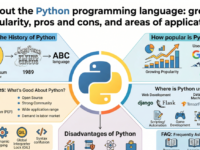
All about the Python programming language: growing popularity, pros and cons, and areas of application
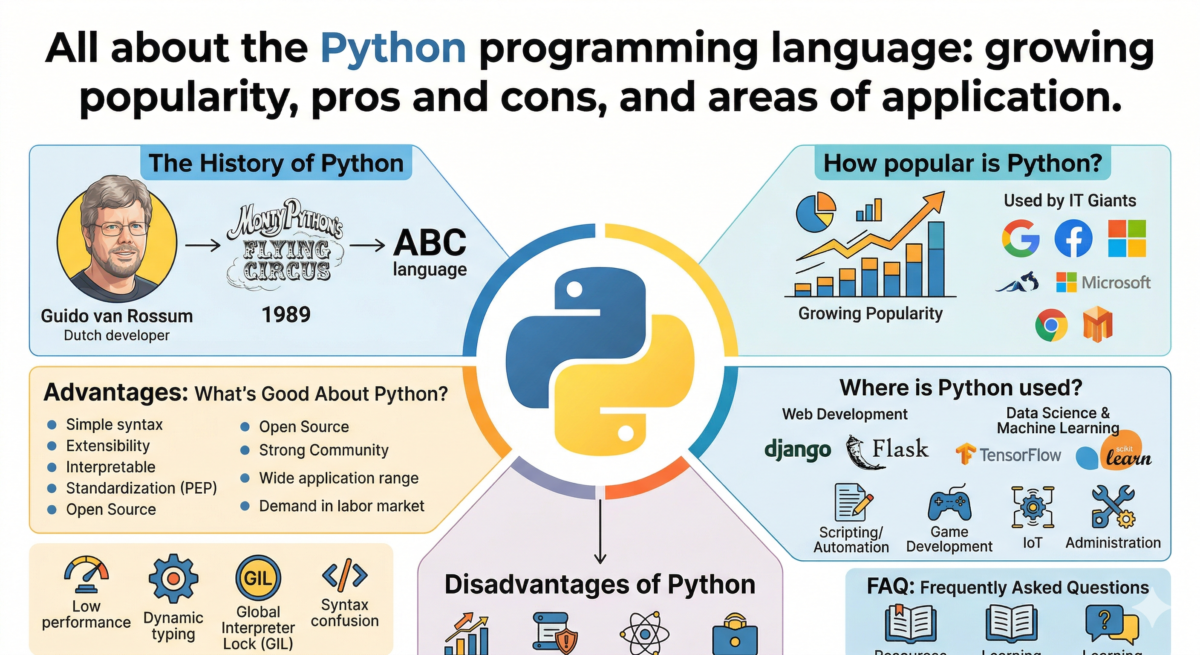
In this article, we discuss the origins of the Python programming language, its pros and cons, why it has become popular, and what tasks it is suitable for.

The History of Python

The Python programming language was created by Dutch developer Guido van Rossum. He had previously collaborated on the ABC language project, intended for teaching programming. In late 1989, Guido began working on a new language, conceived as a successor to ABC with exception handling support and the ability to interface with the Amoeba operating system. This is how Python was born.

Regarding the name, there’s a misconception that the language is named after snakes. In fact, Guido was inspired by the British comedy show Monty Python’s Flying Circus, which he was a fan of while working on the project, so he named the language after the comedy group. The correct pronunciation is “Pyton.”

Python was initially distributed freely over the internet, attracting a community of enthusiasts interested in the language’s development. The first official version, 0.9.0, was released in February 1991. In 1994, Python 1.0 was released, followed by numerous updates and new versions.

Python is among the most popular languages. What’s its secret? Python is suitable for a wide range of tasks and is used on all popular platforms. Python’s growing popularity has also been fueled by its effectiveness in the rapidly growing fields of Machine Learning and Data Science.

Another reason is technical. As technology advances, the computing power of personal computers and servers has increased, resulting in increased demand for interpreted programming languages, including Python. These languages, in addition to running the program itself, also require running an interpreter, which requires additional resources. This was a problem in the past, but it has now been resolved.

Advantages: What’s Good About Python?
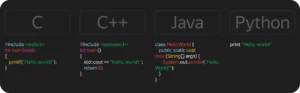
Experts point out a number of advantages of Python—let’s focus on the key ones.Simple syntax means a low learning curve. The language code is clean and understandable, without unnecessary symbols or expressions.

Width 1280 Q80 (2)

Compare the number of lines of code required to print the phrase “Hello, world!” in C, C++, Java, and Python—and you’ll understand.

Interpretable and cross-platform. The Python interpreter is available for all popular platforms and is included by default in most Linux distributions.
Standardization. Python has a single coding standard—the Python Enhancement Proposal, or PEP—which ensures the language remains readable even when shared between programmers.
Open Source. The Python interpreter is open source, meaning anyone interested in the language’s development can contribute to its development and improvement.
A strong community and conferences. Python has a friendly community that is ready to help new and experienced developers solve their problems. There are numerous events around the world where you can meet colleagues and learn new things about Python.
Wide application range. Python is most widely used in web development, data processing, business process automation, and game development.
Demand in the labor market and support from IT giants. Python developers are in demand across many projects and find it easy to find work. Python development is carried out at Google, Facebook, Dropbox, Spotify, Quora, Netflix, Microsoft, Intel, and, in Russia, Yandex, VKontakte, and Sberbank. This significantly impacts the language’s status.

Disadvantages of Python

Python, like any other language, has both its pros and cons, and among developers, there are both fans and haters. Here’s what people accuse the language of:
Low performance. Python programming requires significant computing power from servers and computers. This makes it less fast than expected, and it lags behind other languages ​​in terms of performance. While this isn’t as noticeable as it once was, it still has an impact. To mitigate this issue, developers are turning to C to implement the problematic code.
Dynamic typing. Python is a dynamically typed language, making it incredibly flexible during development. However, it is also resource-intensive and has a slow execution speed.
Global Interpreter Lock (GIL) is a thread synchronization method used in some interpreted programming languages, such as Python and Ruby. Although the GIL is the simplest way to avoid conflicts when different threads access the same memory locations simultaneously, this approach has a drawback: it limits parallelism. It also prevents high computational efficiency on multi-core and multi-processor systems.
Syntax and semantics. While many consider syntax an advantage of Python programming, several architectural decisions can be confusing for programmers accustomed to working in other languages. However, this will only be a disadvantage for experienced programmers, not beginners.

Where is Python used?

Let’s now talk about Python’s programming capabilities. It’s used in many projects, both as the primary language and for creating extensions and application integration. Python is also used to prototype future programs.The three main areas of use for the language are web development, Big Data and Machine Learning, and scripting:

Web development. Today, Python programming is actively used in web development, alongside languages ​​such as PHP, JavaScript, Java, and C#. A significant advantage of Python is that it’s suitable for small businesses that don’t have a 50-person development department and that are implementing relatively simple projects. Therefore, its use has become increasingly common.
The advantages of using Python for the backend over PHP are the ease of learning, improved structure, readily available debugging tools, versatility, and a friendly community.
Web development in Python requires knowledge of frameworks. The most popular are Django and Flask.
Data Science and Machine Learning are hot areas today where Python is used for data analysis, writing ML algorithms, and analytics applications. Among popular ML frameworks and libraries, programmers highlight scikit-learn and TensorFlow.
Scripting. Scripting is the process of writing scripts to automate simple tasks. For example, these could be additional modules or plugins for existing software. Python is also used to automate software testing.
Python is also used for writing and developing software and mobile applications, embedded systems, system administration, and even game development—there’s plenty to choose from if you decide to become a Python developer.

FAQ: Answers to frequently asked questions

In what areas is Python used?

The Python language is used in various IT areas.

  • Web development: website backends, APIs, and services using Django, Flask, and FastAPI.
  • Data Science and ML: data analysis, models, and prototypes.
  • Automation: tests, data processing, business utilities.
  • Game development: prototypes and internal logic.
  • IoT and Embedded Systems: Device Management.
  • Administration: Scripts for infrastructure and DevOps.
  • Applications: standalone programs or the “glue” between components.
What is Python syntax, and why is it useful?
Python’s syntax is as close as possible to standard English: commands read almost like sentences, and unnecessary characters are kept to a minimum. Indentation is used instead of curly braces, resulting in neat and structured code. This approach makes it easier to get started with development: it’s easier to understand other people’s programs, parse examples, and write your own code faster.
Does Python have any limitations?

Python has several technical limitations.

  • It runs slower than compiled languages ​​like C++ or Java.
  • The global interpreter lock limits true concurrency within a single process, making Python not always suitable for high-load systems and real-time tasks.

These limitations can be circumvented by rewriting the most resource-intensive parts in C/C++, using asynchrony, multiprocessing, or choosing another language for “heavy” components.

Where can I learn Python?

There are different ways to learn Python.

There is official documentation, books, and free online resources that cover the basics of syntax, data types, and the standard library.

If you need a system program with practical experience and support, online courses in Python development are a good choice, covering the language, frameworks, and tools.