All about the Python programming language: growing popularity, pros and cons, and areas of application
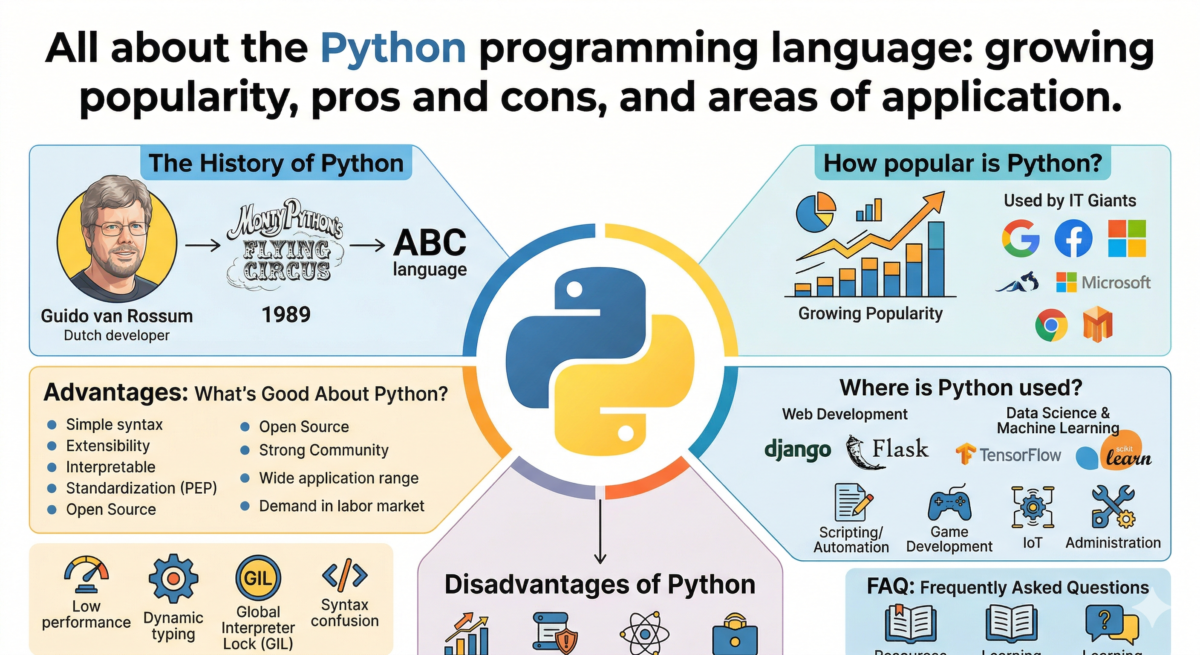
Table of Contents
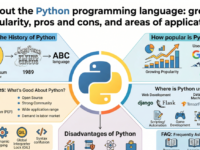
In this article, we discuss the origins of the Python programming language, its pros and cons, why it has become popular, and what tasks it is suitable for.
The History of Python
The Python programming language was created by Dutch developer Guido van Rossum. He had previously collaborated on the ABC language project, intended for teaching programming. In late 1989, Guido began working on a new language, conceived as a successor to ABC with exception handling support and the ability to interface with the Amoeba operating system. This is how Python was born.
Regarding the name, there’s a misconception that the language is named after snakes. In fact, Guido was inspired by the British comedy show Monty Python’s Flying Circus, which he was a fan of while working on the project, so he named the language after the comedy group. The correct pronunciation is “Pyton.”
Python was initially distributed freely over the internet, attracting a community of enthusiasts interested in the language’s development. The first official version, 0.9.0, was released in February 1991. In 1994, Python 1.0 was released, followed by numerous updates and new versions.
How popular is Python?
Python is among the most popular languages. What’s its secret? Python is suitable for a wide range of tasks and is used on all popular platforms. Python’s growing popularity has also been fueled by its effectiveness in the rapidly growing fields of Machine Learning and Data Science.
Advantages: What’s Good About Python?
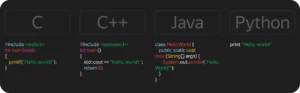
Compare the number of lines of code required to print the phrase “Hello, world!” in C, C++, Java, and Python—and you’ll understand.
Disadvantages of Python
Where is Python used?
FAQ: Answers to frequently asked questions
In what areas is Python used?
The Python language is used in various IT areas.
- Web development: website backends, APIs, and services using Django, Flask, and FastAPI.
- Data Science and ML: data analysis, models, and prototypes.
- Automation: tests, data processing, business utilities.
- Game development: prototypes and internal logic.
- IoT and Embedded Systems: Device Management.
- Administration: Scripts for infrastructure and DevOps.
- Applications: standalone programs or the “glue” between components.
Python has several technical limitations.
- It runs slower than compiled languages like C++ or Java.
- The global interpreter lock limits true concurrency within a single process, making Python not always suitable for high-load systems and real-time tasks.
These limitations can be circumvented by rewriting the most resource-intensive parts in C/C++, using asynchrony, multiprocessing, or choosing another language for “heavy” components.
There are different ways to learn Python.
There is official documentation, books, and free online resources that cover the basics of syntax, data types, and the standard library.
If you need a system program with practical experience and support, online courses in Python development are a good choice, covering the language, frameworks, and tools.