BUZZBONGO TECH GEEKS

YOUR TECH GUIDES
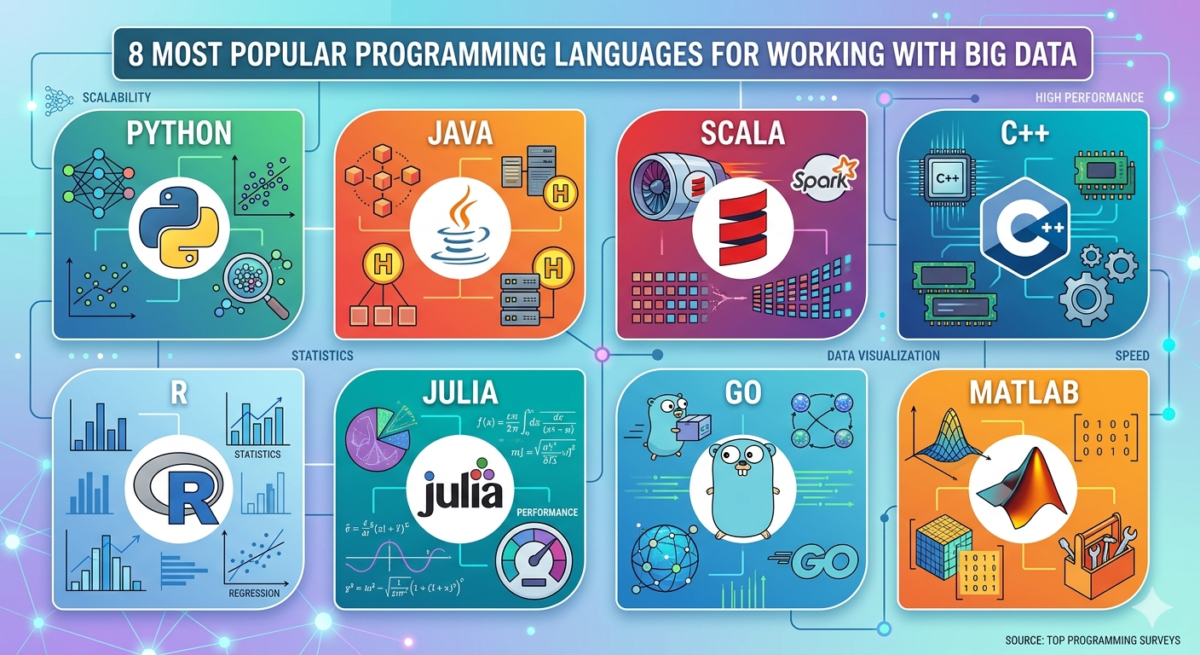
8 Most Popular Programming Languages ​​for Working with Big Data
Analyzing big data requires writing programs and scripts. Many programming languages ​​can be used for this, but some are more suitable – they contain many ready-made tools, functions, and libraries for efficient data processing.

1. Python

The most popular programming language in the TIOBE ranking. It’s used for a variety of purposes, including web development, smart device programming, and API development. But Python is especially popular among those working with big data. It allows:● write artificial intelligence and machine learning programs;

process big data using ready-made libraries and frameworks;

● extract and collect data from disparate sources;

● visualize the results of data analysis.

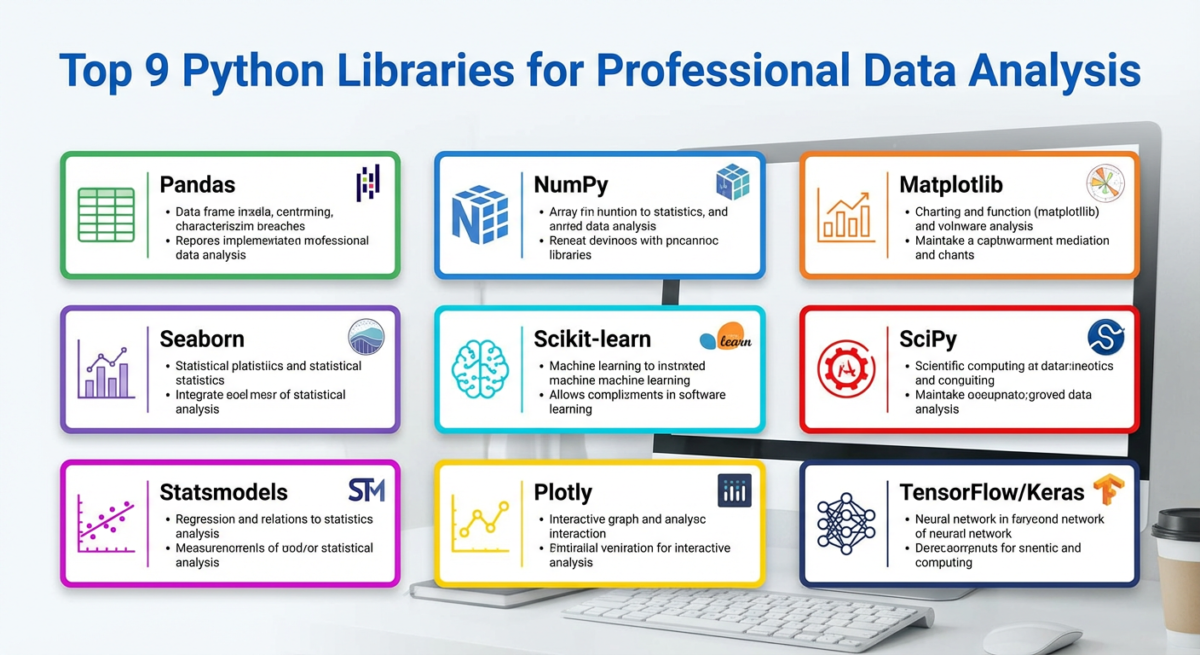
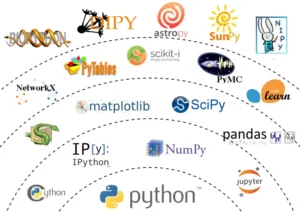
Python has specialized libraries for working with big data: NumPy for calculations, pandas for analyzing tabular data, Matplotlib and Seaborn for visualization, and Scrapy for data mining.
Width 768 Q80 (26)
This is just a small part of the vast zoo of libraries available in Python.

Pros

– Simplicity. Python, the data analysis language, has a low learning curve. This makes it a good choice for those new to programming and working with big data.

– Prevalence. This language is very popular. Many libraries have been written for it, and most online services have APIs specifically for Python. The language has a large community, making it easy to find colleagues, discuss projects, and learn from each other.

– Versatility. Python is used for more than just machine learning. Learning it can make it easier to change careers, for example, to a web developer.

– An abundance of ready-made tools for machine learning and data analytics. Many solutions have been written for Python to help simplify and automate data analytics.

Cons

– Slow speed. Some operations in Python are slower than in some other languages. For applications where speed is important, this language may not be suitable.– Dynamic typing. In Python, a variable gets its type not when it’s created, but when it’s assigned a value. This is convenient for software and web application development, but not so much for working with data. You need to carefully monitor types to avoid errors.

One of the oldest languages ​​for data analysis and statistics: collecting data into tables, cleaning it, running statistical tests, and creating graphical reports. It is actively used for scientific research in all fields—for example, in marketing—as well as for machine learning and statistical data analysis.Working with R requires knowledge of mathematical analysis, probability theory, and statistical methods. This is why it is most often used in science and is considered one of the primary programming languages ​​for data science.

R has thousands of libraries and extensions for data visualization, fast statistical operations, text recognition, A/B testing, and specific scientific fields.


Pros

– A huge number of open-source packages. No other language offers so many ready-made analysis tools. They can be used to quickly solve complex statistical and scientific problems.– There are many options for data visualization. There are ready-made packages for this, too, such as the popular ggplot2. With R, you can plot any function, even the most complex ones.

– Popularity. The R language has a large community, so you can always find people willing to answer questions and share their experiences.

Cons

– High learning curve. R requires a strong background in mathematical analysis and statistics. Furthermore, it differs from classical programming languages ​​in its unconventional data structure, one-based indexing, and other aspects. It’s not easy to learn, even with knowledge of other languages.– Poor performance. R is quite slow, especially with large data sets. This is due to its architectural features and cannot be fixed.

– Specificity. R is not suitable for anything other than data analysis and statistical research.

3. Java

Like Python, it’s a universal language: it’s used for working with big data and creating software and applications. One of its main advantages is its cross-platform nature. Code written in Java runs on PCs, smartphones, consoles, servers, and smart home sensors. This is because Java code runs on a special virtual machine, which is supported by most modern devices.
The compiler converts Java code into a special byte format that runs on a virtual machine and works the same on any OS.
Many big data tools, such as almost the entire Hadoop ecosystem, are written in Java. It is used for machine learning algorithms and the development of high-performance data extraction and processing systems.

Pros

– Versatility. Java is suitable for developing any application and allows for easy integration of data analysis and machine learning elements into existing code.

– Strong typing. Unlike Python, in Java, variable types are specified upon creation. There will be no data errors due to typing.

– High speed and performance. Most Java applications run faster than those in many other programming languages. Python, at least, definitely loses out in terms of speed.

Cons

– Less focus on data analysis. Java doesn’t have as many built-in libraries for analytics as Python, let alone R. Much will have to be developed from scratch.

– Higher entry barrier. Java is more complex than Python and some other languages. It’s not easy to master as a first language.

– “Verbosity.” Java code is always quite long, with numerous symbols and characters. A single simple operation requires several lines of code. This somewhat hinders collaborative development—understanding someone else’s Java code can be difficult.

4. Scala

It’s not the most popular language—it’s not even in the top 20 in the TIOBE rankings. However, it’s well-suited for data processing tasks, especially large ones—thanks to Scala’s performance, it’s used by major companies like Twitter, Netflix, and Tinkoff.

Scala runs on the Java Virtual Machine, making it highly compatible with that language and running on all devices. It’s also the language used to write Apache Spark, an important framework for big data analysis and machine learning.


Pros

– It has a lot in common with Java. Those who already know Java can easily learn Scala.

– Multiplatform. Like Java, you can write universal code for different devices and embed data analysis tools into other programs.

– Multi-paradigm. Scala supports both object-oriented and functional programming. This allows for greater flexibility in leveraging the advantages of both approaches.

– Performance. Scala is considered a programming language for Big Data because it handles large data extremely quickly, thanks to parallel computing.

Cons

– Complex syntax. More complex than Python, and even more complex than Java. Learning the language isn’t easy, and reading programs written in it isn’t either.– Slow compilation. Programs run quickly, but take a long time to compile. This is bad for applications that require constant updates. In data analysis, slow compilation is usually not a problem.

– Low popularity. It’s difficult to find relevant information about Scala on Google or find a specialist who understands the language.

5. Go

This language was developed by Google specifically for analyzing and processing big data. It is primarily focused on extracting and analyzing information from databases, although it is also used for working with artificial intelligence and web development.

Pros

– Maximum simplicity. The language is very beginner-friendly, with a low learning curve and simple syntax. Learning it will definitely be hassle-free.– Numerous standard libraries, including those for data analysis and database management. High performance. Programs written in this language compile quickly and run just as quickly.

– Newness. This is both a plus and a minus. The language has no outdated constructs; it was created with modern programming standards in mind. However, there hasn’t been time for development, and the language still lacks some features.

Cons

– Too simple. Because of its light weight, Go is ill-suited for writing large-scale and complex projects—it lacks the necessary capabilities. It’s most often used for writing standalone microservices.– Limited information. Due to its novelty and limited availability, it can be difficult to find answers to questions.

6. MATLAB

This language is familiar to those who studied engineering at university. Some people think of MATLAB as a program, but it’s actually a language for numerical calculations developed in the last century. MATLAB is designed for complex mathematical operations and calculations. It’s more suited to calculating metrics for data analysis than for the analysis itself.

Pros

– He handles complex mathematical problems extremely well. Quantitative analysis using matrix algebra and Fourier transforms is well within his grasp.– Convenient data visualization. MATLAB has built-in tools for plotting graphs and charts.

– Widespread use. MATLAB is often studied at universities and actively used for scientific purposes, so many specialists are proficient with it.

Cons

– Paid license. You have to pay to use MATLAB, even for personal use.– Narrow scope of use. Suitable only for mathematical calculations, practically unusable for other tasks.

7. Julia

This is a new language developed specifically for working with data. It is used in machine learning, creating computer simulations, and writing backend applications.

Pros

– Convenient work with mathematical functions. Julia has a simpler and clearer mathematical syntax; it’s similar in many ways to MATLAB, only simpler and more convenient.– Widely applicable. Julia is suitable for both analytical tasks and writing full-fledged applications.

– High speed. Julia is much faster than Python and can even compete with C++.

– Both dynamic and static typing. Types can be strictly defined, or they can be dynamically defined, depending on the task.

Cons

– Lack of ready-made libraries. Currently, this data analysis programming language has few libraries, which are poorly structured, often incompatible, and often poorly documented. Working with them is difficult, and much has to be written from scratch.– Little information. It’s difficult to find answers to questions, as the language community is still very small.

– Functional orientation. Julia is not an object-oriented language, so it can be difficult to relearn from, for example, Python.

8. C++

It’s a general-purpose language: it’s used to write games, programs, and entire operating systems. In the Big Data space, C++ is primarily used to write the tools themselves: for example, MapReduce, the Caffe data warehouse, and the Minerva neural network library. It’s rarely used for data manipulation, but it does come into play.

Pros

– Extreme speed. C++ is one of the fastest programming languages ​​in the world. An algorithm that would take 10 minutes to run in another language can be completed in C++ in just a minute. Speed ​​is essential when it comes to processing large amounts of data—for example, to make lightning-fast decisions based on it.– Popularity. C++ has been around for a long time, and it has many supporters and active users. So finding an answer to your question online is fairly easy.

– OOP. This language is ideal for object-oriented programming and developing complex projects in large teams.

Cons

– Complexity. C++ has a complex syntax and many nuances. The learning curve is high, especially for specific tasks like data analysis.– Lack of ready-made data analysis tools. Most tools will have to be written from scratch, which is time-consuming.

Key Points for Working with Big Data

  1. Python is the most popular and versatile, but it is slower than some others and can introduce data errors due to dynamic typing.
  2. R is ideal for complex analytics and contains thousands of ready-made functions, but it is very difficult to learn and is almost unusable for other programming tasks.
  3. Java is fast and even more versatile than Python, but it is more difficult to learn and has fewer built-in tools for data analysis.
  4. Scala is fast when working with big data, but it is difficult to learn and not very popular.
  5. Go is very simple and contains many standard libraries, but it is still too young and not suitable for large-scale projects.
  6. MATLAB is good at handling complex mathematical problems, but only with them—it’s not suitable for other purposes. It also requires a paid license.
  7. Julia is designed specifically for working with data; it’s fast and easy to use. However, due to its young age, it still contains a few ready-made functions and libraries.
  8. C++ is more of a general-purpose language and isn’t suitable for everyday data analytics. However, it’s very fast, so it’s a great choice for applications requiring maximum program speed.
20 gb ssd storage.