Strange new species of blue octopus discovered by scientists 5,900 meters underwater: “Beautiful”

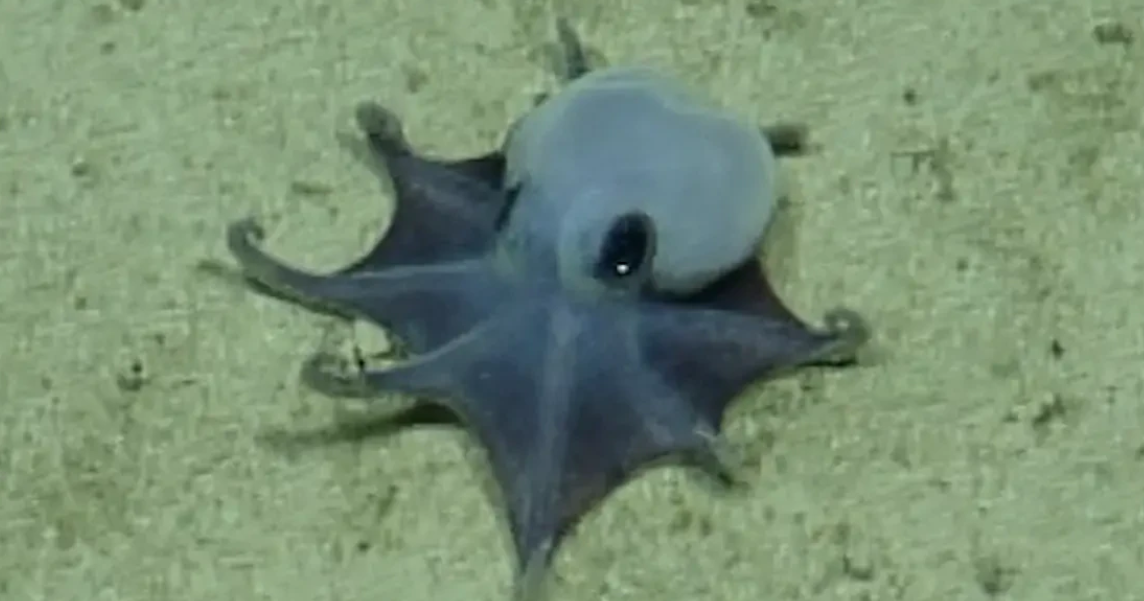
At the bottom of the sea near the Galapagos Islands, a submersible controlled by scientists found a mysterious sea-blue octopus that “could fit in the palm of your hand.”
“Small! It’s blue!” one excited scientist was recorded as saying when he first saw the cerulean cephalopod in images transmitted from the sub.
A team from the Charles Darwin Foundation recently discovered a new species of octopus about 5,900 feet underwater, according to research published Monday.
“Right away, I knew it was something really special,” said octopus expert Janet Voight, who was asked to identify the rare species.
At first the curator of the Field Museum of Natural History in Chicago had to make pictures of the animal. Then he found her body in the mail.
“When it came, I was like ‘Oh! My God! It’s beautiful’,” Voight told AFP.
Charles Darwin Foundation
He immediately became interested because the best-known octopus of that condition lives off the coast of Uruguay — in a different ocean on the other side of South America.
Usually to describe a new species of octopus, the specimen needs to be opened to examine its mouth, beak, teeth and other parts.
“We only had one specimen, so I didn’t want to take it apart,” Voight said.
Instead, the Field Museum team used CT scans to take thousands of X-ray images, then stitched them together to create a 3D model of the octopus, revealing its interior.
“There’s nothing like spending a day looking at something that no one has seen before,” Field Museum lab head Stephanie Smith said in a statement.
“Deep Purple”
The new species, called Microeledone galapagensis, stands out for reasons other than its blue color, which is believed to be the rarest color in nature.
The octopus appears to belong to the Megaleledonidae family, members of which are usually larger and live in the Southern Ocean around Antarctica.
“Its small, strong arms with only one row of suckers set it apart from most octopuses we’re familiar with,” Voight said.
Even among “other species with small, short arms and a single line of suction, their color and smooth back skin distinguish them”, he added.
Although the octopus is light blue on its back, underneath it is “a very deep purple,” Voight said.
“We think this color pattern helps keep it safe. If an octopus catches prey that emits light, that light may attract predators that may eat the octopus,” he explained.
So the octopus puts its dark colored web over the prey, keeping it safe.”
Surprisingly, it’s not uncommon to find new species of octopus in the deep sea — especially in less-explored areas, which are the vast majority of the ocean floor.
“If you took all the land on Earth and added it up, you wouldn’t cover the Pacific Ocean,” Voight said.
He added that he last saw a new octopus in 2023, off the coast of Costa Rica.
The first sighting of a new blue octopus was made in 2015 near Darwin Island, which is said to be an English scientist who visited the Galapagos and helped him develop the theory of evolution.
It’s also the first new type of octopus Voight officially led a team of scientists to describe, in his decade-long career studying octopus evolution, according to the Field Museum.
“These are tiny octopuses that live in the depths of the ocean, and no one on Earth has ever seen them. I feel very fortunate to work with them,” Voight said.
Voight’s research on the species was published in the journal Zootaxa.
There are about 300 species of octopus in the world, living in all the world’s oceans.
In 2024, a team of scientists said they found it four new types of octopus in waters from Costa Rica.


