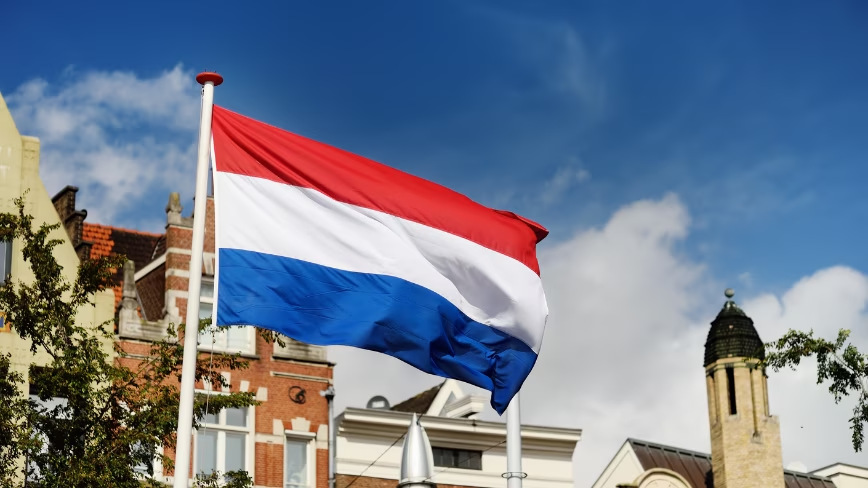
When Pope Leo XIV launched its first book on artificial intelligence at the Vatican on Monday, inviting Christopher Olah, the founder of Anthropic, to speak. The move marked an unprecedented alliance between the Catholic Church and Silicon Valley. But to understand how this collaboration came about, we need to go back to the Anthropic invention.
Why Anthropic?
Anthropic was launched in 2021 after a group of OpenAI researchers, including Dario and Daniela Amodei, left to form a rival lab. They did this with a clear conviction: Artificial intelligence models were becoming too powerful to be developed in accordance with the concept of competition and speed.
Since then, Anthropic has built its public image around the concept of AI security. The company aims to create not only powerful models, but ones that are manageable and guided by ethical principles. This is where the concept of Constitutional AI comes from: the idea of training programs using a constitution made up of principles and rules, instead of just manually adjusting the most dangerous and dangerous responses.
Pope Leo XIV attended the launch of his first Encyclical Letter, Magnifica Humanitasfocusing on the development of artificial intelligence, at the Vatican on May 25, 2026.Photo: Alberto Pizzoli/Getty Images
How the Meeting with the Vatican Began
Olah’s presence in the Vatican was clearly not accidental, or the result of a last-minute symbolic gesture. It was the result of a deliberate, long-term effort in which the Vatican has sought to gradually transform itself from an observer of technological behavior to a direct liaison with the AI industry.
The first major step came in 2020 with the Rome Call for AI Ethics, an initiative promoted by the Pontifical Academy for Life and Microsoft, IBM, and other international organizations. The goal was to establish a shared foundation of ethics for AI development, including transparency, inclusion, and accountability.
At that time, the Vatican seemed to work mainly in the field of bioethics and moral questions. However, in the following years, the context changed significantly. The rise of ChatGPT, the struggle for technological leadership between the United States and China, and the growing power of Big Tech gradually convinced the Holy See that the issue was no longer just about the ethics of technology, but about the future of humanity.
In this sense, Anthropic has been recognized by the Vatican as a very important mediator. Unlike other Silicon Valley companies that have built their reputation primarily around innovation and growth, Anthropic has made AI security a core part of its identity.
In recent years, the Vatican has followed a specific thread of the technological debate with special attention: the preparation of AI models.
Olah’s role
This is where Christopher Olah comes in. Unlike the Amodei children, who are more exposed to the media, Olah represents the theoretical and almost philosophical side of AI research. He is one of the most renowned researchers in the world on the topic of model interpretation, or the attempt to understand what is really happening within complex neural networks.

On his website, Christopher Olah describes himself as someone who is trying to “turn neural networks into algorithms that are understandable to humans.” And it’s hard to think of a figure that fits more closely with the core of Pope Leo XIV’s letter: an allegory focused on the dangers of a construction technology that is too powerful to be understood, controlled, or governed.
According to various journalistic sources, the connection between the circles close to the Holy See and Anthropic may have been strengthened during the international conferences on the safety of AI. The Vatican saw in Anthropic a company at least willing to publicly admit that the problem of artificial intelligence cannot be solved by the technology industry alone.