South Korea’s Hanwha is showing off the submarine as Ottawa finalizes the multibillion-dollar contract


Listen to this article
Average 4 minutes
The audio version of this article was created by AI-based technology. It can be mispronounced. We are working with our partners to continuously review and improve the results.
South Korea’s ROKS submarine Dosan Ahn Chang-ho arrived off the coast of British Columbia on Saturday in a lavish display for Hanwha Ocean’s bid to secure Canada’s multibillion-dollar submarine defense contract.
The ship is visiting Victoria and will take part in joint anti-submarine warfare exercises with the Royal Canadian Navy.
The newly built 3,000-tonne KSS-III submarine made a historic 14,000-kilometre voyage across the Pacific to demonstrate its long-endurance capabilities to Canadian decision-makers.
Prime Minister Mark Carney’s government is expected to make a decision within weeks on whether to go along with a bid by Hanwha Ocean or German rival TKMS (ThyssenKrupp Marine Systems).
The navy hopes to acquire 12 boats over the next decade and a half, with an eye to deploying them not only in the Pacific and Atlantic oceans but also in the Arctic, where they will have to operate under ice for extended periods of time.

Rear Admiral David Patchell, commander of Maritime Forces Pacific and Joint Task Force Pacific, told reporters in Victoria that he was grateful to the people of South Korea for making the trip to Canada and that he felt “excited about the Royal Canadian Navy that we are building.”
When asked how badly Canada needs new submarines, Patchell said, “I need them yesterday.”
“We have operated submarines for over 100 years, but we have never been an underwater nation. But with 12 modern submarines, Canada will be an underwater nation.”
Since the submarines will be built ashore, both companies have submitted proposals detailing what they can do for Canada’s defense industry. They have signed a series of partnership agreements – in some cases with the same firms – to show their determination to create Canadian jobs.
The original deadline for submitting proposals was early March, but the federal government gave competitors more time to refine the economic benefits aspects of their pitches.
Both companies have been told they expect a decision by the end of June, with contract negotiations to follow.
Rivals pull it off
The competition between these rivals was fierce.
The Hanwha group of companies, which owns the submarine manufacturing facility, recently signed a cooperation agreement with the Canadian Automotive Parts Manufacturers’ Association, promising to build a series of armored vehicles in Canada if it wins the submarine bid.
It also signed a memorandum of understanding with Algoma Steel in Sault Ste. Marie, Ont., is making up to $345 million to fund a new steel mill for the building and purchase Algoma products for submarine infrastructure construction and maintenance.
Both plans are based on the idea that Hanwha Ocean wins the submarine contract.
In April, Hanwha produced a study that said all of its Canadian investments could create between 15,000 and 22,500 jobs by 2044.
Both Hanwha and TKMS have committed to building submarine repair facilities in Esquimalt, BC, and Halifax to ensure that Canada maintains independent operational control over the vessels.
The joint German-Norwegian bid includes launching a Type 212CD submarine in Canada. The design is an updated version of the Type 212, an already operational class of three-hulled boats.
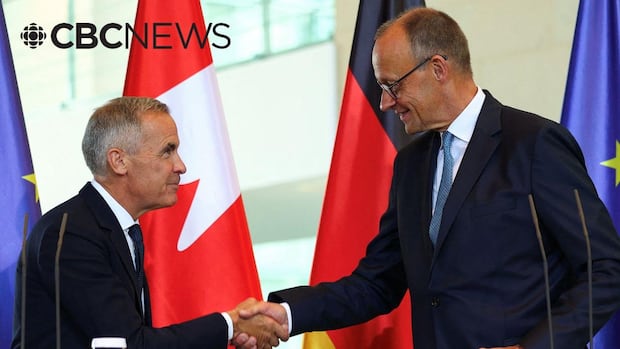
Prime Minister Mark Carney announced that the shipyard for Canada’s new submarines is down to two buyers, Germany’s TKMS and South Korea’s Hanwha Ocean.
The German government has taken the lead and is proposing a package of economic and industrial benefits worth billions of dollars, including a broad part of economic investment over 30 years.
Some of those plans include major investment in domestic EV battery production in Canada, as well as funding and infrastructure for Canada’s rare earth mines and resource security.
Germany has also floated the idea of buying a Bombardier jet for its VIP and early warning planes.


