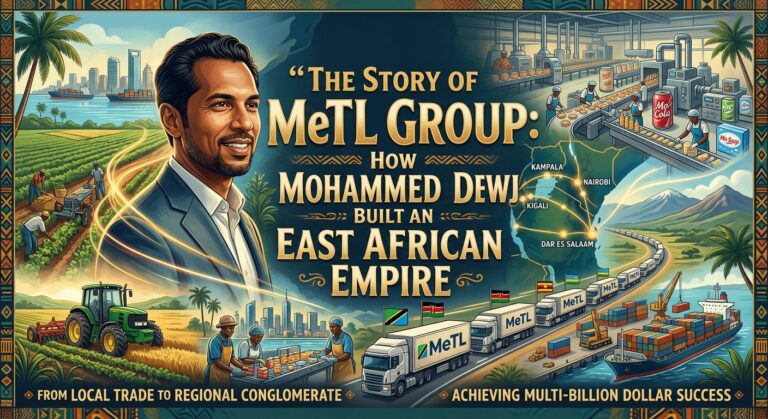
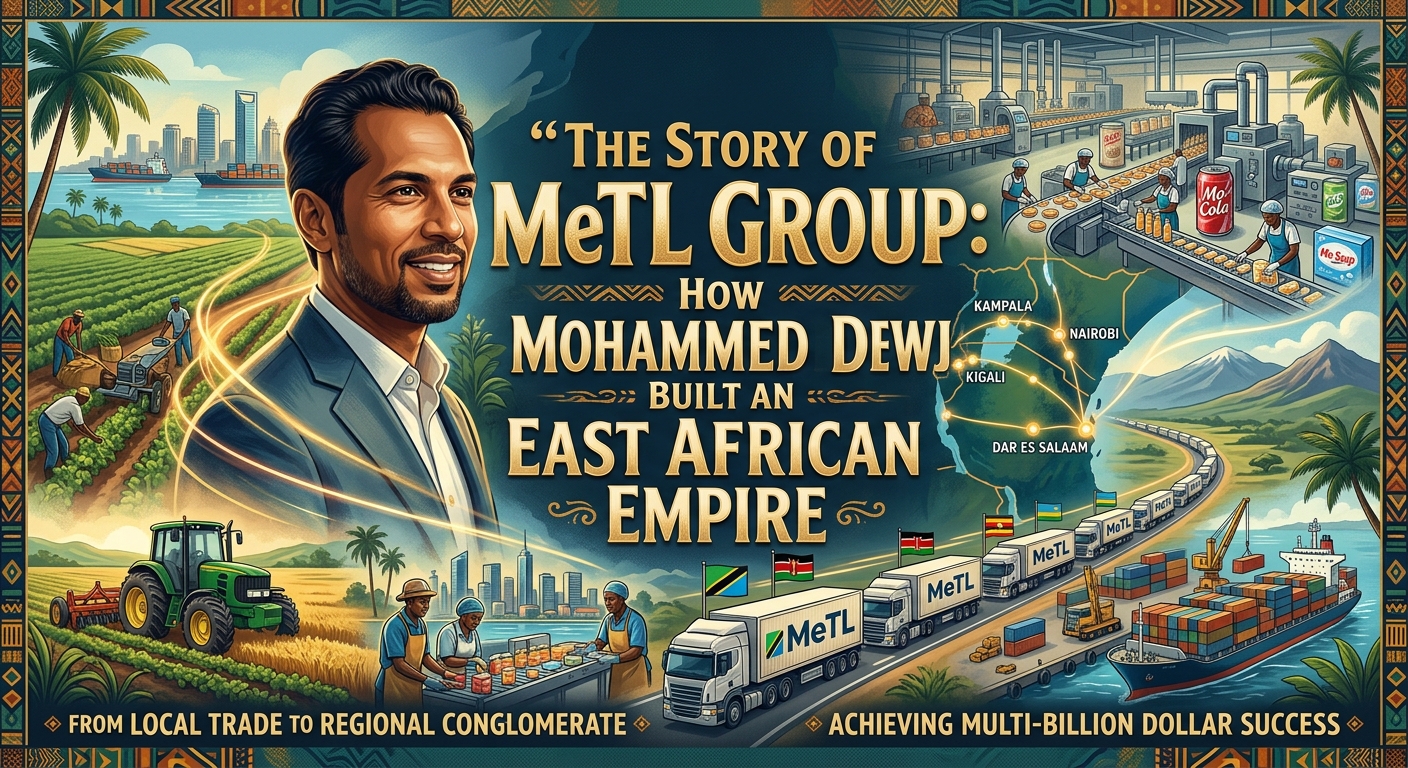
If you walk into a corner shop in Dar es Salaam, Nairobi, or Kampala, you will likely see products from one company everywhere. From soft drinks and cooking oil to soap, bicycles, and textiles, these everyday items share a common origin: MeTL Group (Mohammed Enterprises Tanzania Limited).
At the heart of this massive business empire is Mohammed “Mo” Dewji, Africa’s youngest billionaire. Under his leadership, a family-owned trading house transformed into a multi-billion-dollar conglomerate. Today, MeTL Group contributes over 3.5% to Tanzania’s Gross Domestic Product (GDP) and employs tens of thousands of people across East and Central Africa.
But how did a family trading business in Tanzania grow to dominate the East African market? What is the secret business model that allows MeTL to compete with global giants like Coca-Cola and Unilever? And how is Mo Dewji planning to expand this empire across the continent?
This is the story of MeTL Group’s business model, its vast network of subsidiaries, and its ambitious expansion strategy in East Africa.
The Origins of MeTL Group: From Humble Beginnings to an Industrial Giant
To understand MeTL’s success, we must travel back to the 1970s. The company began as a small, family-owned trading business started by Gulamabas Dewji in Singida, a dusty town in central Tanzania. In its early days, the company focused on import-export activities, trading basic commodities like sugar, rice, and soap.
In 1999, Gulamaba’s son, Mohammed Dewji, joined the family business after completing his education at Georgetown University in the United States. Mo Dewji was young, ambitious, and saw a massive gap in the African market.
At the time, Tanzania, like many African nations, relied heavily on importing finished goods from overseas. Mo realized that importing goods was expensive, slow, and subject to high tariffs. He asked himself a simple but revolutionary question:
“Why import finished products when we can manufacture them right here in Tanzania using our own resources and labor?”
Mo Dewji persuaded his father to pivot the company from simple trading to manufacturing. This decision marked the birth of the modern MeTL Group.
One of Mo’s first major moves was to buy struggling, privatized state-owned factories. The Tanzanian government was selling off factories that had failed under socialist policies. Mo bought these factories—ranging from textile mills to soap manufacturing plants—at a low cost, rehabilitated them with modern machinery, and brought them back to life.
Within a decade, MeTL had transitioned from a trading house into Tanzania’s largest home-grown manufacturing conglomerate.
The MeTL Business Model: High Volume, Low Margin, and Vertical Integration
At the core of MeTL Group’s massive success is a highly refined business model. While global multinational corporations often target high profit margins on premium goods, MeTL takes the opposite approach.
The MeTL business model rests on three main pillars:
- High Volume, Low Margin (The “Bottom of the Pyramid” Strategy)
- Backward and Forward Vertical Integration
- An Unmatched Distribution Network
Let’s look at how each of these pillars works in detail.
1. High Volume, Low Margin
Many global brands design products for middle- and high-income earners. However, the vast majority of consumers in East Africa live on modest daily budgets. They cannot afford expensive, imported premium brands.
MeTL targets the “bottom of the pyramid.” Instead of making a high profit margin on a few expensive items, MeTL makes a tiny profit margin on millions of affordable items.
For example, if MeTL sells a bottle of water or a bar of soap, they might make only a fraction of a cent in profit. But because millions of East Africans buy MeTL products every single day, those tiny fractions of a cent add up to hundreds of millions of dollars in annual revenue.
By keeping prices low, MeTL makes its products accessible to ordinary people. This builds massive customer loyalty and creates a high barrier to entry for foreign competitors who cannot operate on such tight margins.
2. Vertical Integration: Controlling the Whole Value Chain
One of the biggest challenges of doing business in Africa is the unstable supply chain. If a manufacturer relies on external suppliers for raw materials, power, packaging, or transport, any delay or price hike can ruin their business.
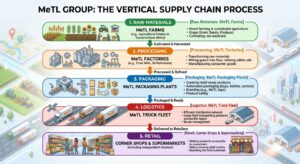
To solve this problem, MeTL adopted a strategy of vertical integration. This means MeTL tries to own and control every step of the production process—from the farm to the supermarket shelf.
- Backward Integration (The Raw Materials): Instead of buying raw agricultural goods from middlemen, MeTL owns its own sisal plantations, cashew farms, and tea estates. They grow the raw materials that go into their factories.
- Forward Integration (Processing and Packaging): MeTL owns its own processing plants, oil refineries, and packaging factories. They design and manufacture their own plastic bottles, cardboard boxes, and woven bags.
- Logistics: MeTL owns its own fleet of over 2,000 trucks and delivery vehicles. If a machine breaks down or a product needs to be shipped to a rural village, MeTL does not wait for a third-party transport company. They ship it themselves.
By controlling the entire supply chain, MeTL reduces waste, avoids middleman fees, keeps operational costs incredibly low, and ensures that their factories never run out of raw materials.
3. An Unmatched Distribution Network
In East Africa, the vast majority of retail sales do not happen in giant, modern supermarkets. Instead, they happen in millions of tiny, informal corner shops, kiosks, and open-air markets scattered across cities, towns, and rural villages.
MeTL built a distribution system specifically designed to reach these informal retailers. They established massive distribution hubs in major cities, which feed into smaller regional warehouses. From these warehouses, MeTL’s fleet of trucks delivers goods directly to local wholesalers and small shopkeepers.
Whether you are in a bustling market in Dar es Salaam or a remote village in the Tanzanian highlands, a MeTL truck will arrive to restock the local shop. This reliable distribution network makes it easy for shopkeepers to sell MeTL products, ensuring that the brand is always visible and available to consumers.
Inside the Empire: A Look at MeTL’s Key Subsidiaries
To understand the sheer scale of MeTL Group, we must look at its diverse portfolio of companies. Today, MeTL operates in over a dozen sectors. Here are the most important subsidiaries that drive the conglomerate’s growth:
1. Agriculture and Agro-Processing
Agriculture is the backbone of East Africa’s economy, and it is a major pillar for MeTL. The group is one of the largest agricultural landholders in Tanzania.
- Sisal Production: MeTL is the world’s largest producer of sisal (a natural fiber used to make ropes, carpets, and handicrafts). They own tens of thousands of hectares of sisal plantations.
- Edible Oils and Fats: MeTL processes sunflower seeds, palm oil, and cotton seeds to produce popular cooking oils, margarines, and shortening. Brands like East Coast Oil are household names in Tanzania.
- Cashews, Tea, and Seeds: They grow and process cashew nuts and tea for both local consumption and export to global markets.
2. Food and Beverages (FMCG)
Fast-Moving Consumer Goods (FMCG) is where MeTL touches the daily lives of millions.
- Mo Extra Beverages: This division produces carbonated soft drinks, energy drinks, juices, and bottled water.
- The “Mo Cola” Phenomenon: One of MeTL’s most famous success stories is Mo Cola. In Tanzanian markets, Coca-Cola and Pepsi were the long-time undisputed leaders. MeTL launched Mo Cola as a high-quality, local alternative sold at a significantly lower price. Today, Mo Cola is a serious competitor to global soft drink giants in East Africa.
- Milling and Food Products: MeTL mills wheat and maize to produce flour, pasta, biscuits, and confectionery products.
| FMCG Sector | Star Product Brands | Key Target Audience |
|---|---|---|
| Beverages | Mo Cola, Mo Orange, Mo Malt, Mo Energy | Price-sensitive youth and families |
| Edible Oils | Korie, Safi, Sunbelt | Everyday households and local food vendors |
| Soaps & Detergents | Poa, Royal, Linda | Budget-conscious consumers |
| Food & Grains | Mo Flour, Mo Pasta, Mo Biscuits | Mass market retail shoppers |
3. Textiles
MeTL owns several textile mills, including A-One Products and Bottlers and 21st Century Textiles.
- They process raw Tanzanian cotton into yarn, fabrics, and finished garments.
- MeTL is the largest textile manufacturer in East Africa. Their factories produce traditional African clothing (like Kangas and Kitenges), school uniforms, bedsheets, and garments for export to Europe and North America.
4. Logistics and Infrastructure
Without strong logistics, MeTL’s manufacturing empire would grind to a halt.
- Glenrich Transportation: This is MeTL’s in-house logistics company. With a massive fleet of heavy-duty trucks, Glenrich handles the distribution of MeTL products and offers transport and haulage services to third-party clients across East and Central Africa.
- Inland Container Depots (ICDs): MeTL operates container depots near major ports, helping to speed up the import of raw materials and export of finished goods.
5. Financial Services, Real Estate, and Energy
In addition to its core businesses, MeTL has diversified into other high-growth sectors:
- Real Estate: MeTL holds a massive portfolio of residential, commercial, and industrial properties across Tanzania.
- Energy: The group has invested in petroleum distribution, operating petrol stations and bulk fuel storage facilities.
- Trading: They trade in bulk commodities like fertilizer, cement, and industrial chemicals.
The East African Expansion Strategy: Beyond Tanzania’s Borders
While Tanzania remains MeTL’s home base and largest market, the domestic market has its limits. To keep growing, MeTL launched an ambitious expansion strategy to turn the Tanzanian giant into a pan-African powerhouse.
Today, MeTL Group operates or distributes products in over 11 African countries, including Kenya, Uganda, Rwanda, Burundi, Zambia, Mozambique, Malawi, and the Democratic Republic of Congo (DRC).
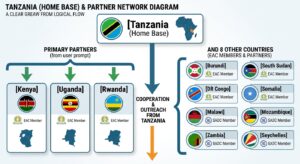
How does MeTL successfully expand into new, highly competitive African markets? Their strategy consists of three main approaches:
1. Exporting and Utilizing Trade Blocs
Instead of building expensive new factories in every country from day one, MeTL often begins by exporting products manufactured in Tanzania.
This approach is made possible by key African trade agreements:
- The East African Community (EAC): A regional treaty that allows for free trade and zero-tariff movement of goods manufactured within East Africa.
- Southern African Development Community (SADC): This facilitates easier trade with southern neighbors like Zambia, Malawi, and Mozambique.
- African Continental Free Trade Area (AfCFTA): A massive free-trade area that MeTL plans to leverage to reach North, West, and Central Africa.
By using these trade agreements, MeTL can manufacture goods in its highly efficient Tanzanian factories and ship them across borders without paying heavy import taxes. This keeps their retail prices highly competitive in neighboring countries.
2. Localized Manufacturing (Greenfield Investments and Acquisitions)
Once MeTL establishes a strong market share in a neighboring country through exports, they transition to local manufacturing.
Building factories inside destination countries has several advantages:
- Lower Transportation Costs: Shipping heavy products like liquid cooking oil or bottled water across borders is expensive. Manufacturing locally eliminates these logistics costs.
- Job Creation and Goodwill: By building local factories and employing local citizens, MeTL builds strong relationships with local governments and avoids political backlash.
- Hedging Currency Risk: Selling goods made in the local currency protects MeTL from fluctuations in exchange rates.
When expanding, MeTL either builds brand new factories from scratch (Greenfield investments) or acquires struggling local companies and models them after their successful Tanzanian operations.
3. Understanding Local Consumer Nuances
A common mistake multinational companies make when expanding in Africa is treating the continent as one single, uniform market. Mo Dewji and his team understand that a consumer in Nairobi, Kenya, has different tastes and purchasing habits than a consumer in Lubumbashi, DRC.
When MeTL enters a new country, they conduct deep market research. They adapt their branding, packaging sizes, and price points to match local preferences. For example, in countries with lower average incomes, MeTL packages cooking oil, laundry detergent, and tea in tiny, affordable single-use sachets (often called the “kadogo” economy). This ensures even the poorest consumers can afford their products.
Overcoming Challenges in the East African Market
Operating a massive conglomerate across multiple developing nations is not easy. MeTL Group faces constant hurdles. Understanding how they navigate these challenges offers valuable lessons for any business operating in emerging markets.
Challenge 1: Poor Infrastructure and Logistics
In many parts of East Africa, roads are unpaved, railways are limited, and electricity is unreliable. Power outages can cause factories to shut down, ruining production runs.
- MeTL’s Solution: MeTL invests heavily in self-reliance. They build their own backup power stations for their factories. They maintain their own logistics company to bypass unreliable delivery contractors. If a public road is unusable, MeTL’s rugged, custom-built transport trucks find alternative ways to get products to market.
Challenge 2: Currency Fluctuations and Inflation
Many East African nations experience high inflation and volatile exchange rates. Since MeTL has to buy some raw materials and machinery in US Dollars but sells its products in local currencies (like Tanzanian Shillings or Ugandan Shillings), currency drops can wipe out profit margins overnight.
- MeTL’s Solution: MeTL balances its business by exporting goods (like sisal, tea, and cashews) to global markets in exchange for US Dollars. They use these foreign currency earnings to buy raw materials and equipment, protecting themselves from local currency drops.
Challenge 3: Intense Competition from Global Giants
When MeTL expands, they go head-to-head with multi-billion-dollar global brands like Unilever, Procter & Gamble, Nestlé, and Coca-Cola. These global giants have massive marketing budgets and decades of experience.
- MeTL’s Solution: MeTL uses its local identity and speed to its advantage. Decisions at MeTL are made quickly, allowing them to launch new products in weeks, whereas a multinational might take years to get approval from a distant headquarters. Furthermore, MeTL’s radically low operational costs allow them to systematically undercut global competitors on price while maintaining excellent quality.
The Philanthropic Angle: The Mo Dewji Foundation
An essential part of the MeTL story is its social impact. Mo Dewji believes that business success must go hand-in-hand with community development.
To achieve this, he established the Mo Dewji Foundation. The foundation receives a portion of MeTL’s profits and focuses on three core pillars:
- Education: Providing scholarships, building schools, and donating learning materials to underprivileged children.
- Healthcare: Funding medical treatments, rehabilitating hospitals, and running free health camps in rural areas.
- Water Access: Drilling water wells and installing clean water delivery systems in dry, rural villages.
Moreover, Mo Dewji is a member of The Giving Pledge—an initiative started by Bill Gates and Warren Buffett, where the world’s wealthiest individuals promise to donate at least half of their wealth to philanthropic causes during their lifetime or in their will. Mo was the first Tanzanian and one of the few Africans to join this club.
This commitment to social good is not just ethical; it is also good for business. It builds trust, strengthens the brand’s reputation, and aligns MeTL’s success with the well-being of the communities it serves.
Key Lessons from MeTL’s Business Model
The success of MeTL Group offers valuable insights for entrepreneurs, business leaders, and investors looking to succeed in Africa and other emerging markets:
- Embrace the Mass Market: Do not ignore the lower-income consumer. By creating affordable, high-quality products for the masses, you can build a highly resilient, high-volume business.
- Control Your Supply Chain: In environments where infrastructure is weak, vertical integration is your best friend. By owning your supply chain, you protect your business from external shocks and middleman costs.
- Build Great Logistics: Manufacturing high-quality goods is only half the battle. You must be able to deliver those goods reliably to the remotest areas. An exceptional distribution network is a powerful competitive advantage.
- Stay Agile: Use local knowledge to make decisions quickly. Adapt your products, packaging, and pricing to the specific realities of each local market.
Conclusion: The Future of MeTL Group
Mohammed Dewji’s vision for MeTL Group is far from complete. He has stated publicly that his goal is to grow MeTL’s revenues to over $5 billion and employ over 100,000 people across Africa.
As the African Continental Free Trade Area (AfCFTA) continues to take shape, regional trade barriers will continue to fall. MeTL is perfectly positioned to take advantage of this shift. With its proven formula of vertical integration, low-cost manufacturing, and distribution, the company is on track to evolve from an East African champion into a truly continent-spanning empire.
The story of MeTL Group is proof that with the right business model, local talent, and a deep commitment to the community, African companies can not only compete with global giants—they can win.
About the Author