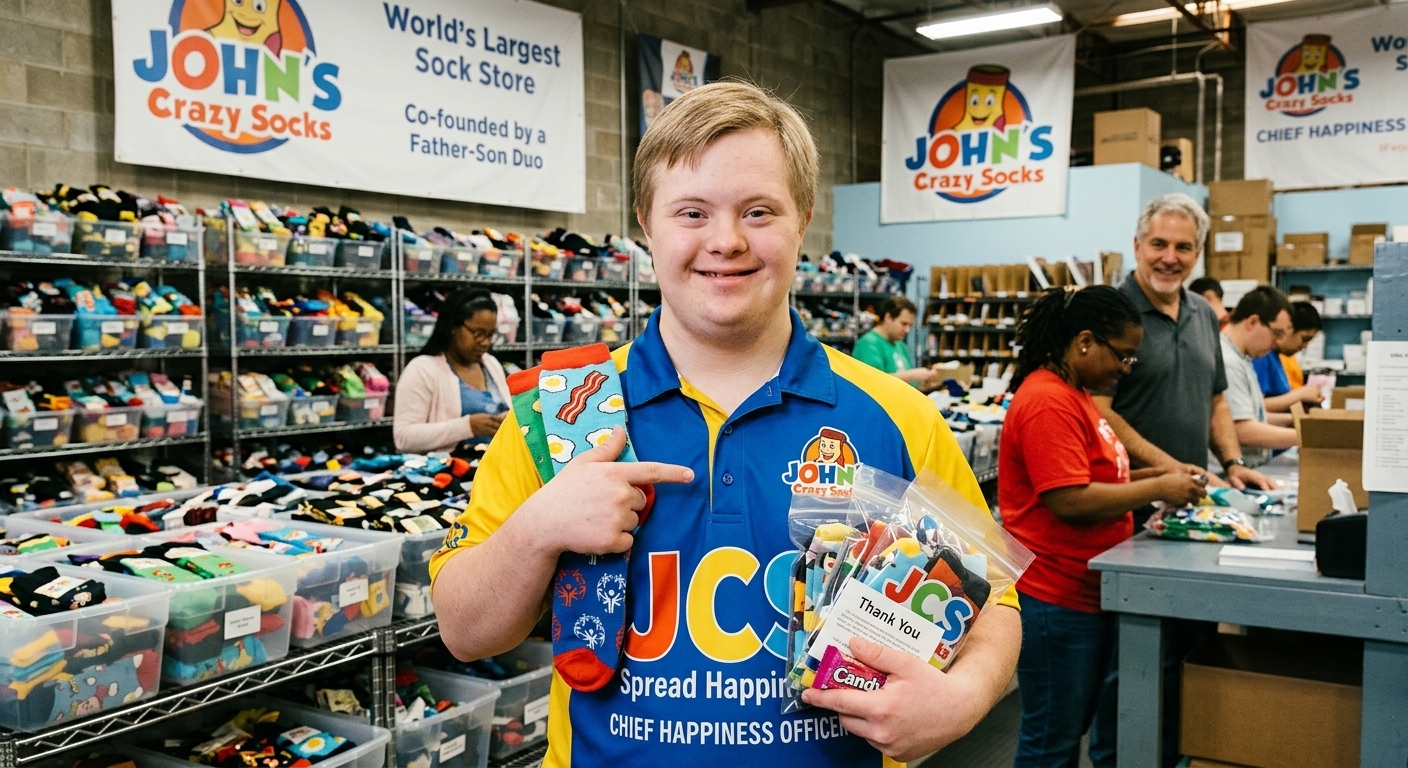
At the age of 20, after finishing high school and due to a cognitive disability that made it difficult for him to find a good job, he decided to start an online sock business with his father. Two years later, his company was generating over $1 million in annual sales, shipping more than 13,000 pairs of socks a month, and providing employment for other people with cognitive disabilities… How did he do it?
The story of John Cronin, founder of John’s Crazy Socks
The protagonist of this story is John Cronin, a young American entrepreneur who was born in Melville, New York, on February 11, 1996.
From birth, John had to struggle with several health problems, receiving gastric bypass and open-heart surgery when he was just 3 months old.
His beginnings as an entrepreneur date back to 2016, when he was 20 years old. John was in his final year of high school and was thinking about looking for a job once he finished his studies; however, job opportunities for people with Down syndrome are quite limited, and no job appealed to him.
So, he decided to tell his father, Mark Cronin, who is the person he loves most in the world, that they should start their own business together.
“John was born with Down syndrome. For him, it’s just a fact of life; he treats it like you would treat your height or the color of your hair. It’s just a part of who he is. It’s never been an obstacle for him, nor is it an excuse; so, like anyone else, he was worried about what he was going to do after finishing school. He wanted to do something meaningful, he wanted to be able to contribute to society, and that’s why he invited me to start a business together,” Mark said in an interview.
Looking for a business opportunity
Excited, they began brainstorming. Initially, they thought of setting up a food truck inspired by the movie “Chef,” which is about a father and son who run a restaurant; but after a few weeks of planning the details, they realized that neither of them knew how to cook, so they discarded the idea.
While they were still considering other business options, March 21st arrived, the date commemorating World Down Syndrome Day, which represents the triplication of chromosome 21, the genetic condition that causes Down syndrome. As a tradition, people in the United States often donate socks with fun and colorful designs on this day. John and his father wanted to buy a pair of commemorative socks that year, but they couldn’t find any designs related to the topic. So John decided to design his own socks, and his father, thanks to his connections, got them manufactured.
The socks were purple with printed hearts, and included the number 3-21 as a reference to World Down Syndrome Day.
Throughout his life, John had worn socks of various colors and styles because, according to him, they made him very happy.
The commemorative day arrived, and John wore his new pair of socks for the first time. However, one of his older brothers told his father not to let him go to school wearing something like that. John replied, “You’re not the taste police .” Mark, supporting his son’s position, let him enjoy his socks.
This event would be the fundamental pillar for John to have his “Eureka” moment months later.
One day, after his father picked him up from school, the young man mentioned that he wanted to start an online sock business. Mark thought it would be worth a try, as he had always supported his son’s happiness.
“I have Down syndrome, but this never stopped me. I wanted to create something fun and creative. I’ve worn crazy socks my whole life; they’re fun, colorful, and creative, and they let me be me.” – John said in an interview.
The sales strategy of a million-dollar business
Mark and John went to several supermarket chains and bought 31 different styles of socks, most of them Christmas-themed. John decided to name his business “John’s Crazy Socks” and set himself the goal of “selling socks, socks, and more socks .” They then worked together to create a website using Shopify and set up social media accounts for the business. The socks were sold for between $5 and $12 per pair.
On November 9, 2016, they posted a video on their social media where John promoted his business and invited his followers to buy socks. The video went viral, and they received 42 orders in just a few hours; most of these came from neighbors and people in the city.
Thrilled by his initial success, the young entrepreneur handwrote thank-you notes to his first customers and packed the socks in a red box, adding some candy. Later, accompanied by his father, they drove around town, and John personally delivered the orders on his own initiative. His delighted customers asked for photos and took videos of him. John couldn’t believe it.
With proof that the business was working, Mark and John began working on improving the website and publishing new content on their social media. With this strategy, they received 452 orders in the first month, representing nearly $13,000 in revenue—a clear indication of the business’s potential.
The family business was a huge hit with the public and caught the attention of the media, who began to cover the fascinating story of John’s Crazy Socks.
This media attention caused a rapid increase in sock orders, and their inventory ran out, so they had to make deals with different suppliers. Thanks to these agreements, they were able to handle up to 1,000 orders a day by the end of 2017.
With this exponential growth in sales, they also had to rent a warehouse, as their house couldn’t handle the number of boxes of socks arriving from their suppliers. Soon, they found employees and, at John’s request, decided to give opportunities to people who, like him, had difficulty finding work due to their cognitive disabilities.
Successful entrepreneur and millionaire at 22 years old
By 2018, John’s Crazy Socks had 20 different suppliers, offered more than 2,000 styles of socks, provided employment for 35 workers (18 of whom were people with cognitive disabilities), and generated more than $1.7 million in annual sales.
Motivated by his company’s success, John decided to start donating 5% of the sales from each pair of socks to the Special Olympics, in which he had participated several times and won numerous medals. Later, he designed a line of exclusive socks, donating 100% of the proceeds to charities that support people with Down syndrome, autism, and cancer. In 2018, John’s Crazy Socks donated a total of over $300,000 to charity.
This success and contribution to society allowed John to receive the New York City Entrepreneur of the Year award in 2019. That same year, he was recognized on the Long Island Business News’ “30 Under Thirty” list as Millennial of the Year for being the co-founder of one of the largest online sock retailers in the United States.
John is currently 24 years old and works alongside his father to run John’s Crazy Socks. His daily responsibilities include preparing and shipping orders, writing and recording thank-you videos, and sharing the happiest moments of his life on the company’s social media. He has also campaigned for the rights of people with cognitive disabilities and has testified before the United States Congress several times to share his story and advocate for more inclusive legislation.
Thus concludes the inspiring story of John Cronin, a passionate young man who always believed in his abilities and who, with his father’s help, found in entrepreneurship the opportunity to positively impact the world by sharing his happiness and charisma through his products. In his father’s words:
“Every day I see John, I feel inspired and hopeful. Seeing what John can do shows what any of us can do. The only limitations are the ones we impose on ourselves. John encourages us, challenges us, and shows us that anything is possible.”
Related story
The story of Jack Ma, founder of Alibaba
The story of Google, the company that started in a garage and managed to revolutionize the world
The story of Canva, the company that revolutionized the graphic design industry
7 Steps to Create an Automated Email Marketing Strategy for Your Business
More than 100 Business Ideas to Start in East Africa in 2026
About the Author