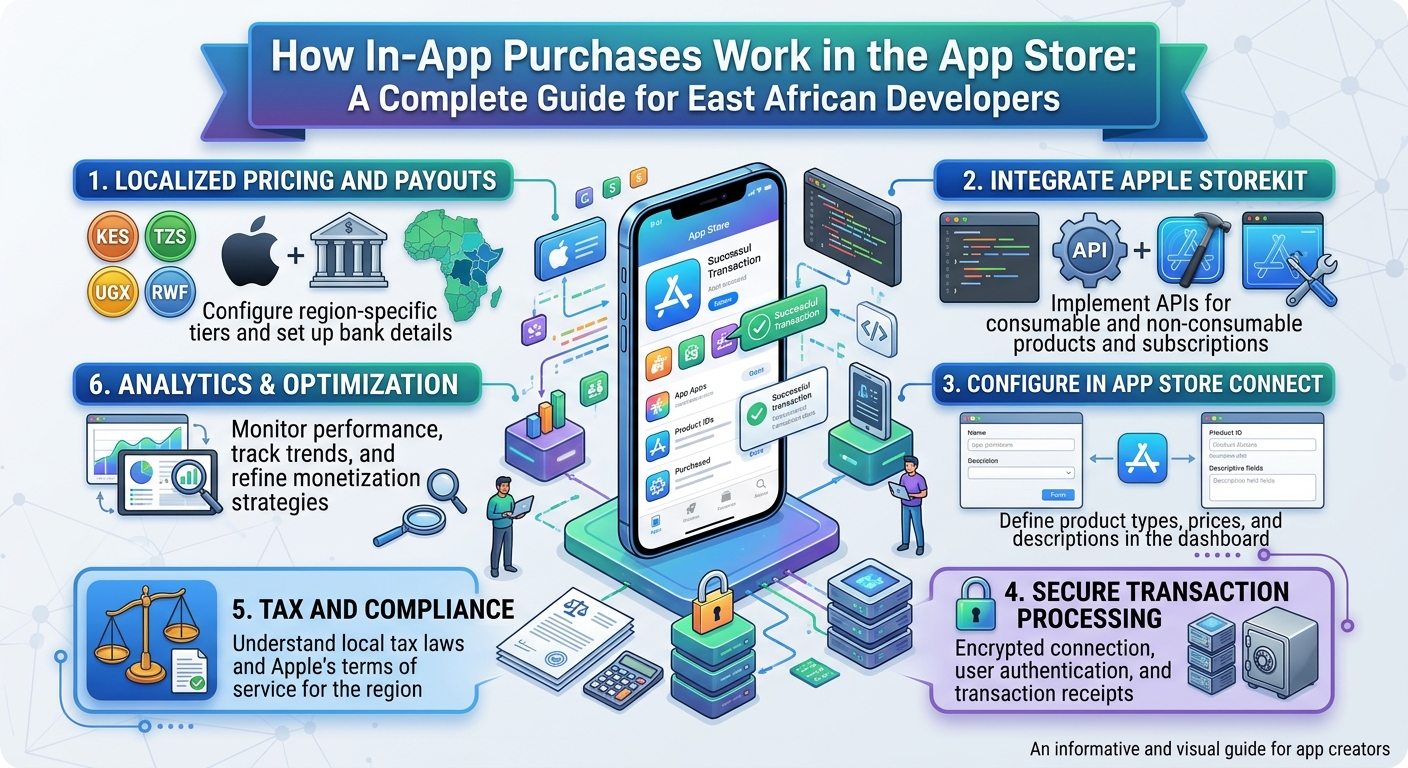
When developing an app, its creators will inevitably encounter the concept of in-app purchases (IAP). What does “in-app purchases” mean? This system is one of the most effective ways to generate revenue. The App Store online platform offers native functionality for implementing such calculations, simplifying revenue generation from both local audiences across East Africa and users globally.
Greetings to all developers across Kenya, Tanzania, Uganda, Rwanda, and the wider region!
In this article, we take a closer look at the concept of in-app purchases on iOS: what they mean, what role they play for users and app creators, how to organize payment setups, and what technical, banking, and local payment realities are most important for East African developers to consider.
How the App Store Works
The App Store is the official online app store for iOS and macOS, serving millions of Apple device users worldwide. It publishes software from major tech companies as well as independent developers.
The platform offers developers extensive opportunities for growth and global distribution. Available tools include app publishing, updates, Search Ads campaigns, TestFlight beta testing, and monetization capabilities.
Built-in payment functionality allows you to receive revenue from international and local users alike—you just need to understand what in-app purchases are. Here is the fully adapted and rewritten article tailored specifically for East African developers (spanning Kenya, Uganda, Tanzania, Rwanda, and the broader region), highlighting local market dynamics, payment processing, cross-border banking, and mobile money realities.
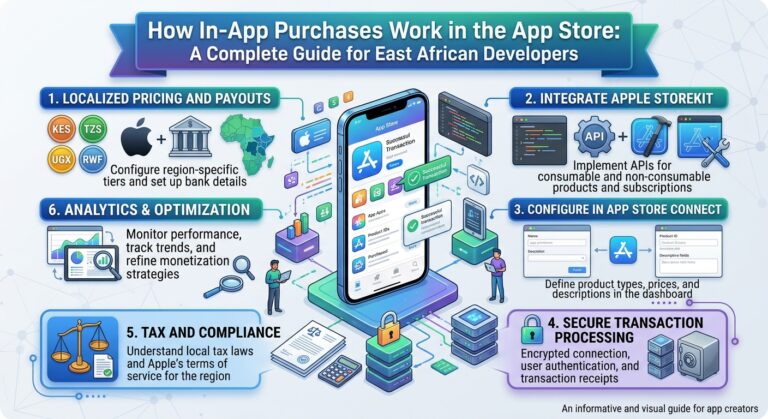
How In-App Purchases Work in the App Store: A Complete Guide for East African Developers
When developing an iOS app, creators inevitably encounter the concept of In-App Purchases (IAP). What does “In-App Purchases” mean? This system is the standard way to generate recurring or one-time revenue directly inside your app, giving East African developers access to both local and lucrative global markets.
Whether you are based in Nairobi, Kampala, Dar es Salaam, or Kigali, the App Store provides the infrastructure to monetize your software—provided you know how to navigate setup, taxes, and local payout solutions.
How the App Store Works
The App Store is Apple’s official marketplace for iOS, iPadOS, and macOS software. It hosts millions of apps built by global tech giants as well as independent African indie developers.
For tech hubs across East Africa (often dubbed the “Silicon Savannah”), the App Store opens access to an international audience. Apple handles app delivery, distribution, cloud infrastructure, and initial billing so you can focus on building products.
How Do In-App Purchases Work?
In-App Purchases (IAP) allow users to buy digital content, extra features, or subscriptions directly inside your application without switching to an external website or third-party web view.
With the rise of mobile app development across Africa, the Freemium model has become dominant. Users download your app for free to test basic features, then upgrade via IAP to access premium features, extra tools, or ad-free experiences.
Main Types of IAP
-
Consumables (Renewable Resources): Items that are used up and can be bought repeatedly (e.g., in-game coins, AI generation tokens, temporary boosts).
-
Non-Consumables (One-Time Purchases): Purchased once and unlocked permanently across all user devices (e.g., unlocking full app lifetime access, removing ads, unlocking specific features).
-
Auto-Renewable Subscriptions: Users are charged periodically (weekly, monthly, annually) to maintain access to content or services (e.g., SaaS tools, streaming apps, news platforms).
-
Non-Renewable Subscriptions: Grant access for a limited time period but do not renew automatically; users must repurchase manually upon expiration.
What East African Developers Need to Consider
While building an app from East Africa provides huge global opportunities, local developers face distinct financial, regulatory, and technical considerations:
1. Payout Banking & Cross-Border Payments
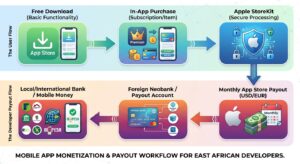
Apple pays developers via direct bank wire transfers, primarily in USD, EUR, or GBP.
-
Local USD Accounts: Most developers in Kenya, Uganda, or Tanzania route payouts directly to a local USD-denominated bank account (e.g., Equity Bank, Standard Chartered, KCB, Absa).
-
International Neobanks: Many regional startups use global business accounts such as Wise, Payoneer, or Mercury (for US-registered entities) to receive Apple payouts and convert them into local currencies (KES, UGX, TZS, RWF) at better FX rates.
2. Local Mobile Money vs. Global Apple Pay
In East Africa, Mobile Money (M-Pesa, MTN Mobile Money, Airtel Money) is the dominant payment rail. However, Apple strictly requires digital products sold inside iOS apps to use native Apple IAP—meaning users pay using credit/debit cards linked to their Apple ID.
-
For Digital Goods/Services: You must use Apple IAP.
-
For Physical Goods & Real-World Services (e.g., ride-hailing, e-commerce, food delivery, utility payments): You are permitted to integrate local payment gateways like Flutterwave, Paystack, DPO, or direct M-Pesa Express APIs.
3. Tax and Regulatory Compliance (DST & VAT)
East African governments (such as the Kenya Revenue Authority and Uganda Revenue Authority) have implemented Digital Services Tax (DST) and VAT on Electronic Services.
-
Apple acts as the merchant of record in many jurisdictions, collecting and remitting local sales tax/VAT on digital purchases on your behalf where applicable.
-
Developers must ensure their tax details (including US W-8BEN / W-8BEN-E forms) are submitted correctly in App Store Connect to prevent double taxation on US-derived income.
App Store Commission Fees and Ways to Reduce Them
Apple’s standard commission rate on digital purchases and subscriptions is 30%. However, high platform fees can compress margins for African tech startups. You can reduce this fee using several approaches:
-
Apple Small Business Program (15% Fee): If your business earns under $1,000,000 USD in net annual revenue across all associated developer accounts, you qualify for a reduced 15% commission rate. Virtually all early-stage East African indie developers qualify and should apply immediately upon setup.
-
Subscription Price Reduction: For auto-renewable subscriptions, Apple automatically drops its commission from 30% to 15% for any subscriber who maintains an active subscription for more than 12 consecutive months.
-
StoreKit External Purchase Link entitlement: Where permitted by Apple policy, certain app categories can link users out to an external web page to complete a purchase, though Apple still levies a reduced fee (typically 27%) on those transactions.
-
Web-Based Subscriptions: You can encourage users to subscribe via your website (using local payment gateways like M-Pesa, Flutterwave, or cards) before logging into the iOS app. Note: You must comply with Apple’s anti-steering rules regarding how you communicate web pricing inside the app.
Technical Step-by-Step: Integrating IAP
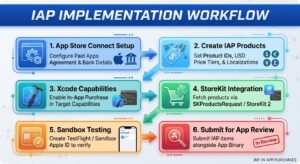
Step 1: Register Your Apple Developer Account
-
Create an Apple ID (ensure two-factor authentication is enabled).
-
Enroll in the Apple Developer Program ($99 USD/year).
-
If enrolling as a Company/Organization, obtain a D-U-N-S Number (Dun & Bradstreet) for your legal entity (free on the D&B website).
-
Pay the $99 annual fee using an international debit/credit card (e.g., Visa, Mastercard).
Step 2: Configure App Store Connect
-
Sign the Paid Applications Agreement in App Store Connect.
-
Fill in tax agreements and enter your foreign currency corporate bank account details (SWIFT code, IBAN/Account Number) to receive monthly disbursements.
Step 3: Create In-App Purchase Products
-
Under My Apps, select your app and navigate to Features > In-App Purchases.
-
Select your model (Consumable, Non-Consumable, or Subscription).
-
Define a unique Product ID (e.g.,
com.yourcompany.appname.premium_monthly). -
Set pricing tiers. Apple automatically converts your base price into global currencies based on local exchange rates.
-
Enter localized titles and descriptions for your target markets.
Step 4: Implement StoreKit in Xcode
-
Open your project in Xcode, go to Signing & Capabilities, and add the In-App Purchase capability.
-
Import
StoreKit(or use modern Swift StoreKit 2 APIs). -
Request product details using product identifiers.
-
Handle transaction queues (
SKPaymentQueueorTransaction.updatesin StoreKit 2) and grant access to features upon successful receipt validation.
Step 5: Sandbox & TestFlight Verification
-
Create Sandbox Testers under Users and Access in App Store Connect.
-
Sign in with the Sandbox account on your test iPhone (do not use your personal Apple ID).
-
Test purchase flows, subscription upgrades, cancellations, and product restoration across devices.
Summary: Building a Sustainable App Business in East Africa
In-app purchases give East African developers a direct pipeline to international revenue while building software from home. By leveraging the Apple Small Business Program, routing payouts to appropriate multi-currency accounts, and maintaining compliance with both regional tax rules and Apple’s StoreKit guidelines, developers can scale globally.
About the Author