At the age of 30, he was working as an English teacher for just $12 a month at a university in his hometown. Twenty years later, he had become the richest person in China and one of the most successful entrepreneurs in the world, after leading an unprecedented digital revolution in his country… How did he do it?
How did Jack Ma become the richest person in China?
The protagonist of this story is Ma Yun, better known internationally as Jack Ma, who was born on September 10, 19,64 into a humble family in the Hangzhou region, the capital of Zhejiang province in China.
Ma Yun was raised without the comforts or luxuries, under the strict Marxist rules of the Chinese communist regime. He grew up alongside his older brother and younger sister.

At that time, Hangzhou was a remote and desolate city, practically cut off from the world, so opportunities for advancement were very limited. However, everything changed in 1972 when Richard Nixon, then President of the United States, visited the city. After that official visit, tourism in the region increased considerably, allowing many of its inhabitants to improve their economic situation thanks to the money spent by visitors.
At school, Ma was never an outstanding student and was constantly getting into fights with his classmates. Math was always the subject that gave him the most trouble; he himself has admitted in several interviews that numbers aren’t his strong suit. However, the boy did stand out for being extremely curious, which led him to develop an interest in learning English after seeing the increasing number of English-speaking tourists visiting his city.
At the age of 12, every morning for more than eight years, he rode his bicycle for approximately 60 minutes from his home to the Hangzhou International Hotel, where he volunteered as a tour guide with visitors to practice his English.
It was precisely in his work as a guide that he received the nickname “Jack” from a tourist, this being a name easier for foreigners to pronounce than his real name.

During his youth, like many ordinary people, he struggled to gain university admission. At higher education institutions, university admissions were highly demanding and were held only once a year. Ma applied to the Hangzhou Teacher’s Institute, now known as Hangzhou Normal University. He took the exam three times and failed; however, he was unwilling to give up, so he decided to try again and finally succeeded in enrolling in the Bachelor of Arts in English Literature program.
During his academic stay, he met Zhang Ying, who would become his wife and with whom he would have two children. They both graduated in 1988
After obtaining his degree, Ma tried to find work in various places, but he was rejected in every single one of them.
“I applied for jobs 30 times… and was rejected. I went to apply to the police force and they said, ‘No, you’re no good.’ I even went to KFC when it came to my town; 24 people applied for the job and 23 were accepted; I was the only one who was rejected.” – Jack Ma commented in an interview at the World Economic Forum in 2015.
Eventually, he and his wife found work as professors at Hangzhou Dianzi University. Although it was a stable job, they felt they were underpaid, earning only $12 a month.
China’s first internet company
In 1994, he founded Hangzhou Haibo Translation Agency, a small business specializing in Mandarin-to-English translations. A year later, one of his clients, the owner of an international company, asked Ma to accompany him as a translator on a business trip to the United States, and he agreed without imagining that this trip would completely change his life…
Upon arriving there, he was impressed by the industrial and technological development of the North American country, which contrasted sharply with the limitations of the region where he grew up. But undoubtedly, what surprised him most was interacting with the internet for the first time.
A friend of his who lived in Seattle sat him down and said, “Jack, this is the internet. You can find anything online .” Intrigued, he typed the word “beer” and searched to verify his friend’s claim. When he got the results, he was fascinated by the technology, but also intrigued because he noticed that no Chinese companies appeared in the search results. He continued investigating and realized there was hardly any information about his country. That’s when he saw an opportunity to develop a portal for Chinese companies to gain exposure in the international market.
Upon returning from his trip, Ma and his friends secured a loan of $2,000 and created China’s first internet company: “China Pages, ” a kind of online yellow pages that presented information in English about the country’s businesses.

With the website online, he began contacting companies to propose advertising; however, the task proved more complicated than he anticipated, as companies in the country remained highly skeptical about the internet. He then decided to seek government support to further his goal, so he traveled to Beijing hoping to partner with the government body responsible for information control in the country.
The year was 1995, and only two years had passed since IP connectivity arrived in China. Furthermore, the media in the country was strictly controlled by the government, making it a significant challenge for Jack to gain support for his project.
After several meetings with different government entities in which he tried to demonstrate the potential of the internet for Chinese commerce, he only managed to run up against the enormous bureaucracy that prevailed in the country. These entities had very little interest in partnering with an unknown English teacher, so, once again, Ma experienced firsthand the harshness of rejection.
Despite everything, China Pages achieved significant success, attracting the attention of Hangzhou Telecom, a government-owned company that had begun offering a service similar to the one Jack had designed. Afraid of competing with a government-backed organization, he concluded that the only way to survive was to partner with Hangzhou Telecom. The two companies joined forces to create a joint venture, but things didn’t work out, and Ma ended up leaving the project shortly afterward, realizing that his opinions carried no weight in the decisions being made.
By 1998, the dot-com boom was sweeping Wall Street. Every day, new online companies went public, creating thousands of new millionaires. Dot-com companies became the market’s darlings. Meanwhile, in Beijing, China, Jack Ma was working in the government’s e-commerce division, helping small businesses get online, and he decided it was time to try again…
The origin of Alibaba
In 1999 already with the experience gained with China Pages an in his work with the government, Ma gathered a group of 17 friends in his apartment in Hangzhou and convinced them to invest capital and time in his business proposal and his vision of an online market, which he called “Alibaba” after the character from “Alibaba and the 40 Thieves”; stating that people believed this was a thief, but that in reality he did not see the character that way, but as someone who helped the people of his village.
“I didn’t know anything about technology or management, but you don’t have to know; you just need to find people smarter than you. When hiring, I look for people smarter than me, people who could be my boss five years later. I like positive people who never give up. Then, my job is to make sure they work as a team,” the businessman commented.
His idea was to build a marketplace connecting small and medium-sized Chinese businesses involved in global trade—manufacturers, trading companies, and wholesalers already part of the global supply chain—so they could sell to customers worldwide via the internet. In his own words, Alibaba would be the “open sesame” for small businesses to access global markets.

With a clear idea, a grand vision, and immense determination, Jack and his team began working day and night on the project’s development. They spent seven months isolated from the world, locked away in their apartment, completely focused on their goal: to have the platform ready as soon as possible.
In October 1999, Alibaba finally emerged from its hiding place and was officially unveiled at a press conference in Hong Kong, where Ma also announced a $5 million investment round in the company led by Goldman Sachs. The news spread rapidly, thrusting Jack and Alibaba into the media spotlight. In January 2000, Alibaba received an additional $20 million investment from SoftBank, a Japanese telecommunications and internet corporation.
Thanks to these investments and media coverage, the platform began to grow, attracting massive numbers of both Chinese exporters and wholesale buyers from around the world, who could now easily find suppliers from the Asian country. However, Alibaba initially generated no profit, as its founder’s goal was rapid expansion and international positioning, so he didn’t hesitate to sacrifice short-term profitability to achieve it.
By March 2000, Alibaba’s team had grown significantly, forcing the company to leave the apartment where it started operations and move to much larger offices.
The internet crisis hits Alibaba.
Despite the company’s steady growth, Jack Ma‘s dreams would be radically impacted by events unfolding in the West. While China was beginning to experience the fervor unleashed by the potential of the internet and Alibaba was focusing its efforts on international expansion, the dot-com bubble was bursting in Europe and North America. Following the dramatic collapse of the Nasdaq stock index, thousands of internet companies went bankrupt, and millions of investors were ruined, generating distrust in the markets toward the digital industry. However, Ma would prove persistent enough to remain afloat during the most challenging moments of the crisis. To streamline the company’s international operations, Alibaba‘s English-language headquarters to Silicon Valley. This decision improved the company’s global image but ultimately exacerbated the operational and management problems they were already facing. Within months, the decision was reversed, leading to a series of mass layoffs in the US offices. This was a significant emotional blow for Jack, who felt guilty about what had happened and began to lose confidence in his colleagues.
By 2001, the dot-com bubble was deepening globally, and Alibaba was not immune. The company continued to struggle to turn a profit, and the press was hounding it with predictions of its demise, causing concern among investors and executives. To save money, they had to lay off almost the entire international team, cut advertising budgets, and return to operating entirely in China. Even so, the company’s financial situation remained unsustainable.
The company’s priority at that time was to achieve stability and ensure its survival, so it implemented an operational plan to organize the company’s functioning. This plan strengthened the company culture and optimized processes, laying a solid foundation to support the rapid growth they faced. The next challenge was to become profitable, so they began evaluating revenue streams for the platform.
After analyzing data and figures and speaking with registered users, they realized that businesses might be interested in paying to appear at the top of Alibaba’s search results. So, they launched a paid service that allowed exporters to have a premium presence on the site. This new service was very well received by users, but the revenue it generated was still insufficient to cover the company’s expenses.
With no other option, they reduced the marketing budget to zero and cut the salaries of top executives so that the company could withstand the crisis it was going through.
The strict measures implemented had an effect, and by the end of 2002, Jack Ma gathered his team to deliver the good news: for the first time in its history, Alibaba had become profitable. That year, the company earned profits of over $60,000, demonstrating that it was not only surviving the dot-com bubble but also beginning to establish itself in the industry.
The company looked stronger than ever and finally seemed to have a clear growth path, but life would once again test the tenacigrowth pather team…
In early 2003, news broke that a SARS outbreak caused by a type of coronavirus had erupted weeks earlier in southern China and was spreading rapidly across the country. One of Alibaba‘s employees contracted the virus, forcing the entire team into quarantine. They were forced to close their headquarters and had to make a tremendous effort to adapt to the situation and keep the platform running. Four hundred employees took their computers home and worked remotely. The team embraced the challenge and remained optimistic throughout the ordeal.

When the quarantine ended for part of the team, Jack contacted Porter Erisman, Alibaba’s then vice president, to tell him to preparebecause tey were about to face the company’s biggest challenge yet, one that would define its destiny forever.
In the United States, the digital industry was recovering and growing at an unstoppable pace. Companies that had managed to survive the dot-com bubble were consolidating themselves into veritable empires, moving billions of dollars in transactions worldwide. One of these companies was eBay, which was already positioning itself as the most valuable internet company in the world, with a presence in more than 150 countries… including China.
The eBay vs Taobao war
It was this presence in China that worried Jack. Three years earlier, eBay had bought a large part of achnet, a Chinese clone of eBay, so it indirectly already controlled part of the Chinese market, and it would only be a matter of time before the platform entered into direct competition with Alibaba, putting his business at risk.
To avoid this, he secretly met with part of his team in the department where the company was born to design the strategy with which they would face the war against eBay.
“eBay is a shark in the ocean; we are a crocodile in the Yangtze River. If we fight in the ocean, we will lose; but if we fight in the river, we will win.” – These were the words with which Jack Ma prepared his team for battle.
While the rest of the staff remained in quarantine, this small, secret team worked tirelessly on a new project for several months. Finally, in May 2003, their creation was launched: “Taobao,” meaning “treasure hunt,” a C2C platform with which the company would seek to gain ground on eBay before its arrival.
The following month, Jack’s fears came true: eBay announced the purchase of the remainder of Eachnet and an investment of $150 million in the business.
With eBay poised to dominate the Chinese market, Alibaba began to make its moves. It organized an event to officially launch Taobao to the media and announced that the platform would be free for all users for three years. But that wasn’t all; the company also introduced Alipay, a new payment platform that allowed transactions to be made from a virtual account and held the money in the customer’s account until they received their order.
Jack’s strategy focused on two key points: first, the site was built with a total focus on the Chinese consumer, since until then similar platforms operating in the country were nothing more than copies of the American model; and second, offering the service for free was something eBay did not consider, because its business model was based precisely on charging users.
For its part, eBay would seek to integrate Eachnet, which already had more than 10 million users, with its global platform, maintaining only some features that were very popular among Chinese users.
With the pieces in place, the war between these two ambitious rivals began…
Weeks passed, and Taobao began to gain immense popularity among young Chinese people thanks to its focus and features; meanwhile, eBay, with its virtually unlimited resources, deployed expensive advertising campaigns to project dominance in the market. The media perceived this battle as a David and Goliath struggle.
Understanding the local market was undoubtedly the key factor in this battle. The features Taobao had developed with the Chinese consumer in mind allowed the platform to grow much faster than its rival. Furthermore, it was only a matter of time before Chinese eBay users began abandoning the platform and migrating to Taobao.
By 2005, the battle had intensified. eBay decided to double its efforts, announcing an additional investment of $100 million and declaring that they were on track to become the undisputed winner in China; but in the United States, investors were concerned about the difficulties the company was facing in the Asian market.
As the days passed and eBay’s results in China worsened, Meg Whitman, who was serving as the company’s CEO, decided to meet with Jack Ma to discuss a possible partnership that could lead to a “ceasefire”.
Feeling misaligned with Whitman‘s vision, who seemed more concerned with pleasing Wall Street than contributing to the development of e-commerce in China, the Alibaba CEO rejected the partnership proposal, bringing the battle to its peak.
As eBay prepared to make its next move, Alibaba pulled an ace out of its sleeve that surprised its rival and the entire world…
The Chinese company received a $1 billion investment from Yahoo! in exchange for 40% of its shares. Furthermore, with this deal, Alibaba would take over Yahoo! China‘s operations to compete directly with Google and Baidu. This was one of the biggest deals in internet history and sparked a media frenzy, but it also presented organizational and political challenges for Jack Ma and Alibaba.
With Yahoo! as its main shareholder and a strong investment in its portfolio, Alibaba was ready to definitively defeat its North American rival.
In 2006, Taobao‘s numbers surpassed eBay‘s for the first time, but the battle wasn’t over. Alibaba had one last attack planned. With Wall Street and the media watching closely, the company announced that Taobao would be free for three more years and invited eBay to do the same.
The blow was devastating.
Following the announcement, eBay’s shares fell 5%, and the news resonated in both China and the United States.
During the following year, Taobao continued to gain market share from eBay, which finally relented by eliminating its fees to attract new users, but the decision came a little late.
By the end of 2006, eBay announced the closure of its website in China, leaving Taobao as the absolute market leader and ending a war that had been fought for years.
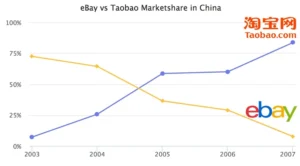
Source: “Why Amazon and eBay Lost in China” www.marketplacepulse.com
Alibaba goes public in Hong Kong
Now free from the pressure of eBay, Jack and his team were ready to take a big step in their business career: Alibaba’s initial public offering
At the end of 2007, the company debuted on the Hong Kong Stock Exchange, nearly tripling its share value on its first day of trading. It was a reality: that small digital business that started in an apartment in Hangzhou had become one of the world’s leading technology companies… But Ma’s ambition wouldn’t stop there.
AsAs Alibaba grew, it began to identify new business opportunities.
In 2008, the company launched its new platform: Tmall, a kind of online shopping mall whose main purpose is to connect major Chinese brands directly with their consumers.
In 2010, they launched AliExpress, a platform geared towards the international market where both companies and individuals can buy and sell almost all kinds of products.
In 2012, the conflicts between Alibaba and Yahoo! intensified, leading Alibaba to buy back a large portion of the stake Yahoo! had acquired. This marked the beginning of the end of the relationship between the two companies.
That same year, Jack Ma announced that he would step down as CEO of Alibaba, but would remain as chairman, focusing on the company’sstrategic vision, developing talent to grow the internal leadership team, and leading corporate social responsibility efforts.
“I’m 48 years old. I’m no longer young enough to run such a fast-growing business. When I was 35, I was very energetic and fresh. I had nothing to worry about. The next generation of people at Alibaba is better equipped to manage an internet ecosystem like ours,” the Chinese entrepreneur said in an interview.
By 2013, the Alibaba Group already dominated around 80% of e-commerce in China and handled transactions worth more than $248 billion through its three main online marketplaces, surpassing eBay and Amazon combined.

Jack Ma becomes China’s richest businessman.
In 2014, due to a failed agreement with Hong Kong stock e.regulators, Alibaba decided to move to Wall Street for a new initial public offering (IPO). The IPO took place in September of that year on the New York Stock Exchange and became the largest IPO in history at the time, achieving a market capitalization of $25 billion and making Jack Ma the richest person in China.
Over the next few years, Alibaba Group launched a wide range of services, including Alibaba Cloud, a cloud and artificial intelligence solutions company; Aisports, a platform aimed at boosting the sports industry as a whole; Hema Supermarket, a new omnichannel supermarket concept; and the Alibaba Entrepreneurs Fund, an organization dedicated to providing financial and strategic support to entrepreneurial projects. It also acquired major companies such as Youku, China’s largest streaming platform, and Lazada, the leading e-commerce company in South Asia.
In September 2019, Ma turned 55 and stepped down as chairman of Alibaba, stating it was “to make way for younger minds .” However, he retains a stake in the company’s management group, though he is not directly involved in board decisions. The end of one era and the beginning of a new one had arrived. His successor was Daniel Zhang, who until then had served as the company’s CEO.
Alibaba has established itself as one of the world’s largest business groups, with investments in sectors such as cloud computing, artificial intelligence, streaming, home delivery, social media, finance, marketing, sports, supermarkets, and, of course, e-commerce. Its services compete directly with companies like eBay, Amazon, Google, Facebook, YouTube, and Visa, among many others. The company has a market capitalization of over $480 billion and generates more than $51 billion in revenue annually.
Jack Ma, for his part, continues to hold the title of China’s richest person, with a personal fortune exceeding $39 billion according to Forbes magazine. He is also considered one of the world’s most innovative and powerful individuals by various publications. Now free from the burden of running a multi-billion-dollar company, he has focused on philanthropy through multi-billion-dollar foundations, supporting causes related to the environment, women’s empowerment, rural education, improved health, and economic and social development.
Thus concludes the inspiring story of Ma Yun (or Jack Ma), a successful entrepreneur who never gave up despite the many obstacles throughout his life and who, with vision, strategy, and determination, led the development of e-commerce in China, building one of the most powerful companies in the world and becoming a billionaire in the process. In his own words:
“An entrepreneur must have skills that allow them to withstand the blows of fate and overcome inevitable failures… What does failure really mean? There is no greater failure than giving up on something you want to achieve.”
Sources:
- Documentary “Crocodile In The Yangtze” – Porter Erisman (2012) www.crocodileintheyangtze.com
- Book “Alibaba’s world: How a Chinese company is revolutionizing the business world” – Porter Erisman (2018)
- Forbes Magazine: “China Rich List 2019” – www.forbes.com/china-billionaires
About the Author