
A corporate website in 2026 is a lead generator. Learn how proper UX design and competent development can double conversion rates.
Customer acquisition costs in B2B and complex B2C markets are breaking records. Clicks in Yandex Direct are becoming more expensive, and SEO competition is becoming increasingly fierce. Under these circumstances, driving expensive advertising traffic to an outdated, inconvenient website literally burns through a company’s marketing budget.
A corporate website is no longer just an online business card with a company mission statement. It’s a fully-fledged digital sales manager, working 24/7 to warm up your audience and generate leads.
Let’s explore the differences between a “show-it-all” website and a profitable tool, and what development stages businesses can’t ignore in 2026.
4 Major Mistakes of Old Websites That Cause Businesses to Lose Customers
If your current website was created 5-7 years ago, there’s a 90% chance it’s losing the lion’s share of warm customers. Here are the most common problems:
- The website talks about the company, not the customer’s problems. Too much text on the first page, along the lines of “We are a dynamically developing company with a personalized approach,” is informational garbage. Customers need to quickly understand what is offered, how much it costs, and why it solves their problem.
- A complex path to a request. If a user has to fill out eight fields on a contact form just to download a price list, or can’t find the service catalog in a confusing menu, they’ll switch to a competitor.
- Lack of 100% mobile adaptation. According to statistics, even in the B2B segment (industrial, wholesale), the share of mobile traffic today reaches 60-70%. If you have to pinch to zoom in and out to click a button, you could lose two-thirds of your leads.
- Slow loading. Every extra second of waiting for a page to load reduces conversion by an average of 15-20%. No one will wait for a heavy promotional video on the homepage to load.
5 Essential Elements of a Corporate Website
Professional website development isn’t about pretty pictures; it’s about building business logic. What should a modern corporate website include?
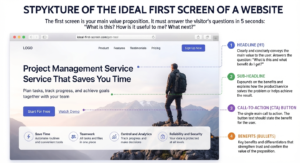
- Offer and first screen according to the 3-second rule. A clear unique selling proposition (USP) + product background video or high-quality photo + a clear call-to-action button.
- Trust blocks. Text reviews like “Thank you for your work, Ivan” no longer work. Trust is built through: digital case studies (before/after/results), GOST/ISO certificates, real photographs of the production facility, and photos of top management.
- Microconversions and the right CTAs. In B2B, the “Buy” or “Order” button is often intimidating—it’s too high a barrier to entry. Conversions will be higher if you offer intermediate, safe steps: “Download the catalog in PDF,” “Get a quote,” or “Schedule a demo.”
- A well-designed catalog and filtering system. If you have a complex product, integrate pricing calculators, a feature comparison feature, and cross-sell blocks (related products/services) into your website.
- Integration with business processes. A website shouldn’t exist in a vacuum. During the website development stage, we always include integration with CRM systems (Bitrix24, amoCRM), end-to-end analytics services (Roistat), and messaging apps. No request should get lost.
Why design is only 20% of the job
Many clients are surprised why a high-quality website can’t be inexpensive and completed in a couple of weeks. The secret is that creating mockups and writing code is just the tip of the iceberg.
What does the correct website creation process look like:
- Pre-project analytics. We start not with design, but with a briefing. We analyze the top 10 competitors, compile a semantic core, and interview your sales team to identify real customer pain points and objections.
- Prototyping. The logic and user journey (Customer Journey Map) are designed. At this stage, the conversion process is determined: where the lead capture form will be located, how the user will navigate from the blog to the catalog.
- UI design. Visually packaging meanings into a modern corporate identity that will set you apart from the competition.
- Programming and platform selection. For large businesses, we recommend building a website using Bitrix or custom frameworks (Laravel, Django). This ensures corporate data security, resilience to high loads, and independence from Western cloud builders.
- Basic SEO optimization at the start. The biggest mistake is creating a website and then hiring an SEO specialist. We make the resource SEO-friendly from the design stage so that after launch, it immediately starts indexing and attracting organic traffic from Yandex and Google.
Conclusion
In 2026, a corporate website will be a business’s most important digital asset. Investments in deep analytics, thoughtful UX design, and robust development will pay off many times over through a steady flow of leads and reduced advertising costs.
About the Author