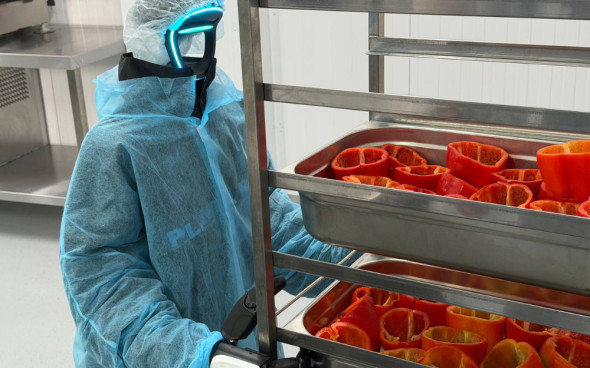
The main driver is no longer generative AI per se, but Physical AI – artificial intelligence capable of interacting with the physical world.
Just a year ago, it seemed that the development of large-scale language models would be the main issue on the technological agenda. ChatGPT, Claude, Gemini, and other systems have demonstrated that artificial intelligence can write texts, program, analyze documents, and perform many intellectual tasks faster than humans. But what will we see in 2026? The world’s leading think tanks— Boston Consulting Group, McKinsey, and Silicon Valley Bank —are talking about the next stage of the technological revolution. The main driver is no longer generative AI per se, but Physical AI* —artificial intelligence capable of interacting with the physical world.
We are facing a situation where the global economy is beginning to shift toward a fundamentally new model. Generative AI has automated information processing, while Physical AI, in turn, aims to automate material production, logistics, transportation, energy, construction, and the entire industrial infrastructure. We present the key insights and conclusions of extensive analytical studies.
From digital to physical intelligence
The first three years of widespread artificial intelligence development focused on the digital environment. Millions of users used neural networks for writing texts, creating images, programming, and searching for information. Companies deployed chatbots and AI assistants, increasing the productivity of office workers, but digital intelligence has a natural limit. The majority of global GDP is generated not in offices, but in the real economy: in factories, warehouses, transportation companies, construction, healthcare, and agriculture. This is why major studies in recent months have increasingly considered artificial intelligence as the foundation for automating physical processes, not just intellectual labor.
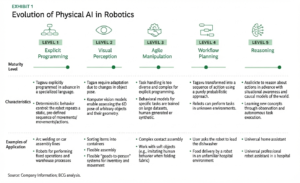
In its study, BCG emphasizes that modern robots are beginning to acquire the ability to operate not only according to predetermined scenarios but also to adapt to new conditions, recognize unfamiliar objects, and make decisions in a changing environment. It is this ability to generalize that distinguishes the new generation of Physical AI from traditional industrial automation.
From AI assistants to AI agents and their symbiosis with humans
The next stage of artificial intelligence development is associated with the emergence of autonomous systems capable of independently planning action sequences, interacting with corporate applications, and executing work processes with virtually no human intervention. The study cites collaboration between humans and AI agents as the key organizational trend for the coming years. We’ve all seen how generative AI has changed the way we work with information, and AI agents are beginning to change the very organization of work.
The BCG study notes that the next step will be transferring these intellectual capabilities to the physical world. In this case, the agent ceases to be a program and becomes the “brain” of a robot, industrial installation, or autonomous machine, capable of perceiving and acting within its environment.
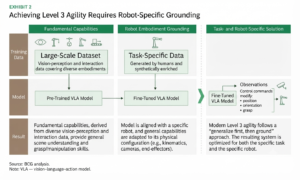
In addition to the three studies mentioned above, two major analytical reports are worth paying attention to: Agents, Robots and Us: Skill Partnerships in the Age of AI (2025) from McKinsey Global Institute and The Symbiotic Enterprise (2026) from QuantumBlack by McKinsey.
The underlying idea is that artificial intelligence is not so much replacing people as changing the structure of the work process, creating a fundamentally new model of collaboration— humans, AI agents, and robots —which is called Symbiotic Enterprise.
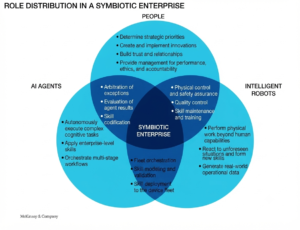
Up to 57% of work time can be technically automated today, but this isn’t a prediction of job losses, as jobs are transformed faster than they disappear entirely. The fundamental unit of an organization is gradually becoming not the individual, but the workflow, which includes not only employees but also AI agents, data sets, automation, and business rules.
Another important conclusion reached by the study’s authors is that most professions in the future will become hybrid, but at the same time, most human skills will remain in demand. Almost every profession consists of:
- tasks that can be 100% automated,
- tasks that require only a human to perform;
- tasks that can be completed together.
Around 72% of skills are used simultaneously in both automated and non-automated work. It’s not so much the skill set that’s changing, but the way they’re implemented. Digital skills, such as accounting, document management, data analytics, information processing, and others, are changing most rapidly. Meanwhile, negotiation skills, leadership, creativity, empathy in social settings, and others remain the preserve of humans.
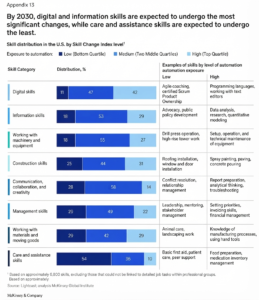
At the same time, artificial intelligence is no longer a tool but a full-fledged participant in a company’s operations —that is, it’s becoming a fully-fledged workforce. Whereas previously it merely helped with task execution, it is now capable of planning, making basic decisions, coordinating processes, and even performing entire business functions. And according to McKinsey, a company’s biggest mistake could be automating individual tasks rather than completely redesigning processes.
McKinsey cites AI fluency as the fastest-growing skill, noting a nearly sevenfold increase in demand for the ability to effectively work with AI in just two years. AI fluency refers to the ability to correctly define AI tasks, evaluate results, integrate AI into workflows, and manage collaboration between humans and AI agents. Consequently, the primary source of productivity growth and maximum value is no longer AI per se, but rather companies’ willingness to redesign processes, redistribute roles, shift responsibilities, and design new ways of working.
Researchers predict that by 2030, AI could create up to $2.9 trillion in additional value in the US alone, subject to widespread adoption, employee training, and organizational model changes. Companies that quickly learn how to design collaborative work between humans and AI, redesign processes, train employees, deploy AI agents, and create hybrid teams will emerge as leaders.
Why now?
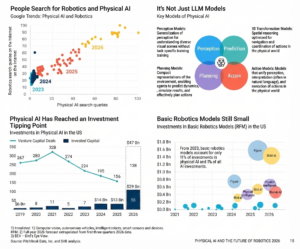
Interestingly, three studies almost independently reach the same conclusion. Generative AI turned out to be not the end goal, but the foundation for the next stage of technological development. Computer vision, as implemented by IT Imperial in hospital food production, has learned to understand the environment, and new planning algorithms allow for the construction of action sequences. The development of specialized AI chips makes it possible to perform complex calculations directly within robots, without constantly accessing the cloud. All these technologies emerged almost simultaneously, resulting in artificial intelligence, for the first time, being able not only to analyze information but also to perform real physical actions based on it.
Change of investment object
During the first wave of the AI boom, the main beneficiaries were model developers and cloud infrastructure developers. Now we see a rapidly shifting investment focus. For example, research by Silicon Valley Bank indicates that venture capital investments in hardware** companies in the US could reach a record $120 billion as early as 2026. At the same time, nearly a quarter of global venture capital funds are already investing a significant portion of their capital in hardware technologies.
Just a few years ago, such a dynamic seemed impossible. Following the mobile app boom, the market for decades considered software a significantly more attractive direction than hardware development. Now the situation has almost completely reversed. Artificial intelligence has unexpectedly revived interest in hardware. And the reason is quite simple: for AI to function in the real world, it requires cameras, lidars, sensors, actuators, batteries, new processors, specialized memory, energy infrastructure, and a huge number of engineering solutions. This creates a paradoxical situation where the most valuable assets of the new AI economy are not models, but infrastructure.
It’s not algorithms that are in short supply, but computations.
Another unexpected finding from the SVB study is that algorithms aren’t the main constraint on AI development. Today, the deficit is driven by:
- high-speed memory HBM,
- data center capacity,
- electricity,
- modern semiconductors,
- chip packaging production facilities,
- global supply chains.
The study’s authors note that the four largest manufacturers consume over 90% of the world’s HBM memory capacity, while the turnaround times for new data center energy projects continue to increase. This suggests that the next competition will no longer be between language models, but between infrastructure ecosystems.
AI is effectively becoming a new industry. When people talk about physical AI, most people think of humanoid robots, but robots are just the tip of the iceberg. Research shows that humanoids aren’t the fastest-growing market; warehouses will be the main market. Their logistics combine several factors that will facilitate the rapid adoption of physical AI: chronic staff shortages, high cost of errors, standardized processes, and clear implementation economics.
Currently, a study by Silicon Valley Bank and Prologis shows that approximately 83% of warehouse companies are not yet using automation at all, meaning the market is in its infancy. At the same time, company executives are significantly more optimistic about the prospects for automation than they were a year ago. Mass adoption remains constrained by project costs, integration complexities, and the need for return on investment. This is where the line between today’s hype and the real economy lies. Companies are and will continue to buy not just robots, but performance, reliability, and cost savings.
What is changing within companies?
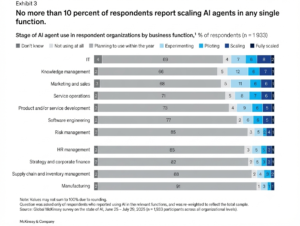
While BCG and SVB’s research focuses primarily on technology and infrastructure, McKinsey examines the organizational implications of the new wave of artificial intelligence. The report’s key conclusion is that AI is ceasing to be a standalone digital tool and becoming a new business operating model. Companies are beginning to restructure processes around AI, rethinking the roles of middle management, changing approaches to knowledge management, and establishing new employee competency requirements. In other words, it’s not just the technology that is changing; the very organization of work is changing. Therefore, in the coming years, competition will no longer be between individual AI products, but between companies that have managed to adapt their processes to the new reality faster than others.
What does this mean for IT companies?
What’s more, a fundamentally new era is dawning for technology businesses. While in 2023–2025, most projects revolved around the implementation of generative models, enterprise chatbots, and AI assistants, demand is now gradually shifting toward solutions that integrate digital intelligence with physical processes. This means growth in the markets for computer vision, edge AI***, digital twins, robotic systems, intelligent industrial automation, AI agents for manufacturing process management, and platforms for integrating artificial intelligence with ERP (enterprise resource planning), MES (manufacturing execution system), WMS (warehouse management system), and industrial equipment. For IT companies, this opens up a significantly larger market than the development of standalone AI solutions.
The history of artificial intelligence has already changed our understanding of how intellectual labor is created and what it costs. Today, a second, no less important stage of this transformation is underway. Artificial intelligence is gradually moving beyond computer screens and beginning to engage with the material world. This is why three independent studies converge on one fundamental conclusion: the next wave of competition will no longer be determined by the quality of language models per se, but by the ability to connect digital intelligence with the physical infrastructure of the economy. This is why Physical AI is one of the key development areas for IT Imperial. If generative AI revolutionized information processing, then Physical AI could revolutionize manufacturing, logistics, and industry. And it is this transformation that will likely become the main technological story of the second half of the decade.
About the Author