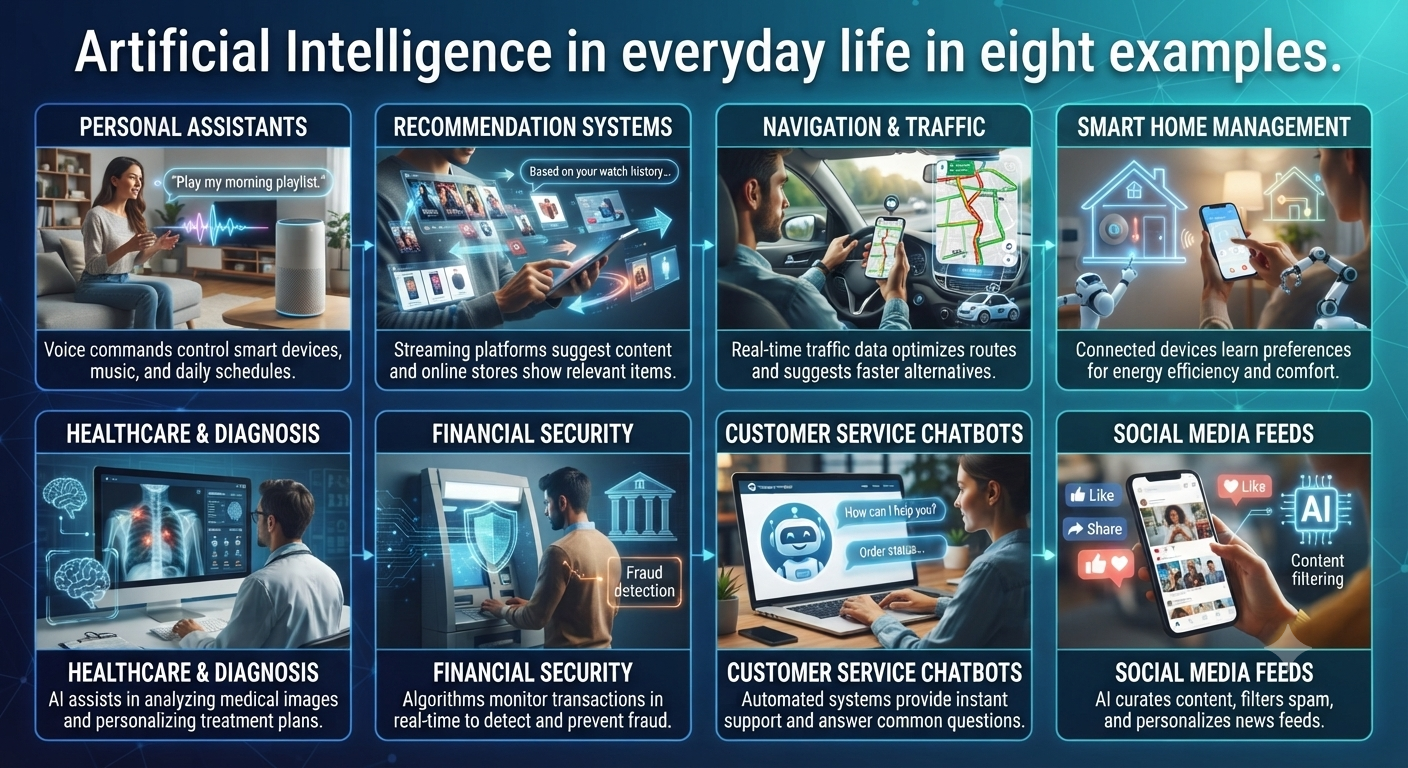
Artificial Intelligence in everyday life: eight examples.
While until recently it was seen as a vision of the future, today we have several examples of the application of Artificial Intelligence in our daily lives, showing that this technology has become much more popular and easier to use.
We’ve selected eight examples of how Artificial Intelligence is already impacting our lives.
Eight examples of how Artificial Intelligence can be applied in everyday life.
1. AI on the Internet
When we think about Artificial Intelligence, perhaps what first comes to mind are those machines that can simulate the human ability to think and perform autonomous tasks, such as building a car almost on their own.
But Artificial Intelligence is much closer to us than these machines. It’s present in the apps on your cell phone, your Smart TV, or Alexa devices connected to the internet, and also on your computer when you access a search engine.
Recommendation algorithms and relevance
In today’s world, we are all surrounded by Artificial Intelligence that enhances our consumption patterns through recommendation algorithms when we visit an e-commerce website, for example. This is without even mentioning relevance algorithms, which permeate all our browsing on social media and today represent the springboard for transforming teenagers into digital celebrities.
Google offers a variety of resources based on machine learning and Artificial Intelligence. The main one, its search engine, uses natural language processing and includes GoogleBot, a robot that crawls the entire web in search of the best search results.
On smartphones, Google is present through its virtual assistants that “talk” to users and even make calls and interact with contacts. Also on your phone, Google’s Artificial Intelligence categorizes photos through facial recognition.
A new Google Lens feature lets you find the same pattern on another piece of clothing from a photo of a shirt, for example. And after revolutionizing our commutes with Google Maps, the company launched Google Trip. This feature helps you create an itinerary for your next trip, organizing destinations, favorite places, and even making necessary reservations.
Amazon
Amazon is able to analyze your digital behavior to make purchase recommendations. Its product recommendation system is based on e-commerce Artificial Intelligence and is internally called an “item-based collaborative filter.” Imagine watching a superhero movie on Prime – the company’s streaming service – and receiving an offer for the character’s t-shirt on the same day via email?
In addition to knowing a great deal about consumer habits, on the other end – the logistics end – Amazon intends to use cameras to monitor its delivery drivers while they are driving. The system is capable of filming and providing analyses based on Artificial Intelligence and notifying, for example, when the driver is distracted at the wheel.
Personal assistants and smart homes
Companies like Amazon and Google are also riding the wave of AI-powered personal assistants and smart homes, with products that have shattered the myth that automating a property is expensive.
Beyond the smart light bulbs that are a hit in USA homes, technology is also increasingly seen in household appliances, starting with Smart TVs with Artificial Intelligence. They already answer questions from users and can become central hubs for smart homes, performing tasks, creating routines, or even shopping. But other activities are becoming increasingly common in the daily lives of US residents, such as turning on the air conditioning, controlling the refrigerator temperature, or configuring the washing/drying machine cycle, all remotely.
Amazon Alexa
It’s not new that large technology companies, such as Google, Apple, and Microsoft, have been investing heavily in solutions with intelligent personal assistants. Alexa’s Artificial Intelligence, Amazon’s virtual assistant, works through machine learning and can set alarms, provide weather forecasts, or play a playlist.
Furthermore, Alexa is compatible with many apps, such as Spotify, Uber, Samsung SmartThings, and even iFood, and can interact with home appliances, remote controls, and light switches. Best of all, over time, the Artificial Intelligence of Amazon’s virtual assistant has been able to adapt perfectly to the tastes of Brazilians.
Google Assistant
Another virtual assistant that has become popular among Brazilians is Google Assistant. With it, users can find the information they need and organize their lives quickly and easily, using only their voice.
Google Assistant’s Artificial Intelligence allows integration with various applications, resulting in over 1 million actions that can be performed by people all over the world. Local partnerships allow Brazilian users to listen to news from CBN, Jovem Pan, and Rádio Globo, watch the Globoplay catalog, reserve a table at Restorando, or call a car through 99 Táxi, among many other possibilities.
Spam and inappropriate content filters
Google is also betting on its machine learning framework to block spam messages that arrive in its users’ Gmail accounts. In this case, Artificial Intelligence has been applied to “train” additional spam filters in the email service. According to the company, the technology is able to block more than 100 million spam messages every day.
Along the same lines, Facebook and YouTube use Artificial Intelligence to moderate content that violates company guidelines or to restrict content by age. Posts that do not comply with the rules are detected automatically and, in some cases, are deleted, and the authors’ accounts are blocked.
2. AI in communication and marketing
In communication and marketing, Artificial Intelligence allows for the analysis of consumer behavior through browsing data on social networks or websites. This helps companies improve their recommendation and sales systems.
Another good example of this approach is the increasingly frequent use of chatbots in customer interaction. Relying on machine learning, bots interact with people by simulating natural human language and, as they are used, increasingly personalize the user experience with the application.
One of the biggest examples of the use of Artificial Intelligence in digital marketing strategies is ad optimization. On Google or Facebook, the technology helps in audience segmentation, directing a campaign to its most assertive and qualified target audience to considerably increase conversion rates.
However, in contrast to all these advances, Artificial Intelligence has been used to spread deepfakes – videos that, despite being fake, are quite realistic. Generally, deepfakes are images that show someone performing actions they never did or saying things that don’t match their nature.
3. AI in big data analytics and autonomous cars
In addition to major international automakers, giants like Apple, Google, and Tesla believe that vehicle automation will have a positive impact on road safety and reduce fuel consumption.
However, autonomous cars operate without a human driver – a rather controversial concept. To ensure safety, they are equipped with high-precision sensors capable of detecting even the slightest disturbances and knowing, for example, thanks to artificial intelligence capabilities in cars, when the brakes will need to be applied.
Big data analysis and the use of Artificial Intelligence in autonomous vehicles will allow integration with municipal, state, or federal networks to generate data about the environment and local roads, and to monitor congestion, accidents, or hazards along the route, for example.
4. AI in the metaverse
Much has been said about the advent of the metaverse – a permanent network of 3D worlds, rendered in real time, that can be experienced synchronously by an unlimited number of users interacting with each other through avatars, each with an individual presence and experience.
Riding this wave, Facebook has already announced that the experiences being built for its celebrated metaverse will require enormous computing power (quintillions of operations per second) and that its “AI Research SuperCluster” supercomputer – the RSC – will enable new Artificial Intelligence models that can learn from trillions of examples and understand hundreds of languages, for example.
5. AI in education and learning
The use of Artificial Intelligence in education allows a student to study anywhere in the world, at any time, and with much greater efficiency, as content is made available according to individual needs. Thanks to this individualized experience, the student can ask questions, have the autonomy to review content, and be evaluated according to their own performance.
In a rather original way, the use of Artificial Intelligence in learning relies on attractive resources such as augmented reality, cloud computing, and gamification.
With AI resources applied to education, it’s possible to identify the subjects in which a student has the most difficulty, allowing the teacher to provide more effective and planned support.
6. AI in medicine and healthcare
Artificial intelligence in medicine relies on computers that analyze large volumes of data and, following algorithms, are able to propose solutions to medical problems with speed and accuracy.
The benefits of applying Artificial Intelligence in medicine have impacted the routines of healthcare professionals and patients, who now have access to previously unimaginable solutions, such as interoperability or surgeries performed by robots without direct interaction from the doctor – who is only responsible for supervising the procedure.
And during the pandemic, Artificial Intelligence in healthcare has been helping healthcare professionals thanks to its high capacity for data analysis and processing, diagnosing, treating, and containing the spread of Covid-19.
7. AI in the field of law
The revolution that Artificial Intelligence has brought to the field of law is already evident, whether in services that automate legal activities or in its role in exercising a “regulatory” and ethical function in cases.
Thanks to its powerful data processing capabilities, Artificial Intelligence in the legal field is already allowing more individuals to access justice, reducing the time and cost of litigation.
And for lawyers, the application of AI allows them to obtain the help and speed of processing from machines, which in turn can make decisions autonomously, without the need for human intervention.
8. AI in businesses and industry
Artificial intelligence in companies has proven to be quite efficient in proactively creating and processing data and increasing their operating profits. Supported by the agile processing of large volumes of data, companies become better able to understand market changes and offer new products and services.
With the revolution brought about by Artificial Intelligence in the job market, companies are able to select professionals suited to available opportunities, increasing the quality of recruitment.
And the use of AI technology in industry allows a machine to learn and reproduce a human task, preventing workers from experiencing situations with the risk of accidents.
About the Author