In 1998, two young students who had created an efficient internet search engine approached several powerful companies, hoping to find one that would buy their project and take it over. However, they were all rejected, with the argument that they didn’t need another search engine. Unable to sell, they ventured to start their own company in a garage to continue developing the project. Twenty years later, that company had become one of the most innovative, powerful, and revolutionary in the world, having outperformed all the companies that had rejected them. How did they do it?
How did Google become one of the most powerful and revolutionary companies in the world?
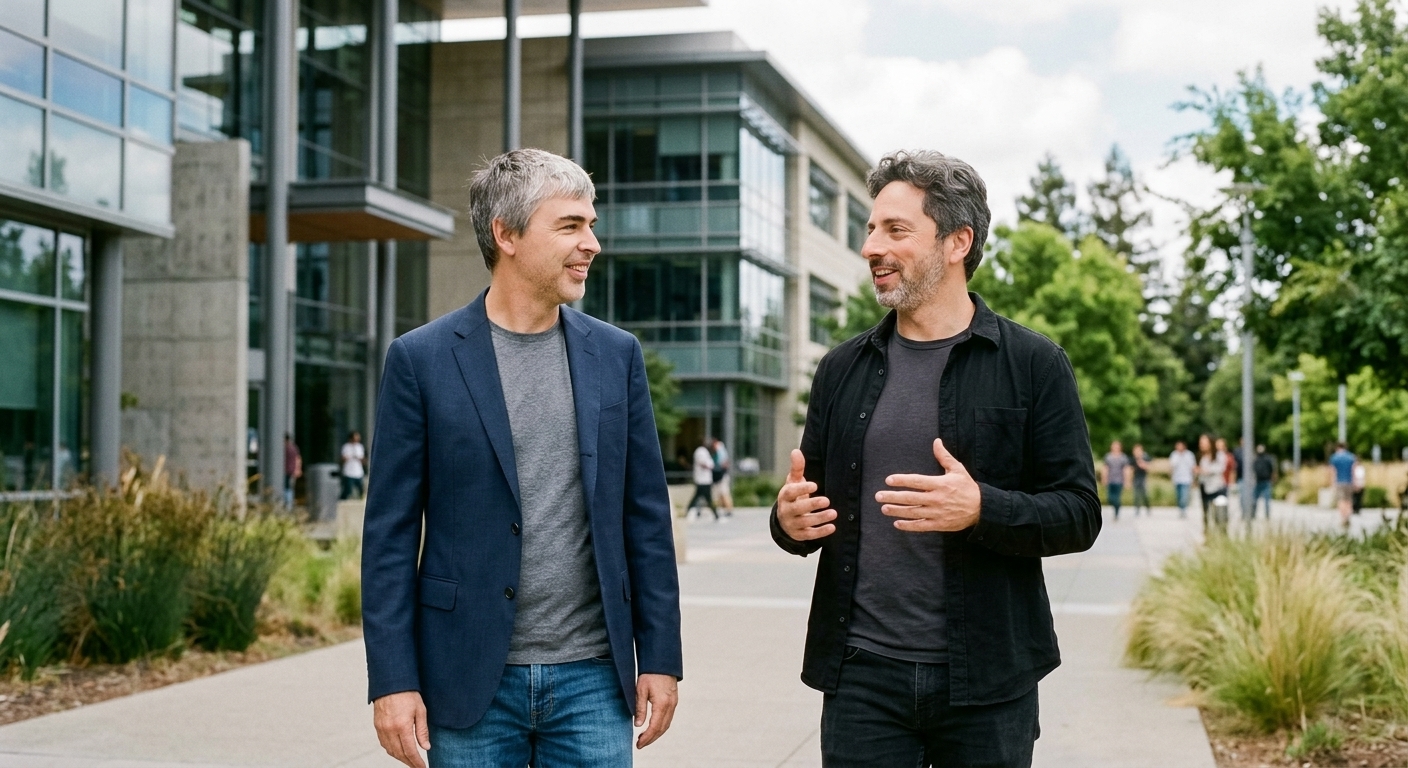
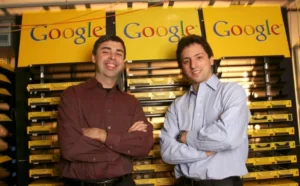
The protagonists of this story are Lawrence Edward Page, better known as Larry Page, and Sergey Mikhailovich Brin, better known as SSergeyBrin.
Larry Page was born on March 26, 973, in Michigan, USA. His parents, Gloria Page and Carl Page, both university professors, instilled in him a great passion for knowledge and computing from a young age. By the age of 12, he was already creating his own inventions, inspired by his idol Nikola Tesla.
After completing his basic studies, he enrolled in the Computer Systems Engineering program at the University of Michigan, where he graduated with honors in 1993.
On the other hand, Sergey Brin was born on August 10, 1973, in Moscow, then the capital of the Soviet Union. His parents, Yevgenia Brin, a researcher, and Mikhail Brin, a mathematics professor, were great role models for him, encouraging him to learn programming, science, and mathematics from a very young age.
When the boy was just six years old, his family was forced to leave the Soviet Union because, as Jews, they suffered constant persecution and their chances of advancement were very limited. In search of better opportunities, they decided to emigrate to the United States.
During his high school years, Sergei developed software that allowed him to compose various styles of music, thus showing his great talent for computing.
After completing his basic studies, he enrolled in the Mathematics and Computer Science program at the University of Maryland, where he also graduated with honors in 1993.
The origins of Google
The two boys met at Stanford University while pursuing graduate studies in computer science. They first met during an orientation session for new students. According to both of them, they didn’t get along very well at first; in fact, each perceived the other as an unpleasant person.
Although the relationship did not start on the right foot, they gradually developed a friendship based on their shared passion for computing.
When it came time to present his thesis, Larry Page had several projects in mind, including one on telepresence and another on autonomous cars; however, he finally decided to “investigate the mathematical properties of the World Wide Web, understanding its link structure and how to proceed with the crawling of the latter”.
At that time, the internet had evolved from a technology useful only to a few academics, researchers, and scientists into a powerful tool with immense social and economic potential, thanks to the development of browsers like Mosaic, Navigator, and Internet Explorer, and the creation of search engines such as Wandex, Aliweb, WebCrawler, Lycos, Yahoo !, Excite, Infoseek, and AltaVista These tools made the information available on the web accessible to ordinary people, thus paving the way for one of the most significant revolutions in human history.
Although early search engines fulfilled their basic function, they weren’t very effective. They relied simply on categorical or keyword searches, but lacked defined criteria for providing users with the most relevant results. For example, if a user entered the word “Flowers,” they would get a list of all sites containing that word, potentially spending hours trying to find the site with the precise information they needed. As the number of websites and content on the web increased, the process of finding relevant information became even more cumbersome.
In this context, Larry Page believed he could use mathematics to create a better internet search experience. He viewed the web as a constant popularity contest, where links between web pages acted as votes to determine a site’s relevance. For example, if page A included a link to page B, that link would grant page B a certain level of relevance. Based on this premise, the most useful and relevant sites were those with the most backlinks or incoming links.
Excited by the enormous possibilities offered by this simple concept, he immediately began working on it in his thesis. Eventually, Sergey Brin joined the project to contribute his knowledge and skills in mathematics.
After months of research, they decided to go a step further and set out to develop a web search algorithm that would work on the principle of giving more relevance to the most linked sites. This algorithm would later be known as “PageRank” and would be patented.
By 1996, they had already managed to build the first version of their search engine, which they called“BackRub,” referring to “Backlinks”, which were the key element of their algorithm.
From the first tests, this search engine proved to be superior to any other search engine that was already available on the market.
During the following months, they continued working on improving the search engine, focusing on optimizing the way the algorithm crawled and interpreted backlinks on the web.
The first versions of the search engine ran from servers at Stanford University, which they built themselves using discarded computers. Since they needed a lot of storage space and the largest hard drives available were only 4GB, they ingeniously constructed a 10-disk drive out of Lego bricks. This allowed them to save costs in the early stages of the project. That Lego drive is still preserved at the university today as a memorial.

In 199, the boys thought they should find a better name for their search engine, one that represented the mission that was guiding them, so they met in their assigned office at the university and brainstormed.
Several names were mentioned at that meeting, but it was Sean Anderson, a fellow student and office colleague, who would catch the attention of Larry Page and SergeyBrin …
Anderson said “Googolplex,” the name used to refer to the number 10 raised to the power of 10 raised to the power of 100(10^(10^100)). Upon hearing the word, Larry Page responded, “Googol,” the name used to refer to the number 0 raised to the power of 100 (10^100).
As a curious act, the number Googol is so large that it exceeds the number of atoms that exist in the universe, so that word represented very well his ambition to build a technology capable of organizing and making accessible all the information on the web.
Anderson checked if the domain was available, but accidentally spelled Googol with a “le” ( Google ) at the end instead of “ol” ( Googol ). Page liked it even more that way, so they proceeded to register it. On September 15, 1997, Larry Page and Sergey Brin became the owners of the name “Google.com.” At that moment, they couldn’t even begin to imagine the magnitude of the colossal empire they were about to create.
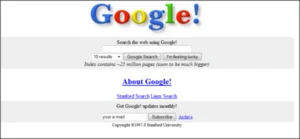
Google’s first demo was published under the domain google.stanford.ed.It was a simple version with a predominantly red logo. The platform allowed users to search within Stanford or the web in general.
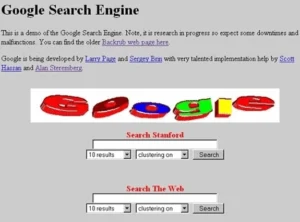
Months later, the first version of Google.com was released, which already included the logo with its final colors and incorporated the iconic “I’m Feeling Lucky” button, which takes the user directly to the top-ranked page for their search. According to some rumors, the logo’s colors were inspired by the Lego bricks used to build that emblematic server in its early days.
From university project to multi-million dollar company
As Google improved its search algorithm, more and more users used and recommended the service, which led to Stanford‘s servers crashing. Faced with this situation, university administrators had no choice but to ask the students to migrate their project to other servers.
The solution seemed simple, but it wasn’t. Due to the high volume of users they were handling at the time, acquiring servers that could support the project would be prohibitively expensive. Their only options were to find investors willing to fund them or to find a large company that believed in the potential of their technology and buy it. They hadn’t planned to create a company or dedicate themselves fully to Google; they simply wanted to continue their research and ensure their search engine was in good hands so it could become useful to the world.
Confident in the superiority of their algorithm, they began knocking on doors; however, most of the investors they visited responded that there were already enough search engines and that they were not interested in investing in another one.
One of the few investors who showed interest, Vinod Khosla, who already had a stake in the search company Excite, recognized that Google did indeed have something special, so he arranged a meeting for his partners to meet Larry Page and Sergey Brin. His idea was for Excite to buy or license Google’s search technology and integrate it into its platform, thus gaining an advantage in competing against Yahoo !, which was already positioning itself as the industry leader.
The meeting did take place, but Excite‘s executives were quite rigid and skeptical. They believed their technology was as good as Google‘s and saw no need to buy another search engine, so they withdrew.
Despite the rejection, the guys from Google kept trying and went to each of the existing search companies to offer them their technology for $1 million, but they were all turned down.
At that time, search engines had become large portals offering multiple services, such as email, chat rooms, and news services, so search itself had become secondary. The main business was not to offer a relevant search experience, but to entertain the user so they would stay on the site as long as possible. This explains why companies showed absolutely no interest in Google.
Time passed, and Larry Page and Sergey Brin’s options dwindled. Everything pointed to the project’s doom. One of the last alternatives they considered was seeking support from one of their professors, David Cheriton, who had made some money creating a company that was eventually acquired by Cisco.
Fortunately, David showed interest and connected them with Andy Bechtolsheim, co-founder of Sun Microsystems and renowned Silicon Valley investor with whom he maintained contact through his business activities.
The students met with the investor at their teacher’s house. There, they showed him their search engine and explained the basics of their technology.
Bechtolsheim was fascinated by the project. He considered it one of the best ideas he had ever seen, so he took out his checkbook and immediately wrote them a check for $100,000; however, he made the check payable to Google. Since Larry Page and Sergey Brin didn’t have an incorporated company, they explained the situation to Bechtolsheim, who replied that they should create one to receive the money.
With no other option, on September 4, 1998, they officially incorporated Google Inc. and were able to cash the check. With that money, they hired their first employee, Craig Silverstein, and built an office in a garage on the outskirts of Menlo Park, California. The garage belonged to Susan Wojcicki, who would later join the Google team as its 16th employee and contribute to the development of various products.

Thanks to Bechtolsheim’s support, other investors soon joined, contributing a total of $1 million, enough capital to guarantee a few more months of survival.
In 1999, Google received a major investment of $25 million from Sequoia Capital and Kleiner Perkins, two prestigious venture capital firms that had already invested in companies such as Atari, Cisco, Apple, Amazon, Compaq, and Yahoo !, among others.
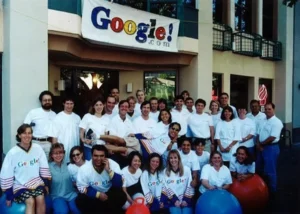
All the money raised was invested in developing the search engine, hiring talent, and improving the infrastructure to handle the growing traffic. They also moved to larger offices in Mountain View, California. In a short time, Google went from being a project of two young university students to becoming a multi-million dollar company with hundreds of employees. Many of the first employees didn’t receive a salary commensurate with their work, since the company had no operating income. To compensate, management offered them stock options and other financial benefits.
In search of a profitable business model
As site traffic increased, project maintenance costs rose, and available resources were depleted more quickly.
Google was a very good search engine, but it wasn’t profitable, and that worried investors. If they didn’t find a way to start making money, they would again run out of resources to continue.
The obvious and easy solution to the problem was to sell advertising space, just as Yahoo! and other search engines of the time had done, but they didn’t want to become just another portal where the search experience took a back seat.
After much deliberation and analysis of various alternatives, they found a possible solution in another company…
Bill Gross, founder of Idealab, an incubator for innovative ideas, was aware of the difficulties search engines faced in building a profitable business model that did not sacrifice the user experience, so he decided to use his ingenuity to tackle the problem.
Gross quickly understood that the core of the problem lay in the fact that online ads were irrelevant. Websites were saturated with advertising that only interfered with the user experience, without adding any value. Furthermore, he believed that search engines were squandering the enormous potential of keywords, since through them users essentially expressed what they wanted, their intentions, and their needs—something of immense value in the world of advertising.
Based on these premises, and taking inspiration from the workings of the Yellow Pages, he designed an advertising system that connected keywords with relevant advertising. For example, if a user searched for the word “Flowers,” they might be interested in buying flowers; therefore, it would be reasonable for companies that sell flowers to pay to appear in that specific search.
Gross envisioned a future where search engine keywords would be a marketplace where companies competed for top placement. Although his colleagues told him it was a crazy idea, he decided to bring it to life. Thus, GoTo was born, eventually becoming Overture, a search engine where companies could pay to appear in the results for specific keywords. It was like a kind of Yellow Pages, but with the benefits of digitalization.
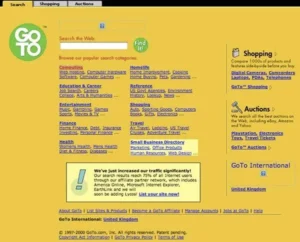
GoTo pioneered the Pay-Per-Click (PPC) advertising model. The system operated like an auction, with advertisers bidding to appear at the top of search results for their target keywords. When a user performed a search, they received a list of sponsored links as a result. The advertiser only paid if the user clicked on a link to their website.
The system proved to be a complete success and began to grow rapidly. When the founders of Google learned about it, they thought they could implement it in their search engine to start generating revenue, so they contacted Bill Gross to negotiate.
Although they met on several occasions and both parties were fully willing to collaborate, it was not really possible to reach an agreement.
Google, needing to become profitable as soon as possible, decided to simply copy Overture and launched a keyword-based advertising system in 2000 called Google AdWords.
Bill Gross didn’t take this lying down and filed a lawsuit against Google, but he eventually reached an out-of-court settlement and withdrew the suit. The details of the settlement are unknown, but it’s presumed that Bill Gross received millions of dollars’ worth of Google stock.
Among the improvements Google implemented to Overture‘s advertising system, the most notable was the separation of organic results from paid ads, which allowed them to continue offering a pleasant and effective search experience to users. Furthermore, they added parameters so that not only the advertiser’s budget but also the quality of the ad was taken into account; this forced companies to strive to optimize their ads if they wanted to achieve better results than their competitors.
By that time, Larry Page and Sergey Brin‘s company was already the undisputed leader in the online search industry, with over 1.3 billion indexed URLs and more than 150 million daily searches. Even Yahoo !, its main rival, succumbed to Google‘s superiority and ended up subscribing to its technology to provide search on its platform… And to think that, just a few years earlier, Yahoo! could have bought Google outright for only $1 million, but they didn’t see the opportunity clearly enough in time.
In 2001, engineer Eric Schmidt became CEO of Google, due to pressure from investors who felt it was best to put an experienced executive in charge. With Eric Schmidt at the helm, Larry Page assumed the role of President of Product and Sergey Brin that of President of Technology.
In 2002, Yahoo! attempted to acquire Google. Terry Semel, the company’s CEO at the time, offered $3 billion, but Larry Page and Sergey Brin countered that the company was worth at least $5 billion. Although Yahoo! could have paid that amount, Semel refused, arguing that it was too high a figure for a company with annual revenues of only around $240 million. Once again, Yahoo! focused only on what Google was and not on what it could become, and thus missed the opportunity. Instead of acquiring Google, they purchased another search company called Inktomi for approximately $235 million.
Google’s growth and consolidation in the digital industry
During the following years, Google, in addition to continuing to develop its search engine technology, launched new features and services, such as Google Images an image search engine; Google Directory, a directory of sites organized by categories; Google News, a news portal; Google Shopping, a price comparison tool; Google Translate, a translation tool between different languages; Google Groups, a system for creating discussion groups; and Gmail, an email service. It also acquired Pyra Labs, owner of Blogger, a very popular blogging service; Picasa, a company focused on digital photography management; and Applied Semantics, owner of AdSense, a system for monetizing digital content that would eventually represent approximately 22% of Google’s advertising revenue and allow small creators to earn money from their content.
One of the people behind these innovations was Paul Buchheit, the company’s 23rd employee. He was responsible for developing Gmail and helped improve AdSense technology. He is also credited with creating the iconic slogan “Don’t be evil,” which for years represented the organization’s philosophy.
Much of the company’s success in innovation has stemmed from its disruptive workplace policies. For example, the organization allowed its employees to dedicate 20% of their work time to personal projects, which became a major source of creativity. Employees also enjoy flexible schedules, are allowed to bring their pets to the office, and have access to game rooms, break areas, a restaurant, a childcare center, and more. All of these policies have led to Google being recognized on several occasions as one of the best companies to work for in the world.
With the company’s rapid growth, they needed to move to much larger offices. This time they leased a building complex, also located in Mountain View, California, which they named “Googleplex .” Years later, they would buy the complex for $319 million and settle there permanently; it remains their headquarters to this day.
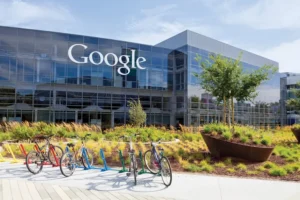
Google had not only become profitable, but had turned into a money-making machine, generating over $960 million in revenue in 2003 and growing faster than companies like eBay and Yahoo !. With these figures, they thought it was the ideal time to go public, so they began preparing their Initial Public Offering (IPO).
Although Google‘s results were promising, going public in 2004 was a huge challenge, given that markets were still recovering from the bursting of the “Dot-com Bubble” in the early 2000s. Thousands of internet companies went bankrupt, causing investor confidence in the digital industry to plummet.
The company filed its application to list on the stock exchange with the proposal to sell shares with an estimated total value of $2.7 billion through an auction method, something that had never been done before in an initial public offering of such proportions.
“When a company is going to go public, it usually does a roadshow, which involves placing a certain number of shares with private investors at a preferential price, but Google chose to go public and let people participate,” explained Cipactli Jiménez , an independent stock market analyst.
This proposal generated all kinds of controversy and aroused the anger of Wall Street bankers, who argued that the auction method would create more volatility in stock prices and exclude large institutional investors, making the initial public offering a total failure.
Various media outlets were filled with articles criticizing Google and predicting what would be one of the biggest stock market crashes. Many of these articles were influenced by powerful forces on Wall Street who benefited from the conventional way of doing business, so it wasn’t in their interest for a company of this magnitude to challenge the system.
After several months of paperwork and dealing with criticism, Google finally made its debut on the NASDAQ stock exchange on August 19, 2004, for $85 per share. By the end of its first day of trading, the shares had reached a value of $100.43 each, bringing the company’s total valuation to $23 billion.
After the initial public offering, Google‘s first employees, who believed in the company and accepted stock and financial options as part of their compensation, became millionaires overnight. One of the most interesting cases is that of Charlie Ayers, a cook who joined the company in 1999. When he was offered the possibility of receiving stock instead of a full salary, he was somewhat skeptical; he even consulted his father, who suggested he not accept because “it was surely a scam .” In the end, he accepted, and time would reward him immensely. Today, his shares are estimated to be worth more than $70 million.
The following years were a period of sustained growth for the company. New services were launched, such as Google Maps , Google Earth , Google Talk , Google Scholar , Google Books , Google Apps , and Google Analytics . They also attempted to enter the nascent social networking industry with a platform called Orkut, but it did not achieve the expected success and was eventually shut down.
An interesting fact is that many of Google‘s services are free. This is because its core business is attracting large numbers of users and gathering as much information as possible from them to use as a basis for improving its services and optimizing the performance of its advertisers’ campaigns. Hence the phrase: “If something is free, you are the product. “
In 2006 one of the biggest deals in internet history was finalized: Google bought YouTube for $1.65 billion This purchase represented the immense power Google had attained, as YouTube was unprofitable and faced all kinds of legal problems due to its content, so it wasn’t a very justifiable decision from a financial point of view; however, Google saw immense potential in the platform and was willing to take whatever risks were necessary.
That same year, Google Docs was launched, a suite of online tools for creating, editing, and sharing documents such as spreadsheets, text documents, presentations, and forms. This platform has become one of the main competitors of Microsoft Office and other office software.
In 2007, Google finalized another of its most important deals: the acquisition of DoubleClick for $3.1 billion. This platform was positioned as a leader in the advertising industry, which is why companies like AOL, Yahoo!, and Microsoft were interested in acquiring it, but ultimately it was Google that succeeded. To this day, DoubleClick remains a key element in the company’s business strategy, enabling it to develop innovative advertising services and provide its technology to millions of customers worldwide.
In September 2008, the Google Chrome browser was launched, which grew rapidly and became the most used worldwide, surpassing Internet Explorer, Safari, and Mozilla Firefox.
Weeks later, Google introduced a mobile operating system called Android, which grew rapidly and became the most used worldwide, surpassing iOS, Windows Phone, BlackBerry OS, and Symbian OS.
In 2010, they entered the mobile device industry with the Nexus One, a smartphone manufactured in partnership with HTC. Later, other versions of phones and tablets in the Nexus line were developed in partnership with manufacturers such as Samsung, LG, Asus, and Motorola.
That year, they also created Google Person Finder, a tool to help locate people in the event of natural disasters, and launched Google Buzz, a new social network integrated with Gmail as an attempt to leverage the user base that regularly used the email service. Unfortunately, this social network was a complete failure and shut down a year later.
On January 20, 2011, it was announced that Larry Page would assume the role of CEO. Although there were some initial doubts about his appointment and Google‘s stock price fell at the close of trading that day, it was only a matter of time before he proved himself truly ready for the position. Eric Schmidt, the previous CEO, remained with the company as an executive, focusing on business, partnerships, and customers.
With Larry Page at the helm, the company attempted another entry into the social networking industry by launching Google+ to compete with platforms like Facebook, Twitter, and LinkedIn, which had experienced exponential growth in recent years. Although Google‘s social network included some interesting features and attracted millions of users within a few months, its usage fell short of expectations, and it was later shut down.
In August 2011, Google bought Motorola for $12.5 billion to bolster its efforts in the mobile industry, but things didn’t go as planned, and a couple of years later they sold the company for $2.91 billion, almost a quarter of what they had paid, although they had previously sold the Motorola Home division for $2.35 billion In any case, this is remembered as another major failure in their history.
In 2012, Google Drive was launched, a cloud file hosting service that entered into competition with Dropbox, iCloud, and Windows Live SkyDrive, and Google Glass was introduced, augmented reality glasses that caused a sensation among technology fans, and that would later be relaunched as Google Glass Enterprise Edition.
In 2013, the company launched a cross-platform messaging service called Google Hangouts and introduced a new line of electronic devices called Google Pixel. This line has since expanded to include laptops, tablets, smartphones, and accessories. That same year, they also announced another major acquisition: the purchase of Waze for $1.1 billion. The goal of this acquisition was twofold: to leverage Waze‘s technology to enhance Google Maps and to provide Google resources to help Waze continue to grow. In 2014, Google My Business was launched, a tool designed to help businesses manage their online presence. It allows businesses to create profiles with addresses, photos, contact information, and customer reviews.
Google expands its reach in the digital industry, and Alphabet is born.
By 2015, Google had already established itself as one of the most powerful companies in the world, with investments in diverse industries, generating over $ 65 billion in annual revenue and a market value exceeding $400 billion. At this point, Larry Page and Sergey Brin decided it was necessary to restructure their organization to consolidate the wide variety of projects they were developing, as they had long since ceased to be just a search engine. With this in mind, they created Alphabet Inc., the parent company that now encompasses Google, its largest subsidiary; Calico, a biotechnology company seeking to extend lifespan; Nest Labs, a company that creates smart home products; Google Fiber an organization that provides high-performance internet services; X Development, a research and development company focused on creating products that make the world a better place; and Google Ventures, a venture capital firm that supports high-potential, early-stage technology projects. And CapitalG, an investment company that focuses on large, growth-stage technology companies.
“Over time, companies tend to get comfortable doing the same thing. But in the technology industry, where revolutionary ideas drive the next areas of great growth, you have to feel a little uncomfortable to remain relevant.” – These were the words of Larry Page and Sergey Brin in a letter at the time of presenting Alphabet .
Under this new structure, Alphabet would guide the overall vision of the business conglomerate, but each subsidiary would have its own CEO to enable decentralized decision-making. Larry Page left his position at Google and became CEO of Alphabet, while Sergey Brin assumed the role of president of Alphabet. Sundar Pichai was appointed as Google‘s new CEO, replacing Larry Page. He joined the company in 2004 and made significant contributions to the development of projects such as Gmail, Google Maps, Google Chrome, Google Drive, and Android.
In the following years, Alphabet continued to exand its reach b creating new ubsidiaries, uch as Sidewalk Labs an organization that aims to improve urban infrastructure through technological solutions; Chronicle Security, a cybersecurity company; DeepMind, an artificial intelligence company; DoubleClick a platform dedicated to developing advertising services; Jigsaw, a technology incubator; Loon LLC a telecommunications project that provides internet access to rural and remote areas using helium balloons; Makani Technologies, dedicated to developing airborne wind energy extraction systems; Verily, an organization that studies the life sciences; Waymo, a manufacturer of autonomous vehicles and Wing, a company dedicated to developing drones. It should be noted that the vast majority of these subsidiaries began as projects or divisions within the organization, but as they grew, they were spun off into independent companies due to their significant potential.
In 2017, Google Meet was launched, a video conferencing platform that was set to compete with Zoom, Skype, Microsoft Teams, and other similar services.
In 2019, after more than 20 years of monumental effort leading one of the most innovative and revolutionary companies of our time, Larry Page and Sergey Brin decided to step down, marking the end of an era. Following their resignations, Sundar Pichai assumed the role of CEO of Alphabet.
“While it has been a great privilege to be deeply involved in the day-to-day management of the company for so long, we believe it is time to assume the role of proud parents: offering advice and love, but not nagging on a daily basis!” – the successful entrepreneurs wrote on their blog upon resigning.
Alphabet is currently considered one of the world’s largest and most powerful business groups, with investments in sectors such as cloud computing, artificial intelligence, robotics, connectivity, education, mobility, geolocation, communications, finance, e-commerce, productivity, virtual reality, home automation, augmented reality, cybersecurity, biotechnology, and advertising, among many others. The organization has over 135,000 employees, generates more than $180 billion in annual revenue, and has a market capitalization of over 1.9 trillion, positioning it as one of the world’s most valuable companies alongside Apple, Saudi Aramco, Microsoft, Amazon, and Facebook.
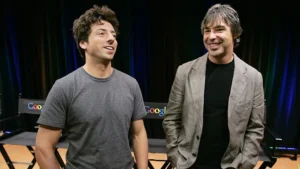
Larry Page and Sergey Brin, both 48, are considered two of the mostimportat entrepreneur in the modern world. Each has a personal fortune of over $100 billion, and they are on Forbes magazine’s list of the world’s richest people alongside Elon Musk, Jef,f Bezos, Bernard Arnault, Bill Gates, Larry Ellison, and Mark Zuckerberg. Although they no longer work actively at Alphabet, they remain on the board of directors and together control more than half of the voting power. Throughout their lives, both have made significant contributions to supporting social causes related to public health, scientific research, and education.
Keys to the success of Google and Alphabet
What are the keys to Google and Alphabet’s success? The company itself published them in an article titled “10 Truths We’re Sure Of .” Here they are:
-
- If you focus on the user, the rest falls into place. All their products and services are designed with the best user experience in mind: “Whenever we develop new tools and applications, we strive to make them work so well that no one wonders if they could have been designed differently,” they state in the publication.
-
- It’s best to focus on one thing and do it very well. Although they’ve created hundreds of services of all kinds, their priority remains organizing the world’s information and making it universally accessible. That hasn’t changed at any point: “Our drive to improve the search experience allows us to apply the concepts we’ve already learned to new products, like Gmail and Google Maps. Our goal is to bring the power of search to unexplored areas and make it easier for users to access vast amounts of information, as well as encourage the use of that information in everyday life. ”
-
- Fast is better than slow. Paradoxically, while most websites aim to keep users on their site for as long as possible, Google focuses on helping them quickly find what they’re looking for: “We know our users’ time is precious, and they want immediate answers to their web searches, and we strive to deliver that. Probably no one else in the world claims their goal is to get users off their website as quickly as possible. Whenever we launch a new product, we think about speed. We’re constantly working to make everything faster and faster ”
-
- Democracy is a good form of governance for the Web. The company has always strived to build its services on the concept of community, so that its own users contribute to improving the experience of other users: “Google Search works because it relies on links posted by millions of users on websites to determine which other sites offer valuable content. Furthermore, we develop open-source software where innovation stems from the collective effort of many programmers. ”
-
- You don’t need to sit at your desk to get an answer. Much of the company’s focus in recent years has been on providing mobile solutions that allow users to access relevant information anytime, anywhere. They understand that technology is meant to empower people by helping them be more efficient in their daily lives: “We are pioneers in developing new technologies and offer mobile solutions that allow users around the world to use their phones for all kinds of tasks, from checking email and calendar events to watching videos, and to access Google Search in various ways through their phones. ”
-
- You can make money without doing evil. The iconic slogan “Don’t be evil” remains part of the organization’s philosophy, only now it has been replaced by “Do the right thing .” In any case, the core principle is the same: avoiding questionable practices to achieve financial goals. “To guarantee comprehensive service to all users (whether advertisers or not), we create principles to guide our advertising programs and practices. Users trust our objectivity, and no short-term gain could justify losing that trust. ”
-
- There is always more information to discover. Complacency is not a word in the company’s DA: “After indexing more HTML pages on the internet than any other search service, our engineers turned their attention to information that wasn’t so readily accessible. We continue to look for ways to provide all the world’s information to people seeking answers ”
-
- The need for information transcends all borders. They have always thought globally, which is why their innovations easily spread to every corner of the planet: “Google was founded in California, but our mission is to make information accessible to everyone, in every language. ”
-
- You don’t need to wear a suit to be professional. From the beginning, the company challenged the traditional rules of the corporate world. Its hierarchical structure was very different from that of other large corporations of the time, and its labor policies made even the most conservative executives tremble: “Our founders created Google with the idea that work should be challenging, and that challenge should be fun. Although the work environment is informal, all the ideas that come up in the cafeteria line, in a team meeting, or at the gym are discussed, analyzed, and implemented at breakneck speed ”
- Excellent isn’t enough. A core principle that has always guided them is creating solutions that drastically exceed user standards. For example, when Gmail launched, it offered 1 GB of storage, which was 10 times more than Yahoo! Mail and far more than other similar services. These kinds of radical innovations are what have allowed them to dominate various markets in the challenging digital world. They also often launch their services in a “Beta” phase, as a way of showing that they are still working to improve them: “We believe that being very good at something is just the starting point, not the goal. We set objectives that we know we can’t yet reach, because we are convinced that the efforts to achieve them can lead us to better-than-expected results. Our constant dissatisfaction with the way things are done becomes the driving force behind all our work. “
Controversies and failures in Google’s history
But it hasn’t all been smooth sailing for this mega-company. On several occasions, it has been embroiled in controversies related to copyright claims, violations of user privacy, and the execution of monopolistic practices. Some of these controversies even resulted in sanctions and fines for the company, but its vast economic power and influence have allowed it to remain afloat without difficulty. Perhaps the case that worries it most is the lawsuit filed by the United States Department of Justice for “allegedly abusing its dominant position to preserve a monopoly in online search and advertising .” The government seeks to dismantle the company to end its dominant position, similar to what happened in 1911 with John D. Rockefeller‘s Standard Oil Company. Other companies that have faced similar charges in recent history include Microsoft and Facebook. In its defense, Alphabet has argued that “People use Google because they choose to, not because they are forced to or because they can’t find alternatives. “
As for failures, the company’s “project graveyard” includes failed video platforms, underperforming social networks, expensive electronic devices, irrelevant instant messaging services, and various applications that failed to find their niche in the market. You can see all of their discontinued projects on the website killedbygoogle.com. Interestingly, many of these so-called “failures” became the foundation for later, highly successful innovations.
Thus concludes the fascinating story of Google, a company that began as a university project by two brilliant young men who believed they could improve the quality of internet searches, but who ended up building one of the most innovative, powerful, admired, and revolutionary companies of all time, one that has led several of the most important developments in the digital industry in recent years. In the words of Larry Page and Sergey Brin themselves :
“Although we got rid of the Lego servers and added a few more dogs to the company, our passion for creating technology for everyone remains intact, from the days of the college dorm and the garage, to today… If we were motivated by money, we would have sold the company and be on the beach.”
About the Author