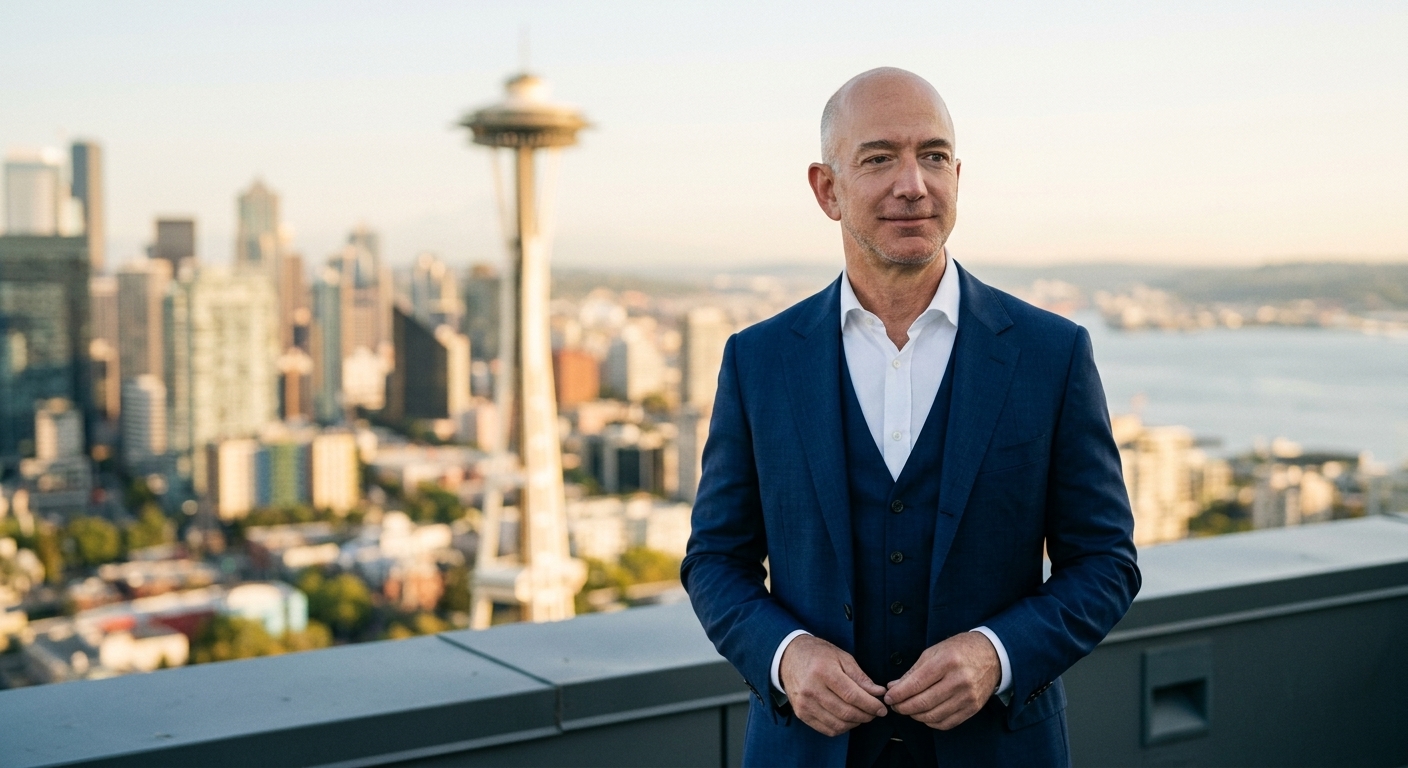
In 1994, a young executive invited his boss for a walk in Central Park in New York to share an idea that had been on his mind for several days.
This young man was Jeff Bezos, and at the time, he held the position of senior vice president at the DE Shaw hedge fund in New York. His idea was to create a company to sell books over the internet. His boss listened attentively before offering a little advice: “That sounds like a very good idea, but it would be a better idea for someone who didn’t already have a good job,” were his words.
Guided by his vision, Jeff Bezos decided to ignore his boss’s advice and, that same year, he would launch the company that would make him the richest person on the planet.
The origins of Amazon

The idea to start this company came to him while reviewing a report showing that the Internet had grown by 2300% in the last year, a trend that caught his attention and immediately made him question the tremendous potential of this emerging technology that offered great business opportunities.
At that time, the Internet was mainly used for sending emails and searching databases, but Bezos thought it was only a matter of time before people started using it to buy products. Without hesitation, he began compiling a list of the products people frequently purchased.
From this list, he decided that the ideal product to market via the Internet was books, thanks to the wide variety of books that existed, their high global demand, and their ease of shipping.
Firmly believing in his idea, he called his parents to explain it to them and ask for their financial support to put it into action.
His parents understood very little of the idea, but they trusted Jeff’s abilities and determination, so they decided to give him the $300,000 they had saved throughout their lives for his retirement.
Together with his wife and money from his parents, he set off for the American West in search of a place to establish the office where he would launch his project. While his wife drove, Bezos wrote the business plan for the new company.
Finally, they decided to settle in Seattle, a city where they could find professionals with experience in computers. There they rented a two-bedroom house and used the garage as the headquarters for their fledgling company.
Jeff Bezos named his company Cadabra and Relentless, but his lawyer and friends recommended he look for a less sinister name.
He thought it would be a good idea to find a name starting with the letter “A,” since website listings were usually alphabetized, and beginning with that letter would place it near the top of directories and lists. With a dictionary in hand, he began reviewing different options until one particularly caught his eye: Amazon, the name of the world’s largest river. A name that perfectly represented his ideal of building the world’s largest bookstore.
The birth of an empire: Amazon.com
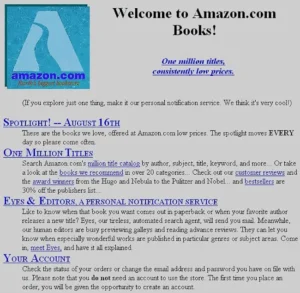
After months of work, on July 16, 1995, the first Amazon website was officially launched, which followed the style of websites that existed at that time: a gray background with links underlined in blue.
From the outset, Amazon experienced exponential growth that exceeded all of its founder’s predictions. Just two months after launching, the site was already selling in 45 countries and generating around $20,000 in revenue per week. However, it took years before the company turned a profit.
Jeff Bezos was a visionary. He knew that if he wanted to establish himself in the market, he had to sacrifice short-term profits and focus on rapid growth by earning customer loyalty.
On May 15, 1997, Amazon began trading on NASDAQ at a price of $18 per share, a price that skyrocketed from day one. Thanks to this capitalization, the company began to diversify by adding new product categories to its catalog, such as music CDs, DVDs, software, video games, and clothing.
By December 1999, Amazon was already an internet giant, nd its founder was chosen as Person of the Year by Time Magazine, being recognized as “the king of e-commerce”.
At that time, many Internet companies succumbed to the explosion of the so-called “Dot-com Bubble, however, Amazon continued its steady growth and, by the fourth quarter of 2001, it had already exceeded one billion dollars in revenue and achieved its first profits, which were 5 million dollars, equivalent to 1 cent per share.
Despite this massive growth, Amazon’s beginnings were anything but easy. Its business model threatened the interests of large corporations that weren’t going to stand idly by, so Bezos’s company had to face powerful competitors, even dealing with lawsuits filed by companies like Barnes & Noble and Walmart. Furthermore, several of the company’s initial shareholders constantly complained that Amazon wasn’t generating profits, and many critics predicted its inevitable bankruptcy.
Thanks to Jeff Bezos ‘ leadership, Amazon was able to stay afloat, continue gaining ground on the web, and consolidate itself as one of the most powerful technology companies in the world.
As the Amazon empire grew, the company continued to explore business opportunities, launching successful services and products such as Amazon Web Services, Amazon Kindle, Amazon Alexa, and Amazon Go among many others.
Today, Amazon’s figures are simply staggering. Its sales now exceed $177 billion annually, generating profits of over $3 billion. Its brand is worth more than $187 billion, solidifying its position as the world’s most valuable brand according to the Brand Finance Global 500 study . It employs more than 560,000 people worldwide. And, in 2018, its market capitalization surpassed the $1 trillion mark, making it the second company to achieve this milestone after Apple.
Impressive figures for a company that started with the goal of becoming the world’s largest bookstore, but ended up completely revolutionizing the way we shop. Below, we share some of the keys to its success.
The keys to Amazon and Jeff Bezos’ success

-
- Constant Innovation: Complacency is not a word in Jeff Bezos’s or Amazon’s DNA. The company has consistently reinvented itself, pioneering several industries. Currently, the company is investing in sectors and technologies such as Artificial Intelligence, Virtual Reality, Augmented Reality, Robotics, and Cloud Computing.
-
- Customer obsession: From the beginning, Jeff Bezos knew that gaining the trust and loyalty of customers would be crucial to the success of his company, so the customer focus became the most important pillar of Amazon‘s strategy
-
- Long-term vision: While many startups seek to make a quick profit, Jeff Bezos was obsessed with dominating the market, even sacrificing short-term profitability to establish himself as the leader in e-commerce.
-
- Focus on what matters: For Bezos, luxuries weren’t a priority. Although his company was growing at an unstoppable pace, his office was quite modest. In fact, in a 1999 interview for the program “60 Minutes,” the host asked him why his desk was so unkempt, to which the entrepreneur replied: “We only spend money on what really matters.”
- Flexible organizational structures: For Amazon, it was essential to achieve accelerated growth that would allow it to quickly gain ground on the large bookstores of the time, so Jeff Bezos opted for simple and flexible organizational structures that facilitated decision-making and the implementation of new projects.
The richest man in the world: Jeff Bezos
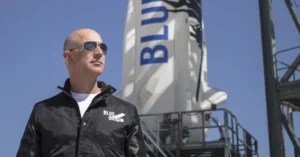
Thanks to the aforementioned keys and his relentless ambition and determination, Jeff Bezos not only managed to build one of the largest internet empires but also became the richest person in the world in the process, amassing a personal fortune of more than $130 billion, according to Forbes Magazine.
At 55, Jeff Bezos continues to lead Amazon with the same conviction that drove him to start it, striving to instill a culture of innovation and customer focus in every employee. And although he claims to have a succession plan in place for when he finally decides to retire, that moment doesn’t seem likely to arrive anytime soon.
Regarding his fortune, he says he has already decided how he will spend it. The world’s richest man wants to use his money to fund Blue Origin, an aerospace transportation company he founded in 2000. Bezos’s goal is to contribute to the development of the space industry, which he considers essential for cultivating and promoting a more advanced human civilization. A very ambitious plan, but one that will surely generate much discussion in the coming years.
Thus concludes this summary of the inspiring story of a visionary who decided to challenge large corporations to pave the way for a new industry in which a whole new generation of entrepreneurs would emerge. As Jeff Bezos himself says :
“At the end of our lives, we are the result of the decisions we have made throughout them.”
About the Author