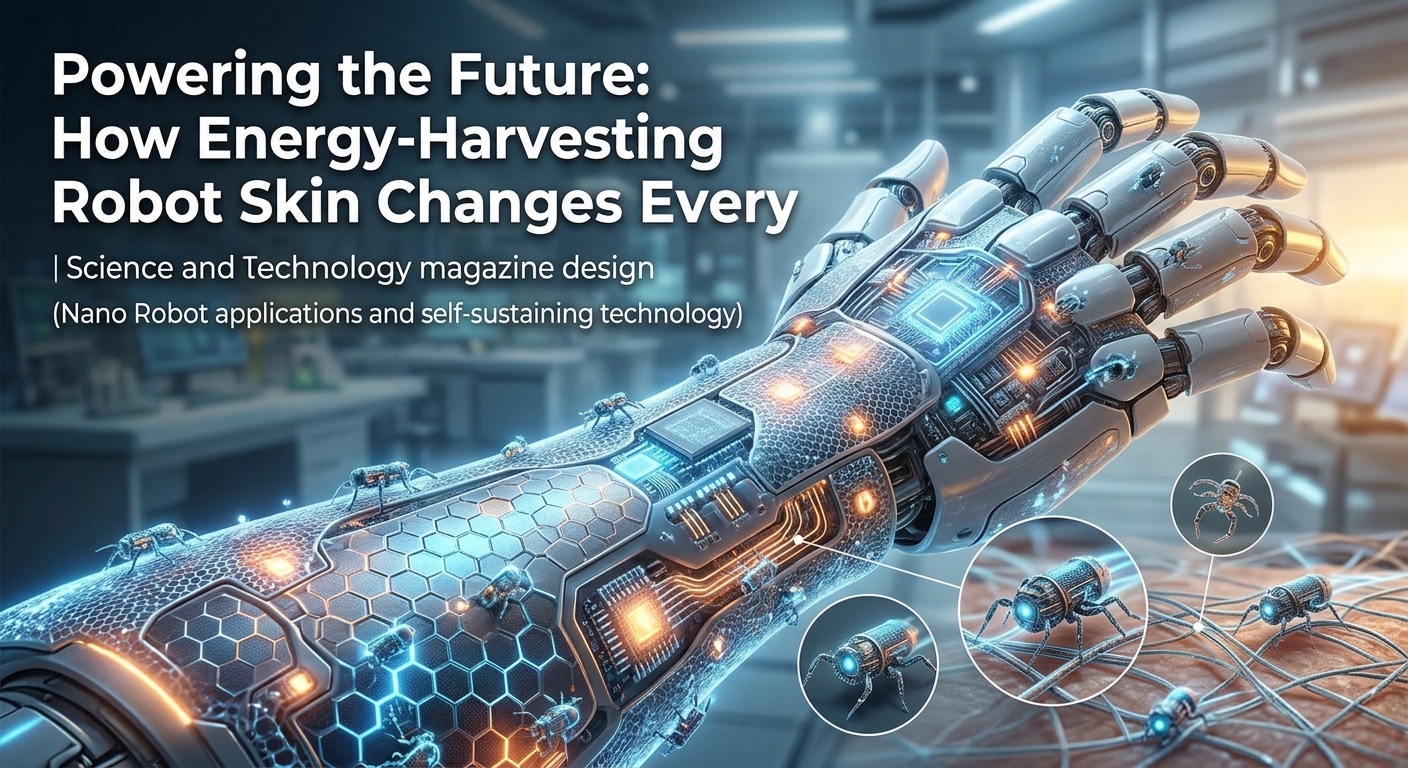
Imagine a tiny robot that never needs to have its batteries changed. For decades, scientists have dreamed of building micro-robots—machines so small they are measured in micrometers and nanometers. While much of the funding for these tiny machines comes from the medical field, where they promise to revolutionize treatments inside the human body, their potential uses go far beyond healthcare.
However, engineers have run into a massive roadblock: the battery problem.
The Problem with Batteries
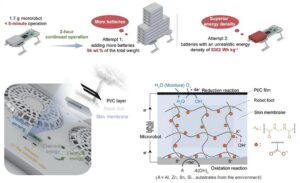
When a robot is very small—weighing just one or two grams—carrying a traditional battery is nearly impossible. If a tiny robot relies on a standard battery, it can only move for about two minutes before running out of power.
To make that same robot run for two hours, the battery would need to make up 94% of the robot’s total weight. Furthermore, it would require an energy density of 5,382 watt-hours per kilogram (Wh/kg). That is roughly ten times more powerful than the best lithium-ion batteries available today. Simply put, standard batteries are too heavy and too weak to power micro-robots effectively.
A Brilliant Solution: Energy from Movement
To solve this issue, a research team led by Ganyu Wang at Fudan University in China decided to try a completely different approach. Instead of forcing the robot to carry its own stored energy, they designed a system that allows the robot to harvest electricity directly from the surface it walks on.
By making the robot’s feet trigger a chemical reaction upon contact, the machine’s operating time is no longer limited by an internal battery.
The secret lies in an open electrochemical energy system. The researchers attached a microscopic membrane made of potassium polyacrylate to the bottom of the robot’s foot. This clever skin converts chemical energy—sourced from the ground, the air’s moisture, and oxygen—into usable electricity.
How the Robot Skin Works
The manufacturing process is remarkably straightforward. The membrane is created in a single step by polymerizing an acrylic acid mixture directly onto the robot’s base. A flexible platinum-carbon film is then added to act as a reaction site where oxygen and water can meet.
Despite being powerful, the membrane is ultra-thin—measuring just 135 micrometers thick, with a usable area of only one square millimeter. Because it is so compact, it acts almost like a second skin for the robot, adding power without changing the machine’s design or adding burdensome weight.
Generating Power on the Go
The skin generates electricity the moment the robot’s foot touches a metallic surface, and it stops the exact moment the foot is lifted.
When the foot touches the metal, a chemical reaction begins in just 0.1 milliseconds. The metal substrate loses electrons, while the platinum-carbon side accepts oxygen and water, generating hydroxide ions.
One of the best features of this design is that it cleans itself. Every time the robot takes a step, the reaction interface is renewed. The waste products of the reaction stay behind on the metal surface rather than building up on the robot’s foot. This prevents the performance drop that usually ruins traditional, static batteries over time.
So far, the team has focused on metals like aluminum, zinc, silicon, tin, and lead. These materials are already common in everyday environments where future robots will need to work, such as inside industrial pipes, buildings, data centers, and heavy machinery.
When tested, the results were impressive: on a zinc surface, the energy collector provided a power density of 133 milliwatts per square centimeter (mW/cm2), and on aluminum, it reached 103 mW/cm2. These numbers are roughly ten times higher than what standard micro-batteries can provide.
Skin That Generates Energy and Feels
Amazingly, this energy-generating skin does more than just power the robot—it also acts as a sophisticated sensor that can “feel” the world around it.
Different materials trigger different rates of chemical reactions, creating unique electrical signals. Furthermore, if the robot walks over a rough surface, it physically deforms the membrane, altering the flow of ions and producing a different type of signal.
Because changes in the material create steady square-wave signals, while changes in surface roughness create sharp voltage peaks, the robot can easily tell the two apart. By adding an XY electrode array, the membrane can even pinpoint the exact spot where the contact is happening.
This dual-purpose skin allows the robot to understand its environment, map its surroundings, and actively seek out energy-rich pathways to keep itself running indefinitely. By letting robots live off the land they explore, scientists have opened the door to a new generation of truly independent machines.