
The labor market isn’t changing smoothly—it’s turning upside down. Jobs that seemed secure and stable just ten years ago are now being automated or disappearing, replaced by specialties for which universities haven’t yet written textbooks. The digital economy isn’t an abstraction from government reports, but a mechanism that’s currently determining who will earn a good living, who will retrain in time, and who will wait for vacancies that no longer exist. This article isn’t about how to “get into IT.” It’s about what jobs the digital transition is actually creating, why businesses need them, and where your entry point is—regardless of your background.
What is the digital economy and why is it changing the labor market?
The term “digital economy” was coined by American scientist Nicholas Negroponte in 1995, describing the transition from atoms to bits as the fundamental unit of value. Today, it’s no longer a metaphor, but an operational reality: an economic system in which the production, distribution, and consumption of goods and services are based on digital technologies, data, and platforms. The key components of this system—digital infrastructure, e-commerce, digital platforms, and big data analytics—create an environment where speed, automation, and data replace traditional factors of production. You can read more about this in CyberLeninka’s study on the impact of the digital economy on the labor market.
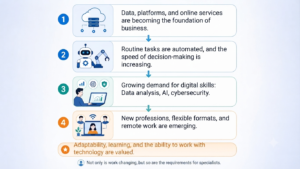
The digital transition is creating demand for new professions through a simple mechanism: wherever a new tool appears, someone is needed who can configure it, maintain it, analyze the results, and make decisions based on them. Artificial intelligence doesn’t replace people; it redistributes tasks. Routine operations are transferred to machines, and the tasks of interpretation, management, and creation are transferred to humans. This is the driver of demand for digital skills.
In 5-10 years, the most vulnerable occupations will be those with a high proportion of repetitive, algorithmic tasks: call center operators, primary documentation accountants, manual data processing logisticians, and proofreaders of standard texts. Key occupations will be those that require critical thinking, adaptability, and working with technology—data analysts, machine learning engineers, product managers, and cybersecurity specialists. A study by the Journal of Education, Management, and Analytics confirms that digitalization is leading to job redistribution, not simply job losses—those who retrain quickly will benefit.
Finance, telecommunications, retail, and logistics across East Africa and the wider continent have transformed rapidly. These sectors are experiencing the most acute shortages:
💼 Data specialists — data analysts and data engineers
🔐 Cybersecurity and data privacy compliance experts
📦 Product managers with an understanding of digital products
🤖 AI solution developers and machine learning engineers
📊 Digital marketing and traffic analytics specialists
Map of in-demand professions in the digital economy
All new digital labor market specialties can be conveniently divided into five clusters, each covering its own area of business challenges:
| Direction | Professions | Level of demand |
| 📊 Data and Analytics | Data analyst, data scientist, data engineer, BI analyst | Very high, growing |
| 💻 Development and DevOps | Backend, frontend, full-stack developer, QA, DevOps, architect | Tall, stable |
| 📣 Digital Marketing | Performance marketer, SEO specialist, SMM, content strategist | Tall, competitive |
| 🔐 Cybersecurity | Information security specialist, penetration tester, SOC analyst, DPO | Critically in short supply |
| ⚙️ Management and product | Product Manager, Digital Transformation Manager, Agile Coach | Tall, grows quickly |
AI/ML specialists and cloud data engineers are experiencing the fastest growth in demand across emerging digital hubs: enterprise surveys and industry reports indicate that over 85% of firms report significant shortages of AI, data science, and cybersecurity talent, aligning with the accelerating push toward digital infrastructure.
Where is the line between buzzwords and a real task? It’s simple: if an employer pays for results, it’s a profession. “Prompt engineer” became a real position in tech enterprises precisely when the quality of prompts began to be measured by automation output and operational efficiencies. “Digital transformation manager” isn’t a title for fashion, but a critical role that bridges the gap between legacy corporate setups and scalable cloud solutions.
Market compensation ranges for high-demand tech roles (reflecting regional tech hubs and localized digital economy standards):
🤖 AI/ML Engineer — competitive executive and senior packages
🔐 Cybersecurity Specialist — high-premium scaling with certifications
⚙️ DevOps Engineer — robust packages driven by cloud adoption
📊 Data Scientist / Engineer — strong demand across fintech and banking
📦 Product Manager (3+ years of experience) — vital core role for scaling startups
Data and Analytics Specialists: What They Do and Why They’re Needed
🔢 Who’s Who in the Data World
📈 Career track: Analyst → Senior Analyst → Lead → Head of Analytics / CDO
All three roles address fundamentally different business objectives but operate within a single ecosystem. Companies pay for them because every management decision without data is a guess. A retailer who knows what a customer will buy in two weeks builds up inventory in advance. A bank with a credit risk model reduces default rates. A marketplace with a working recommendation system increases the average order value without increasing its advertising budget.
To enter this field, a basic understanding of SQL and a visualization tool such as Power BI or Tableau is sufficient. Data analytics is well-received by people with backgrounds in marketing, finance, economics, and sociology: the ability to read numbers and ask the right questions is valued just as much as technical skills. An analysis of over 100,000 job postings on hh.ru by Esbord’s team shows that Python is taking over analytics entirely—it’s even included in the requirements for business and product analysts.
The career path within the direction is built linearly and predictably:
Junior Data Analyst — Basic SQL, Reports, Dashboards
Middle Data Analyst / Data Scientist — independent projects, ML models
Senior / Lead — analytics architecture, mentoring, business partnerships
Head of Analytics / Chief Data Officer — a company’s data strategy
Development and technical professions for the digital economy
⚙️ Technical Professions: Who Does What?
Of all technical roles, QA testers have the lowest barrier to entry. They don’t require math or a programming degree; they require a methodical approach, attention to detail, and a willingness to understand how a product works. This is why testing is a common entry point into a tech career for people from related fields.
The most sought-after stack among employers in 2026 looks like this: PostgreSQL + Docker is the standard tool for technical roles. React is a must-have for frontend. Kubernetes and Ansible are for DevOps and MLOps. Python is a language that permeates virtually all technical roles. All of this can be learned through structured online courses with hands-on practice—this is where the first portfolio is built, which serves as a substitute for a diploma when applying for a job.
Digital Professions Without Programming: Where Should Humanities Students Go?
The digital economy needs more than just coders. It needs people who understand users, communicate effectively, and make data-driven decisions—without having to collect the data themselves. This opens up three key areas.
A product manager is someone who manages a product, from concept to release and growth metrics. They don’t write code, but they must understand what’s technically possible, what users want, and what’s beneficial for the business. A hh.ru analysis of job postings shows that employers are looking not for a “task manager,” but for a strategic “thinker”—analytical thinking and product strategy development are prioritized over backlog management. Good entry-level backgrounds include marketing, project management, business analysis, and journalism.
A UX/UI designer is a specialist who designs interfaces so that users don’t have to think about how to use them. Figma has conquered the market and become the de facto standard. The barrier to entry is lower than it seems: design thinking, a keen eye, and an understanding of user experience are more important than mastering complex tools. People from print, architecture, education, and journalism demonstrate excellent results when transitioning to UX.
A digital marketer attracts, retains, and converts audiences through digital channels. Google Ads and Google Analytics are the main tools in the South African market. An AI marketer is already a real asset: ChatGPT and Midjourney are part of the minimum working stack. When anyone can generate content, strategy, analytics, and tone management become paramount—the very thing that distinguishes an experienced marketer from a novice with prompts.
Thabo Mokoena, career consultant
One of my clients—I’ll call him Sipho—worked as an editor at a regional publication for eight years. His salary was 25,000 rands, and his prospects were dim. When the editorial staff began laying off staff, he came to me with the question:
“Where should someone without technical knowledge go?”
We explored his real-world skills: his ability to structure complex information, work with different audiences, understand how readers perceive text, and experience coordinating with authors. Sipho was accustomed to thinking about the user—he simply called them “the reader.”
The solution turned out to be a non-obvious one: UX writing and content strategy for digital products. This profession is built on understanding how people feel when interacting with an interface. Sipho completed a four-month course, completed three training projects—rewriting interface text for several existing applications—and built a portfolio. Six months after our first conversation, he landed a job as a UX writer at a product company with a salary of 65,000 rands. His editing experience didn’t have to be thrown away—it became a major competitive advantage over design candidates with no understanding of text.
Sipho’s story is no exception. People from teaching are moving into online education methodology, lawyers into compliance and DPO, and journalists into product copywriting and content marketing. Related skills from traditional industries remain valuable—they’re becoming a differentiator in professions where people without subject-matter expertise are moving en masse.
Professions at the intersection of security, law, and digital management. The most in-demand market segment is specialties that require both technological understanding and subject matter expertise from another field. This segment has minimal competition and the greatest gap between supply and demand.
A cybersecurity specialist protects a company’s infrastructure from hacks, data leaks, and internal threats. This discipline encompasses several roles: a SOC analyst monitors incidents in real time, a penetration tester conducts controlled attacks to find vulnerabilities before attackers, and a DPO (Data Protection Officer) is responsible for ensuring compliance with personal data laws. Cybersecurity remains one of the most stable fields, even during economic downturns: threats don’t disappear with a recession.
A digital lawyer is a specialist who works at the intersection of law and technology: data regulation, intellectual property in the digital environment, contracts with IT contractors, and compliance with the Protection of Personal Information Act (POPIA) and GDPR. This role emerged as an independent one after the volume of digital legal relationships exceeded the ability of traditional corporate lawyers to understand the details without technical training.
Digital Transformation Manager is the person who digitalizes a company’s business processes: they determine what needs to be automated, select tools, and coordinate IT and business units. This is neither a CIO nor a project manager—it’s a bridging role that requires an understanding of both.
Hybrid skills are valued higher for a simple reason: the market is saturated with “pure” techies and “pure” humanities specialists, but someone who speaks both languages is rare. It is precisely these specialists who occupy positions with the greatest bargaining power when applying for jobs.
Why these roles address complex business challenges:
🔐 Security – because one data leak costs more than a year’s information security budget
⚖️ Digital law – because fines for violating data laws are real and growing
🔄 Digital transformation – because without change management, technology adoption becomes a costly failure
How to choose a profession in the digital economy and avoid mistakes
The biggest mistake when choosing a career is focusing on popularity rather than a combination of demand, personal strengths, and entry barriers. A popular profession with a low entry barrier quickly becomes competitive—and salaries there stop growing. The right choice is a combination of three factors: what the market needs, what interests you, and where you have at least some advantage over the crowd.
For students and graduates – guidelines for choosing a direction:
- Look not at the title of the profession, but at the tasks it covers – they do not become obsolete.
- Choose a field with a career path built into it, rather than a one-time specialization.
- Assess whether you have subject-matter expertise that can be combined with digital skills—this will yield results faster than starting from scratch.
- Practice is more important than theory: academic projects and portfolios are valued more than a diploma when applying for a first job.
Checklist for a specialist from a traditional industry when changing professions:
✅ Make a list of the skills you already have—many of them are transferable
✅ Find a role that combines your current expertise and digital competencies
✅ Determine the minimum set of skills required to enter the chosen role
✅ Take a course with real projects, not just theory
✅ Complete 2-3 academic projects and format them as a portfolio
✅ Start with a Junior position or internship—don’t expect perfect preparation
How to evaluate your strengths: If you’re good with numbers and love finding patterns, consider analytics. If you can easily explain complex ideas in simple terms, consider product management or UX. If you’re interested in systems and how things work from the inside, consider DevOps or architecture. If you enjoy order, processes, and documentation, consider testing or business analysis.
The initial portfolio is built through academic projects, participation in hackathons, open source contributions (for developers), case studies (for analysts and product managers), and UX research (for designers). This takes two to six months of intensive work.
A practical guide for HR, managers, and parents
For those who make decisions about hiring, training, and career planning for others, it’s a different story. We don’t need abstractions here; we need actionable criteria.
Who to hire and what competencies to develop in your team right now:
| Role | Hiring priority | Key competencies | What to look for in a portfolio |
| Data Analyst | 🔴 Tall | SQL, Python, visualization, business thinking | Concrete insights from data, not just dashboards |
| Backend developer | 🔴 Tall | Company stack, working with databases, Git, understanding architecture | Real code in the repository, description of tasks |
| Product Manager | 🟠 Medium-high | Analytical thinking, user understanding, prioritization | Cases with metrics before and after the solution |
| Information security specialist | 🔴 Critical | Threat awareness, infrastructure understanding, incident response | Certificates, participation in CTF |
| DevOps engineer | 🔴 Tall | Docker, Kubernetes, CI/CD, cloud platforms | Description of configured pipelines and infrastructure |
How HR and recruiters can track trends: look at job posting dynamics, not the current volume. If there are few openings but their number is growing, this is an early sign of a shortage. Monitor stack requirements in competitors’ job postings: they reveal where demand is shifting faster than any analytical report. Use hh.ru, Habr Career, and Superjob as primary sources of labor market trends.
For parents of schoolchildren, here are some skills to develop now:
📐 Mathematical thinking and statistical literacy are the foundation for analytics and ML
💬 The ability to argue and structure thoughts is the foundation for product management and UX
🖥️ Basic understanding of programming — Python or Scratch to get started
🔍 Critical thinking and working with sources are key competencies in the era of AI content
🤝 Teamwork and communication — according to hh.ru, soft skills become more valuable as the position grows
Signs of a promising profession when making career or personnel decisions:
- A profession exists not only as a name, but also as a set of specific tasks with a measurable result.
- Demand for it is growing faster than supply appears on the labor market.
- The salary range is above the market average and continues to grow.
- Competencies are transferable between industries—a specialist is not tied to one industry
- It has a career track: it is clear where to grow in 2, 5, and 10 years
- 55% of companies predict that AI literacy will be a key competency for most roles by 2028—a key consideration for any planning, whether it’s hiring or a child’s education.
Final Words
The digital labor market doesn’t wait. It doesn’t forgive those who view current events as a temporary trend, and generously rewards those who prioritize specific competencies before they become mainstream. A student who understands the difference between a data analyst and a data scientist makes a conscious choice. An HR professional who monitors job posting trends hires before the competition. A parent who develops analytical thinking and digital literacy in their child creates a real career asset. The map of digital economy professions is open—all that remains is to choose the entry point and take the first step.
About the Author