The AI infrastructure challenge
Artificial intelligence demands ever-increasing resources, posing a significant challenge to IT infrastructure. In data centers, the surge in computing power brings with it density issues, extremely high energy consumption, and, above all, a massive amount of heat that needs to be dissipated.
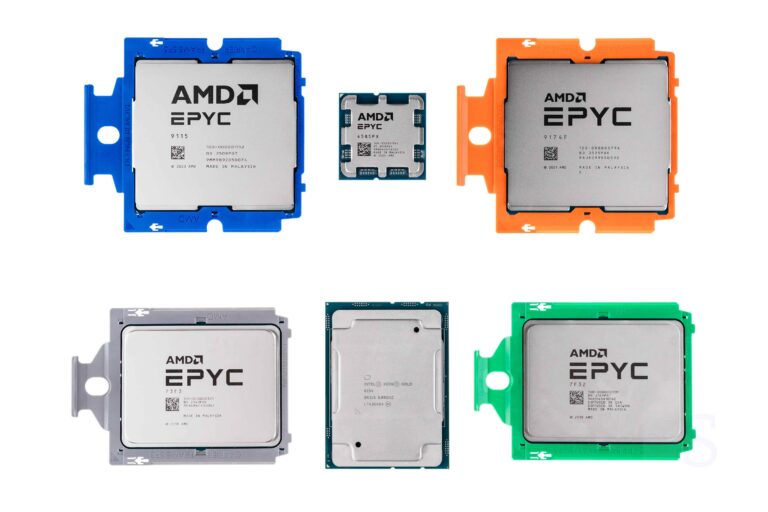
GIGABYTE’s comprehensive AMD-based solutions go beyond offering individual servers, presenting a complete catalog of AI infrastructure capable of covering everything from enterprise installations to exascale deployments. In this article, we’ll review the various cooling strategies they offer to keep everything under control.
Gigabyte EIA DLC (G4L3-ZX1-LAT4) Exascale AI Infrastructure and Direct Liquid Cooling
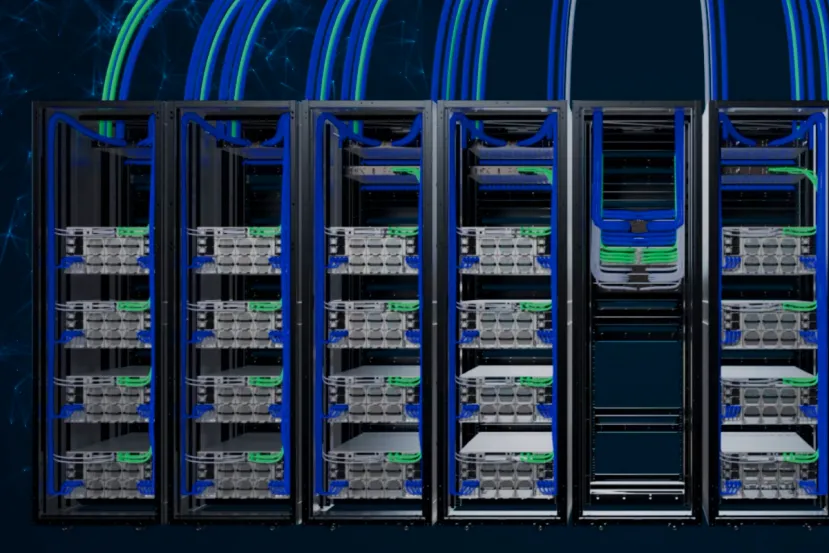
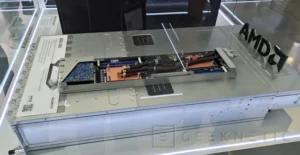
For companies that need to set up large-scale AI installations with maximum capacity, the model to consider is the Gigabyte EIA DLC rack with G4L3-ZX1-LAT4 modules. We’re not talking about a single server, but a complete AI infrastructure.
Its most notable feature is the integration of a Direct Liquid Cooling (DLC) system that simultaneously cools the CPU and GPU and also incorporates leak detection. This technology allows for the highest possible rack density, making it ideal for hyperscalers and massive deployments. By delivering the liquid directly to the key components, it prevents temperature from impacting performance under extreme loads.
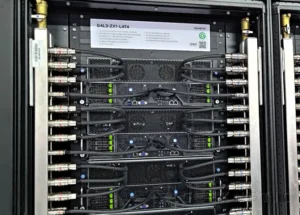
This thermal dissipation capacity allows each module to house eight liquid-cooled AMD Instinct MI355X accelerators. The primary computing power of each module is a dual-processor configuration of AMD EPYC 9005 or 9004 series processors, along with 12-channel DDR5 RDIMM memory distributed across a total of 24 DIMM slots.
Each module of this server features a base connectivity of two 10Gb/s LAN ports (Intel X710-AT2) and offers ample expansion capacity with four dual-slot FHHL PCIe Gen5 x16 slots and eight single-slot FHHL PCIe Gen5 x16 slots. For storage, there are eight hot-swap 2.5-inch Gen5 NVMe bays for easy, non-disruptive drive replacement, along with two internal M.2 PCIe Gen3 connections.
Finally, to meet the high energy demands of this hardware, GIGABYTE has integrated a set of redundant (3+3) 5200W power supplies with 80 PLUS Titanium certification. This entire system is housed in a device that also incorporates recycled materials (PCR/PIR) in its construction.
Gigabyte G893-ZX1-AAX4: Maximum performance for AI training
If you’re looking for maximum computing performance, the G893-ZX1-AAX4is the brand’s most advanced model in this segment. It’s built around a dual-processor AMD EPYC 9005 or 9004 series configuration, managing eight AMD Instinct MI355X OAM accelerators. This configuration makes it ideal for training large language models (LLMs) and handling demanding workloads in data centers.
To support this level of computing power, the server integrates 24 x 96GB DDR5 RDIMM memory modules from SK hynix, running at 6400 MT/s. These modules are built on 24Gb DRAM using a 1a-nm process and are specifically optimized for AI, cloud computing, and data centers. Networking determines the overall performance of the system, so this server is compatible with AMD Pensando Pollara 400 AI NIC network cards, complementing its two 10Gb/s LAN ports (Intel X710-AT2)
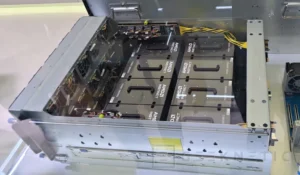
For storage and expansion, it includes eight hot-swappable 2.5-inch Gen5 NVMe drive bays, two M.2 PCIe Gen3 slots, and multiple PCIe Gen5 x16 connections (four dual-slot and eight single-slot). All of this hardware is powered by a massive array of redundant (6+6) 3000W power supplies with 80 PLUS Titanium certification.
G294-Z22-AAP2: AMD EPYC 9005/9004 with up to 8 AMD Instinct MI350P GPUs
As an alternative for those organizations looking to implement advanced acceleration without immediately jumping to rack-scale liquid cooling, the G294-Z22-AAP2 is a more business-friendly option for traditional enterprise environments, with all the power of AMD’s Instinct MI350P accelerators.
This system stands out for its exceptional hardware configuration flexibility. With a motherboard powered by a single AMD EPYC 9005 or 9004 series processor and 12 channels of DDR5 RDIMM memory (with 12 DIMM slots), the server supports the installation of up to eight dual-slot PCIe Gen5 cards Compatible acceleration options include four AMD Instinct MI350P PCIe cards, eight AMD Radeon AI PRO R9700S units, and even NVIDIA-based solutions such as four H200 NVL GPUs with a 2-way NVLink bridge or four RTX PRO 6000 Blackwell Server Edition GPU.s
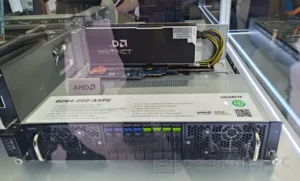
Network connectivity is provided by two 10Gb/s LAN ports via the Broadcom BCM57416 controller. For storage, it features four Gen5 NVMe/SATA/SAS-4 bays and four additional 2.5-inch SATA/SAS-4 bays, all hot-swappable, offering versatile options without needing to power down the machine, along with two M.2 PCIe Gen5 x4 slots. Power is supplied by two redundant 3000W 80 PLUS Titanium power supplies, ensuring stability under heavy workloads in a system built using recycled materials.
Gigabyte W793-ZU0-LA71: Liquid cooling without the need to modify your data center
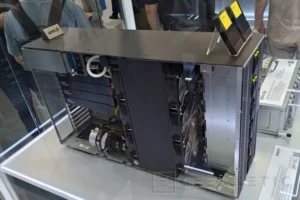
We know that not all companies have the resources to remodel their facilities to add water connections and complex piping. For these cases, the W793-ZU0-LA71 tower server is a fantastic option. It’s an AMD-powered system that integrates closed -loop liquid cooling with leak detection for added safety. Its biggest advantage is that it offers many of the thermal dissipation benefits of liquid cooling without requiring any water connections in the facility. This is especially useful for IT administrators who need to keep temperatures under control without dealing with construction or cumbersome configurations in their server room.
This cooling system goes beyond simply cooling the processor, as the closed-loop system covers both the CPU and GPU, allowing for the installation of up to four liquid-cooled AMD Radeon AI PRO R9700S graphics cards, supported by an AMD EPYC 9005 or 9004 series processor and 12 channels of DDR5 RDIMM memory (with 12 DIMM slots). All of this is designed to deliver maximum AI computing power in a tower form-factor system, without bottlenecks, as it also includes multiple PCIe Gen5 x16 slots for both graphics cards and expanding network capabilities, complementing its two integrated 10 Gb/s LAN ports managed by the Intel X550-AT2.
On the other hand, data speed is key in Artificial Intelligence. Therefore, this model is compatible with the 8TB Phison Pascari AI200E aiDAPTIVCache SSD for caching nd allows the installation of up to four 2.5-inch Phison Pascari X202Z eSSDs. These drives offer performance capable of reaching 10,000 MB/s write speeds with extreme endurance of 60 DWPD, ensuring that the server can withstand intensive and sustained operations over time.
To complete this system, the power section features redundant (2+1) 2400W power supplies with 80 PLUS Titanium certification, which, like the rest of the components mentioned, are also liquid-cooled.
Gigabyte B353-C60-LAS1: Maximum density with 20 AMD nodes in just 3U
Finally, we end the review with the B353-C60 high-density server, a device designed for environments where rack space is expensive and limited, a very common situation in European data centers.
We’re talking about a system designed with a front-access 10-blade module system that houses a total of 20 nodes, all compressed into a chassis of just 3U. This represents a higher-than-usual computing density.
To efficiently dissipate heat in such a small space, GIGABYTE offers several options for maximum flexibility, depending on the company’s setup: the chassis is available with either closed-loop liquid cooling with an integrated collector (170 W) or standard air cooling (65 W). This allows us to fit significantly more computing power into less space, reducing overall infrastructure costs and maximizing the use of every unit in our data center
At the hardware level, each of these 20 nodes operates independently. Each node is powered by a single AMD EPYC 4005 series processor or an AMD Ryzen 9000 series processor. It also features four DIMM slots for dual-channel DDR5 memory, compatible with both ECC and non-ECC UDIMM modules, allowing the memory configuration to be tailored to the data integrity requirements of each environment.
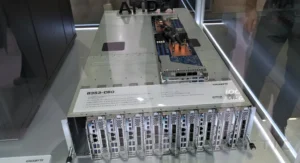
Storage and networking are also handled individually for each node. Each compute module integrates two M.2 PCIe Gen5 x4 slots for high-speed drives. For connectivity, each node has two 25 Gb/s SFP28 LAN ports and one 1 Gb/s LAN port. The entire chassis is managed via two CMC LAN ports.
Finally, to support the high energy consumption of this hardware setup, the equipment relies on a main group consisting of four redundant 3200W power supplies with 80 PLUS Titanium certification.
Infrastructure that adapts to each deployment
As we’ve seen, GIGABYTE’s extensive catalog covers a wide range of professional environments, demonstrating that a single solution isn’t suitable for all modern AI installations. With this offering, the company clearly positions itself as a comprehensive AI infrastructure provider, not just a server vendor. By covering everything from motherboard design to liquid cooling flow engineering, they greatly simplify deployment for IT managers and system integrators.
Everything will depend on the specific needs of each organization and its space and energy budget. We have models of all kinds to get the most out of high-performance ecosystems like AMD Instinct: from air-cooled enterprise systems and closed-loop platforms to complete rack-scale infrastructures with direct liquid cooling (DLC) focused on massive workloads and exascale computing.
This allows any company to design and build its data center by choosing the approach that best suits its performance requirements, energy efficiency, and the physical limitations of its facilities. If you want to learn more about keeping temperatures under control in your next large-scale deployment, explore the full range of GGIGABYTE AdvanceCooling platforms and their Gigapod ecosystem.
About the Author