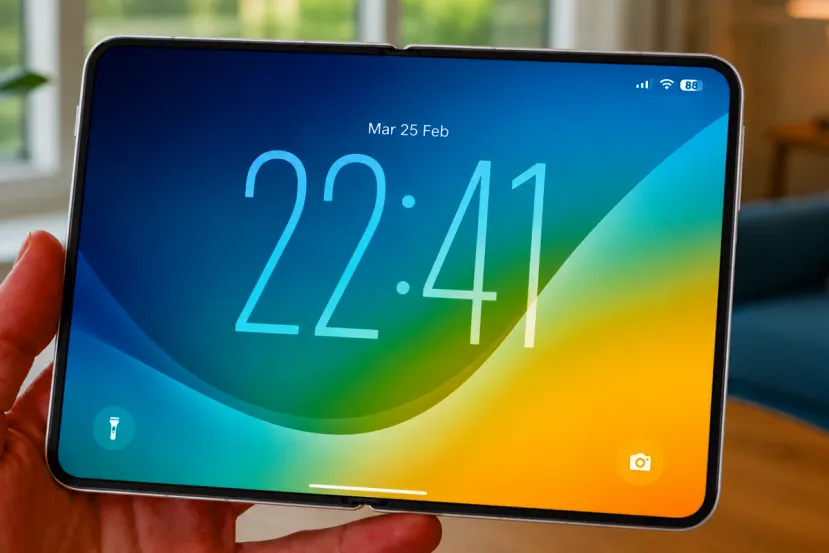
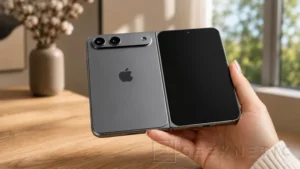
The battery capacity of the iPhone Ultra, Apple’s first hinged model, has been revealed through new records from a company battery supplier, and the figures point to a smaller capacity than initially expected.
Foldable phones have faced the same technical challenge for several years: fitting a sufficiently large battery into a chassis that, by definition, must be thinner and lighter than that of a conventional smartphone to be convenient to fold and carry. Apple, which entered this segment later than other manufacturers, now faces the same dilemma with its first foldable model.
Two records totaling 4,883 mAh
According to a new leak, an Apple battery supplier has submitted two new capacity records: one of 1,921 mAh and another of 2,962 mAh. Combined, these two figures yield a total capacity of 4,883 mAh, significantly lower than the 5,800 mAh previously reported, which had generated higher expectations for the battery life of this first foldable iPhone.
If this is indeed the battery configuration that comes to the foldable iPhone Ultra this year, Apple will likely market it as a 5,000 mAh battery, should the company mention the specific figure at some point in its official communication, something that hasn’t always been common in its product presentations.
How does it compare to other foldable phones already available?
When comparing this figure with other foldable phones already on the market, the iPhone Ultra would be in a reasonable position. Last year’s Samsung Galaxy Z Fold 7 has a 4,400 mAh battery, while the Google Pixel 10 Pro Fold offers 5,015 mAh. The figure for the iPhone Ultra would therefore fall between these two phones, surpassing the Samsung Fold 7 but falling short of the Google Pixel 10 Pro Fold.
It’s particularly striking that the Samsung Galaxy Z Fold8 Ultra, which will compete more directly with the iPhone Ultra in the larger foldable segment, is rumored to have a 4,800 mAh battery. This figure is very close to the one used for Apple’s device, which might not be a coincidence considering that both manufacturers face very similar space limitations within a foldable chassis.
A mystery that will be solved in September
The foldable iPhone Ultra is expected to arrive this September, according to current market expectations, which means there are still several months ahead in which more details about its final battery capacity and how Apple has resolved the distribution of internal space between the battery, foldable screen, and the rest of the components could be leaked.
Given the anticipated price of this device, which is expected to exceed $2,000, the final battery capacity is shaping up to be one of the most crucial factors in assessing whether Apple’s first foldable phone delivers the battery life expected of a high-end product. A smaller-than-expected battery capacity doesn’t necessarily translate to worse real-world battery life, as this also depends on processor efficiency, power management software, and the screen panel itself, but it does reduce Apple’s competitive advantage.
With Samsung and Google also making their respective moves in the foldable segment this year, the direct comparison between the three main foldable smartphone manufacturers promises to become one of the most recurring debates of the fall, especially regarding the real-world battery life that each device is capable of offering in daily use.
The usual challenge of hinged terminals
For years, limited internal space has been a major design constraint for foldable devices. The hinge occupies a considerable volume within the chassis, and this space cannot be used for the battery or any other component. This forces manufacturers to distribute the remaining available volume between the screen, motherboard, cameras, and battery cells, typically divided into two separate sections on either side of the hinge, as suggested by the two battery capacities of 1,921 mAh and 2,962 mAh detected for the iPhone Ultra.
This division into two separate cells, instead of a single continuous battery, is a common solution among foldable device manufacturers, as it facilitates folding the chassis without the battery itself having to physically fold. The drawback of this approach is that the total capacity is usually lower than that offered by a single battery of the same total volume, due to the additional space required to house two independent cells along with their corresponding management circuitry.
Apple isn’t the first company to face this design dilemma, and in fact, it entered the foldable market several years after Samsung, which has been selling its Fold series for considerably longer. This newcomer position could work in Apple’s favor in some respects, allowing it to observe the design successes and failures of its competitors before launching its own device.
About the Author