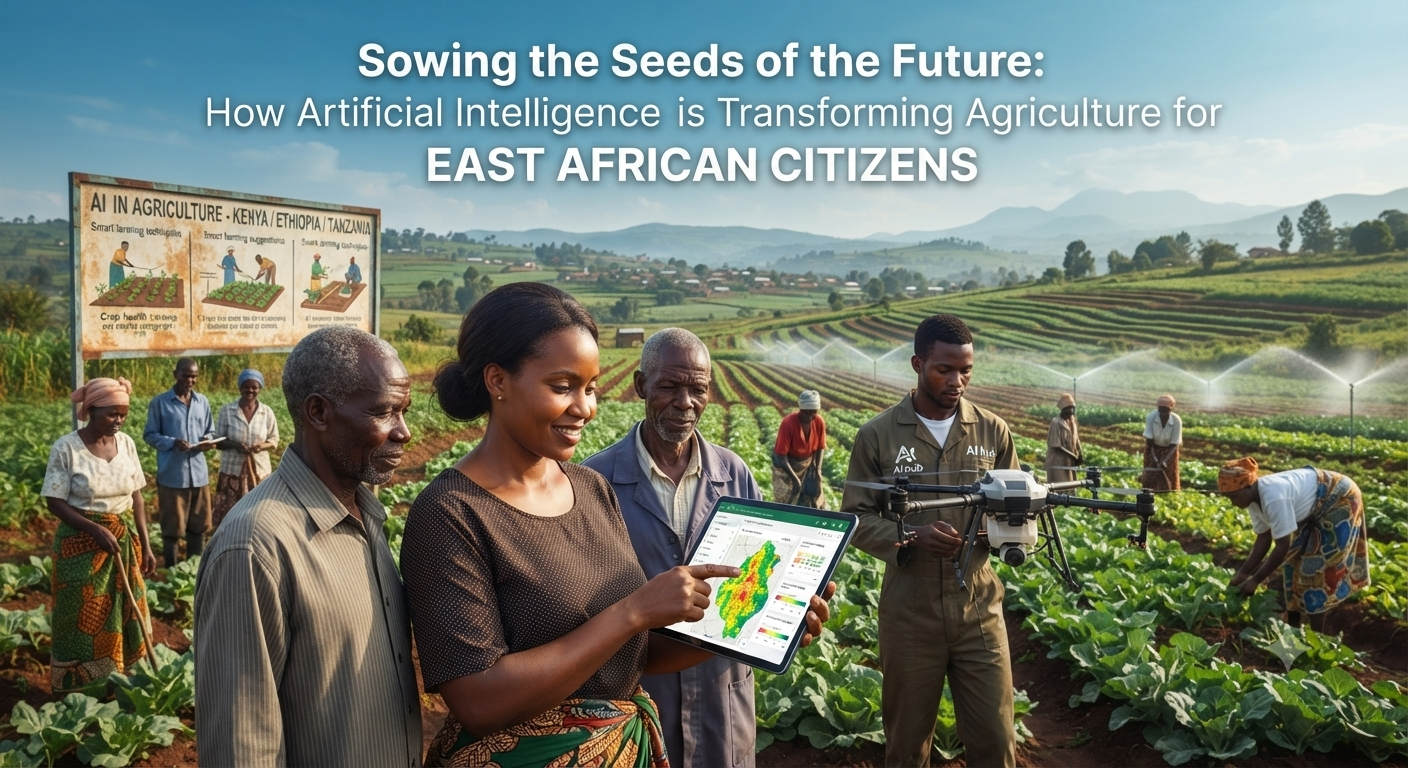
Agriculture is the heart and soul of East Africa. From the green hills of Rwanda and the fertile valleys of Uganda to the vast plains of Tanzania and the bustling agricultural hubs of Kenya, farming is more than just a job. It is a way of life, a primary source of food, and the biggest driver of the region’s economy.
However, farming in East Africa is becoming harder. Farmers face unpredictable rainfall, prolonged droughts, rising fertilizer costs, soil degradation, and sudden pest invasions like the desert locust or the Fall Armyworm.
So, how can we solve these big problems? The answer lies in technology—specifically, Artificial Intelligence (AI).
While “Artificial Intelligence” might sound like a complicated term used only in high-tech laboratories in Europe or Silicon Valley, it is already working on farms across East Africa right now. From basic mobile phones in rural villages to advanced satellite mapping in capital cities, AI is helping everyday citizens grow more food, make more money, and protect their land.
In this comprehensive guide, we will explore in simple terms how East African citizens—from smallholder farmers and young tech entrepreneurs to everyday consumers—can benefit from AI in agriculture.
What is AI in Agriculture? (In Simple Words)
Before diving into the benefits, let us demystify what AI actually means in the context of farming.
Artificial Intelligence (AI) refers to computer systems that can learn, think, and make decisions just like a human expert would.
Imagine you have a master farmer in your village who has 50 years of experience. This master farmer can look at a maize leaf, instantly tell you what disease it has, and tell you exactly which natural medicine or chemical to use. Now, imagine putting that master farmer’s knowledge into a simple smartphone app that millions of people can use at the same time, 24 hours a day.
That is AI.
It processes massive amounts of data—like satellite images, weather patterns, soil samples, and historical crop yields—and gives farmers quick, smart advice through simple SMS messages, voice notes in local languages, or easy-to-use apps.
The East African Context: Why AI is Needed Now
To understand why AI is a game-changer, we must look at the current numbers in East Africa:
- Economic Impact: According to the World Bank, agriculture accounts for roughly 25% to 33% of the Gross Domestic Product (GDP) in East Africa and provides employment to over 65% of the population.
- Smallholder Dominance: Over 80% of the food produced in East Africa comes from smallholder farmers who work on less than two hectares of land.
- Climate Vulnerability: Research by the African Development Bank (AfDB) shows that climate change could reduce crop yields in Sub-Saharan Africa by up to 20% by 2050 if smart interventions are not made.
Traditional farming methods alone are no longer enough to feed the growing population. AI provides the tools needed to farm smarter, not harder.
7 Major Benefits of AI for East African Citizens
                     ┌─────────────────────────────────────────┐
                     │    AI IN EAST AFRICAN AGRICULTURE       │
                     └────────────────────┬────────────────────┘
                                          │
       ┌───────────────────┬──────────────┴───────┬───────────────────┐
       ▼                   ▼                      ▼                   ▼
┌──────────────┐   ┌───────────────┐      ┌───────────────┐   ┌───────────────┐
│ Early Disease│   │  Hyper-Local  │      │ Financial     │   │ Direct Market │
│  Detection   │   │ Weather Data  │      │ Inclusion     │   │ Access        │
└──────────────┘   └───────────────┘      └───────────────┘   └───────────────┘
1. Early Pest and Disease Detection Using Smartphone Cameras
One of the biggest threats to an East African farmer is a crop disease that spreads quietly until it is too late to save the harvest. Diseases like Cassava Mosaic Virus, Banana Bacterial Wilt, and Maize Lethal Necrosis Disease ruin millions of dollars worth of crops every year.
How AI Helps: With AI-powered applications, a farmer does not need to wait weeks for an agriculture extension officer to visit their farm. They can simply take a photo of a sick plant leaf using a smartphone.
The AI app analyzes the photo within seconds by comparing it to a database of thousands of plant disease images. It then tells the farmer:
- What disease or pest is attacking the plant.
- The exact step-by-step treatment required.
- Where to buy genuine, safe treatments locally.
Real-World Example: Apps like Plantix and Nuru (developed in collaboration with the International Institute of Tropical Agriculture) are widely used across East Africa. In Uganda and Tanzania, cassava farmers use the Nuru app to scan cassava leaves for whitefly damage and mosaic disease, saving up to 40% of yields that would otherwise be lost.
2. Hyper-Local Weather Predictions and Climate Adaptation
In the past, farmers relied on traditional weather signs, such as the behavior of birds or wind patterns, to know when to plant. However, climate change has made rainfall patterns erratic. Planting too early or too late can lead to total crop failure.
Standard weather forecasts on TV or radio cover huge regions, making them too general to be helpful for a farmer in a specific village.
How AI Helps: AI combines global satellite data, local weather station inputs, and ocean temperature readings to give hyper-local weather forecasts. This means a farmer in a specific sub-county in Kenya or a sector in Rwanda gets a prediction tailored to their exact location.
AI can send a simple text message saying: “Rain is expected in your village in 4 days. Hold off on applying fertilizer today so it does not wash away.”
The Citizen Benefit: Farmers save money by avoiding wasted fertilizer and seed, while urban consumers benefit from stable food supply and steady market prices.
3. Precision Farming: Soil Health and Fertilizer Optimization
For decades, many African farmers have used the same type of fertilizer (like DAP or CAN) for every type of soil and crop. Over time, this makes the soil acidic and unfertile.
How AI Helps: AI-powered soil sensors and drone mapping allow for “precision agriculture.” Small hand-held devices powered by AI can analyze a soil sample in less than five minutes.
The AI system looks at:
- Soil pH levels.
- Nitrogen, Phosphorus, and Potassium (NPK) levels.
- Moisture content.
It then generates a custom soil report that tells the farmer exactly what nutrients their soil lacks and the exact amount of fertilizer needed.
Real-World Example: In Kenya, companies like CropJets and regional research groups use drones equipped with multispectral cameras. These drones fly over large farms, and AI analyzes the images to show farmers which specific rows of crops need water or fertilizer, cutting down resource waste by up to 30%.
4. Financial Inclusion: Getting Loans Without Traditional Collateral
Historically, traditional banks viewed smallholder farmers as “high-risk” borrowers. Most farmers do not have land title deeds, formal bank accounts, or steady paychecks to show as collateral. As a result, they cannot get loans to buy quality seeds, modern equipment, or livestock.
How AI Helps: AI is revolutionizing credit scoring for rural citizens. Agritech companies use AI algorithms to build a “digital credit score” for farmers using alternative data, such as:
- Mobile money transaction history (e.g., M-Pesa, MTN Mobile Money).
- Satellite images showing the health and size of the farmer’s land over past seasons.
- Historical weather records in the farmer’s area.
If the AI determines the farmer’s land is healthy and likely to produce a good harvest, the bank or financial technology (FinTech) company approves a micro-loan directly to their mobile phone.
Real-World Example: Apollo Agriculture, a Kenyan agritech company, uses satellite data and AI to evaluate credit risk for smallholders. They provide farmers with high-quality seeds, fertilizer, insurance, and farming advice on credit—enabling thousands of unbanked citizens to transition from subsistence farming to commercial farming.
5. Smart Market Connections and Reducing Food Waste
Post-harvest loss is a major crisis in East Africa. According to the Food and Agriculture Organization (FAO), up to 40% of food produced in Sub-Saharan Africa spoils before it reaches the consumer. Tomatoes, mangoes, and milk often rot on farms because farmers cannot find buyers in time or cannot arrange transport.
+-----------------------------------------------------------------------+
|                       THE POST-HARVEST PROBLEM                        |
|                                                                       |
|   [ Harvest ] ---> [ No Buyer Found ] ---> [ Food Spoils ]           |
|                                            (40% Loss in Region)       |
+-----------------------------------------------------------------------+
                                   │
                                   ▼
+-----------------------------------------------------------------------+
|                        THE AI-POWERED SOLUTION                        |
|                                                                       |
|   [ Harvest ] ---> [ AI Predicts Demand ] ---> [ Direct Transport ]   |
|                                                (Higher Profits)       |
+-----------------------------------------------------------------------+
How AI Helps: AI algorithms help optimize supply chains by matching supply with demand in real time.
- Predictive Pricing: AI can analyze historical market prices across different urban markets and advise farmers on where and when to sell their produce for the highest profit.
- Smart Logistics: AI optimizes delivery truck routes to transport perishable foods from rural farms to city markets faster and at lower transport costs.
Real-World Example: Twiga Foods, based in Kenya, uses an AI-driven platform to connect small-scale farmers directly with urban vendors in cities like Nairobi. The AI platform predicts how many bananas, onions, or tomatoes the city will need tomorrow, orders the exact amount from farmers, and manages the logistics efficiently. Farmers get guaranteed buyers and quick payments, while city residents get fresher food at lower prices.
6. Livestock Management and Smart Dairy Farming
Livestock is a crucial source of wealth for pastoral communities and dairy farmers across East Africa. However, cattle diseases, poor feeding practices, and late heat detection in cows severely lower milk and meat production.
How AI Helps: AI isn’t just for crops—it is changing livestock management too:
- Heat Detection: AI algorithms analyze data from wearable neck collars or leg bands on dairy cows to detect when a cow is in heat. This ensures timely artificial insemination, raising milk yield consistency.
- Disease Monitoring: Farmers can take pictures of cattle skin lesions, eye discolorations, or mouth sores and upload them to an AI app to detect diseases like Foot and Mouth Disease early.
- Pasture Mapping: For pastoral communities in Northern Kenya, Uganda’s Karamoja region, or Northern Tanzania, AI uses satellite imagery to map where healthy pasture and fresh water sources are located, preventing animal deaths during droughts.
7. Empowering Youth and Creating High-Tech Jobs
One of the biggest socio-economic challenges in East Africa is youth unemployment. Many young people view traditional farming as backbreaking, low-paying work and move to big cities looking for office jobs.
How AI Helps: AI is making agriculture “cool” and tech-focused again. It creates new opportunities for young East Africans to work as:
- Drone pilots for crop dusting and mapping.
- Ag-tech data analysts.
- Software developers creating localized farming tools.
- Digital extension service providers.
By turning agriculture into a high-tech industry, AI encourages educated young people to stay in or return to the sector, driving innovation and rural development.
Country Highlights: How East African Nations Are Leveraging AI
Every East African country is finding unique ways to integrate technology into agriculture:
| Country | Key AI & Tech Innovations in Agriculture | Primary Focus |
|---|---|---|
| Kenya | Satellite credit scoring, mobile marketplace platforms (e.g., Digifarm, Twiga, Apollo). | Financial inclusion, logistics, mobile-first extension services. |
| Rwanda | Government-backed agricultural drone program, soil mapping initiatives. | Precision agriculture, hillside farming management, data policy. |
| Uganda | Cassava and banana disease detection apps, localized voice advice platforms. | Pest/disease control, rural advisory services in local dialects. |
| Tanzania | Climate-smart agriculture platforms, automated weather monitoring. | Drought-resilient planning, sunflower and maize yield optimization. |
Simple Real-Life Scenario: A Day in the Life of a Smart Farmer
To see how all these benefits come together, let us look at a fictional story of Amina, a smallholder maize and bean farmer in Western Kenya.
  07:00 AM ─── Scans diseased maize leaf using AI app on her phone.
  07:01 AM ─── Gets instant diagnosis (Fall Armyworm) + affordable treatment steps.
  11:00 AM ─── Receives AI SMS warning about heavy rain in 3 days; delays fertilizing.
  02:00 PM ─── Gets instant micro-loan via mobile money based on AI satellite credit score.
  04:00 PM ─── Pre-sells upcoming harvest through an AI marketplace app at guaranteed prices.
Through AI tools that cost very little, Amina saved her crops, spent less money, accessed working capital, and guaranteed a buyer for her upcoming harvest—all without leaving her farm.
Challenges to AI Adoption in East Africa (And Solutions)
While the benefits are clear, AI is not a magic solution that instantly solves every problem. Several real-world barriers remain for everyday citizens in East Africa.
1. The Digital Divide (Internet & Device Access)
- The Problem: Many smallholder farmers live in deep rural areas with poor internet connectivity, no electricity to charge phones, and no money to buy expensive smartphones.
- The Solution: Agritech developers are creating offline-first AI applications and using USSD technology (like dialing
*123#) and simple SMS channels. This allows farmers with basic $10 feature phones (“button phones”) to benefit from AI-driven insights without needing an internet connection.
2. Language and Literacy Barriers
- The Problem: Most advanced AI software is built in English or French. Millions of East African farmers speak local languages like Swahili, Luganda, Kinyarwanda, Oromo, or Kikuyu, and some cannot read or write.
- The Solution: Developers are integrating Voice-based AI and Natural Language Processing (NLP). Farmers can record a voice question in their local dialect, and the AI translates it, finds the answer, and responds in spoken audio.
3. Data Privacy and Ownership Concerns
- The Problem: Farmers are often asked to provide location data, personal photos, and farm information, leading to worries about who owns and profits from their data.
- The Solution: Governments across East Africa are enacting data protection laws (such as Kenya’s Data Protection Act and Rwanda’s Data Protection Law) to ensure tech companies use farmers’ personal data ethically and transparently.
The Road Ahead: How to Accelerate AI Benefits for All Citizens
To make sure that every citizen—not just tech-savvy farmers—benefits from AI in agriculture, several actions must be taken:
1. Government Investments in Infrastructure
Governments across the East African Community (EAC) need to invest in rural internet connectivity, affordable electricity access, and open-source agricultural data hubs that local tech startups can use to build useful tools.
2. Digital Literacy Training
Agricultural extension services must evolve. Government extension officers should be trained on how to use AI apps so they can teach rural farmers how to interpret and act on AI advice.
3. Support for Local Agritech Startups
Instead of importing technology solutions from Western countries, local incubators and innovation hubs (like iHub in Kenya or Innovation Village in Uganda) must receive support to develop solutions tailored to East Africa’s unique soil conditions, climate, and culture.
Conclusion: A Greener, More Prosperous East Africa
Artificial Intelligence is no longer a futuristic concept reserved for science fiction. In East Africa, it is becoming a practical, daily tool that helps put food on tables, protects crops from deadly pests, empowers female farmers, creates jobs for young people, and builds a stronger economy.
By turning raw data into clear, actionable advice, AI allows smallholder farmers to act with the confidence of agricultural experts. When a farmer increases their yield, their income rises, their children go to better schools, and food prices stabilize for citizens living in urban cities.
The journey is just beginning. As mobile phone penetration grows, internet access expands, and local innovations flourish, AI will stand alongside the hoe and the rain as an essential part of farming in East Africa.
Useful Resources & Further Reading
- FAO: Digital Agriculture in Africa
- World Bank: Enabling Smart Agriculture through Tech
- African Development Bank Group: Feed Africa Strategy
- Plantix App: Mobile Crop Doctor
Did you find this guide helpful? Share it with a farmer, student, or entrepreneur in your community to help spread knowledge about smart farming in East Africa!
About the Author