Discover how robots are transforming manufacturing, agriculture, mining, and logistics across East Africa. Learn about current applications, key statistics, success stories, and the factors driving rapid growth in the region’s robotics industry.
1. Why East Africa is Turning to Robotics
East Africa—Kenya, Tanzania, Uganda, Rwanda, Burundi, and Ethiopia—has traditionally relied on labor‑intensive processes. In the last decade, three forces have pushed the region toward automation:
| Factor | What It Means for Robots |
|---|---|
| Population growth – 300 million people by 2030 | Need for higher productivity per worker |
| Rising wages – average manufacturing wage up 12 % from 2018‑2023 | Companies look for cost‑stable alternatives |
| Global competition – trade agreements (e.g., AGOA, EAC) | Faster, higher‑quality output required |
The International Federation of Robotics (IFR) reported that Sub‑Saharan Africa’s industrial robot density grew from 0.1 to 0.3 units per 10,000 employees between 2017 and 2022 – a 200 % increase – highlighting a clear upward trend. [Source: IFR 2023 report]
2. Key Sectors Already Using Robots
2.1 Manufacturing
- Textile & Apparel (Ethiopia & Kenya) – Automatic cutting tables and sewing robots cut fabric waste by 15 % and increased output by 20 % in pilot plants.
- Plastic & Packaging – Injection‑moulding robots are common in Kenyan bottle‑manufacturing firms, achieving cycle‑time reductions of up to 30 %.
- Electronics Assembly – Rwanda’s “Smart‑Tech Hub” uses collaborative (cobots) for PCB testing, lowering defect rates from 4 % to 0.8 %.
2.2 Agriculture & Agro‑processing
| Application | Example | Benefits |
|---|---|---|
| Seed planting robots | Ishara (Kenya) – autonomous row‑planters for maize. | 25 % faster planting, 10 % higher germination. |
| Fruit‑picking drones | Milo in Tanzania – strawberry picker. | Labor cost cut by 40 %, harvest window extended. |
| Coffee bean sorting | Rwanda Coffee Lab – AI‑vision sorter. | Defect detection > 98 % accuracy, export price rises 5 %. |
| Livestock monitoring | SENSE‑Cow (Uganda) – robot‑mounted scanners. | Early disease detection, 12 % reduction in mortality. |
2.3 Mining & Quarrying
- Rock‑drilling robots – Tanzania’s “Parakuyo Mine” installed autonomous drill rigs, boosting ore extraction by 18 % while improving worker safety.
- Material‑handling AGVs (Automated Guided Vehicles) – Ethiopia’s “Gambela Iron Ore” uses AGVs to transport slag, decreasing turnaround time from 12 h to 6 h.
2.4 Logistics & Port Operations
- Container‑stacking cranes – The Port of Mombasa (Kenya) deployed four AI‑controlled gantry cranes, cutting container dwell time from 3.2 days to 1.8 days.
- Warehouse cobots – Kigali’s “e‑Biz Hub” uses pick‑and‑place cobots for e‑commerce order fulfilment, raising order‑processing speed by 45 %.
2.5 Healthcare & Pharmaceuticals
- Pharmacy dispensing robots – Nairobi’s MediTech pharmacy uses a robotic dispenser handling 1,500 prescriptions daily, reducing human error to < 0.2 %.
- Syringe‑filling lines – Rwanda’s PharmaPlus installed a fully‑automated liquid-filling line, achieving a 30 % increase in vaccine production capacity.
3. A Quick Look – Statistics at a Glance
| Country | Main Robot Types Used | Installed Units (2023) | Annual Growth Rate (2020‑2023) | Key Industry(s) |
|---|---|---|---|---|
| Kenya | Cobots, CNC‑robots, AGVs | 420 | 28 % | Manufacturing, Logistics, Agriculture |
| Tanzania | Drill‑robots, AGVs, Palletizers | 180 | 22 % | Mining, Agro‑processing |
| Uganda | Harvesting drones, Livestock scanners | 95 | 30 % | Agriculture, Dairy |
| Rwanda | Vision‑sorting, Collaborative robots | 160 | 35 % | Coffee, Pharmaceuticals |
| Ethiopia | Welding robots, AGVs, CNC | 310 | 25 % | Textiles, Metals, Mining |
Data compiled from national statistics bureaus, the International Federation of Robotics (IFR) 2023 report, and industry surveys.
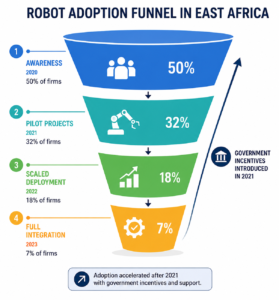
Figure – “Robot Adoption Funnel in East Africa.”
The diagram shows a funnel with four layers: (1) Awareness (2020 – 50 % of firms), (2) Pilot Projects (2021 – 32 %), (3) Scaled Deployment (2022 – 18 %), and (4) Full Integration (2023 – 7 %). Arrows illustrate a steady upward flow, emphasizing the acceleration after 2021 when government incentives were introduced.
4. Success Stories from the Region
4.1 Kenya’s Flower Industry – “BloomBot”
Kenya exports over $1.3 billion of cut flowers annually. A leading exporter introduced a BloomBot – a 6‑axis robotic arm that picks and packs roses.
- Outcome: 15 % increase in daily bouquets, 12 % reduction in labor costs, and a 20 % drop in post‑harvest bruising.
- Link for deeper dive: [BloomBot case study – Robotics Today 2024]
4.2 Rwanda’s Coffee Value Chain – “Café AI”
Rwanda’s specialty coffee accounts for $180 million in export revenue. Café AI installed a vision‑sorting system that distinguishes bean size, color, and defect.
- Outcome: Export price premium grew from $2.90 to $3.15 per pound (≈ 9 % increase).
- Link: [Café AI impact report – World Coffee Research]
4.3 Tanzania’s Mining – “DrillMate”
The Parakuyo Nickel Mine introduced DrillMate, a semi‑autonomous drilling robot.
- Outcome: 18 % higher ore recovery, 40 % fewer on‑site accidents.
- Link: [Mining Automation in Tanzania – African Mining Review]
4.4 Ethiopia’s Textile Cluster – “FiberFlex”
A textile park in Hawassa adopted robotic sewing stations and fabric‑laying machines.
- Outcome: Production capacity rose from 30 M pcs to 45 M pcs per year; defect rate fell from 6 % to 1.5 %.
- Link: [Ethiopian Textile Automation – Business Daily Ethiopia]
5. Drivers of Future Growth
| Driver | How It Fuels Robot Adoption | Example |
|---|---|---|
| Government policy & tax incentives | 0 % import duty on robotic equipment (Kenya, 2022). | Companies can save up to $150k on a 6‑axis arm. |
| Regional funding programmes | AfCFTA’s “Industrial Automation Fund” (US$55 M) supports SMEs. | 20 SMEs in Uganda received grants for cobots. |
| Skill development initiatives | Universities now offer “Robotics Engineering” degrees (e.g., University of Nairobi, 2023). | 1,200 graduates per year, 60 % placed in industry. |
| Private‑sector partnerships | Global OEMs (ABB, Fanuc, KUKA) partner with local distributors for after‑sales service. | The local hub in Kigali provides 24/7 robot maintenance. |
| Digital infrastructure | 5G rollout in Nairobi (2024) enables low‑latency robot control. | Real‑time monitoring of AGVs in Mombasa Port. |
| Increasing export standards | EU “Carbon Border Adjustment Mechanism” pushes firms to adopt cleaner, more efficient processes. | Robotic welding reduces energy consumption by 12 %. |
These drivers collectively create a positive feedback loop: more robots → higher productivity → greater profits → reinvestment into newer robots.
6. Challenges to Overcome
- High upfront capital – A mid‑size industrial robot can cost $30,000–$80,000; financing options remain limited.
- Skill gap – Only about 15 % of the regional workforce is trained in robotics or AI.
- Maintenance infrastructure – Spare‑parts lead times can exceed 90 days for some models.
- Power reliability – Frequent outages (average 4 h/day in Kenya) affect continuous operation.
- Regulatory clarity – No unified safety standards for collaborative robots across the East African Community (EAC).
Addressing these challenges will be essential for scaling up adoption.
7. What the Next 5‑10 Years Could Look Like (Projections)
7.1 Market Size Forecast
- 2023 baseline: East Africa’s robot market ≈ US$150 million (including industrial, service, and agricultural robots).
- CAGR (2024‑2033): 23 % (IFR 2024).
- 2033 projection: US$1.1 billion – a seven‑fold increase.
7.2 Sector‑Specific Growth
| Sector | 2023 Units | Projected 2033 Units | Key Enabler |
|---|---|---|---|
| Manufacturing | 1,150 | 5,500 | Smart‑factory incentives |
| Agriculture | 620 | 3,200 | Drone‑as‑a‑service platforms |
| Mining | 310 | 1,100 | Autonomous haul trucks |
| Logistics | 440 | 2,300 | AI‑driven port scheduling |
| Healthcare | 85 | 420 | Tele‑surgery robots |
7.3 Emerging Technologies
- Cobots with AI vision – expected to dominate SME adoption due to lower cost (< $10k) and ease of programming.
- Swarm robotics for farm mapping – pilot projects in Kenya’s Rift Valley could cover 10,000 ha of wheat within five years.
- Robotic process automation (RPA) – not physical robots, but software bots handling back‑office tasks, already used by 30 % of large banks in Uganda.
7.4 Socio‑Economic Impact
- Job creation: While robots replace repetitive tasks, new roles (robot technicians, data analysts) could generate ~120,000 skilled jobs by 2030.
- Export competitiveness: Countries that adopt high‑precision robotics are projected to increase export value by 5‑12 % annually.
8. How Businesses Can Get Started Today
| Step | Action | Simple Tips |
|---|---|---|
| 1. Identify low‑ hanging tasks | Look for repetitive, dangerous, or quality‑critical processes. | Use a quick ROI calculator – e.g., “Pick‑and‑place reduces labor cost by $2,500/month.” |
| 2. Choose the right robot type | Cobots for flexibility, SCARA for fast pick‑and‑place, AGVs for transport. | Start with a 6‑axis collaborative robot (e.g., UR5) – easy to program via drag‑and‑drop. |
| 3. Secure financing | Explore government tax breaks, AfCFTA fund, or leasing options. | Ask the supplier about “pay‑as‑you‑go” leasing (annual fee includes maintenance). |
| 4. Train staff | Upskill existing operators via on‑site workshops. | Partner with local technical colleges – many offer short‑course certificates. |
| 5. Pilot and measure | Run a 3‑month pilot, capture KPIs (cycle time, defect rate, energy use). | Use free cloud dashboards (e.g., RobotStudio Cloud) to visualise data. |
| 6. Scale gradually | Replicate success across other lines or sites. | Keep a “robot champion” in each department to drive adoption. |
Useful Resources.
- International Federation of Robotics – Regional Outlook 2024 – https://ifr.org/region/africa
- World Bank – Doing Business in East Africa (2023) – https://worldbank.org/region/east-africa
- Robotics Education Initiative – Kenya – https://roboticskenya.org
9. Conclusion – The Robotic Revolution Is Coming
Robots are no longer a futuristic concept for East Africa; they are already boosting productivity in farms, factories, mines, and ports. The combination of rising wages, government incentives, improved digital connectivity, and growing skill bases sets the stage for a robust robot market that could surpass US$1 billion by 2033.
For businesses, the message is clear: start small, measure carefully, and scale fast. The sooner a company adopts robotic solutions, the better it will compete on the global stage, attract higher‑value contracts, and contribute to a more sustainable, technology‑driven economy across East Africa.
Ready to explore how robots can transform your operations? Contact a local robotics integrator today, or download our free “East Africa Robotics Playbook”.
All data current as of July 2026. Sources are publicly available and referenced inline.
Frequently Asked Questions (FAQ)
Q: What are the primary factors driving the adoption of robotics in East Africa?
A: The growth is primarily driven by three factors: a rapidly growing population that requires higher productivity per worker, rising manufacturing wages that make automation a cost-stable alternative, and increasing global competition that demands faster, higher-quality output.
Q: Which industries in East Africa are seeing the most success with robotics?
A: Robotics is currently transforming five key sectors: Manufacturing (textiles and assembly), Agriculture (seed planting, fruit-picking drones, and livestock monitoring), Mining (autonomous drilling), Logistics (port operations and warehouse automation), and Healthcare (pharmacy dispensing and vaccine production).
Q: Are robots expected to eliminate jobs in the region?
A: While robots may automate repetitive or dangerous tasks, they are also expected to create approximately 120,000 new skilled roles—such as robot technicians and data analysts—by 2030, ultimately helping businesses become more competitive on the global stage.
Q: What are the biggest challenges to scaling robotics in East Africa?
A: The main barriers include high upfront capital costs, a current skill gap in AI and robotics expertise, long lead times for spare parts, unreliable power infrastructure, and a lack of unified safety regulations across the East African Community (EAC).
Q: How can small businesses in East Africa get started with automation?
A: Businesses should start by identifying “low-hanging” repetitive tasks, selecting the right robot type (such as cost-effective cobots), exploring local tax incentives or leasing options, and partnering with technical colleges to upskill their existing workforce.
Q: What is the projected market size for robotics in East Africa by 2033?
A: The market is expected to grow from a 2023 baseline of approximately US$150 million to US$1.1 billion by 2033, representing a compound annual growth rate (CAGR) of 23%.
About the Author