In the last decade, East Africa has emerged as a beacon of innovation. Often dubbed the “Silicon Savannah,” cities like Nairobi, Kigali, and Dar es Salaam have become hubs for groundbreaking tech solutions. From mobile money pioneers like M-Pesa to logistics platforms transforming agriculture, the region is proving that African problems are best solved by African entrepreneurs.
However, beneath the veneer of success stories and high-profile funding rounds lie deep-seated systemic challenges. While the potential is immense, the journey for a startup founder in East Africa is riddled with obstacles that go far beyond just having a good idea.
In this guide, we will explore the major hurdles facing the East African tech ecosystem and what they mean for the future of the region.
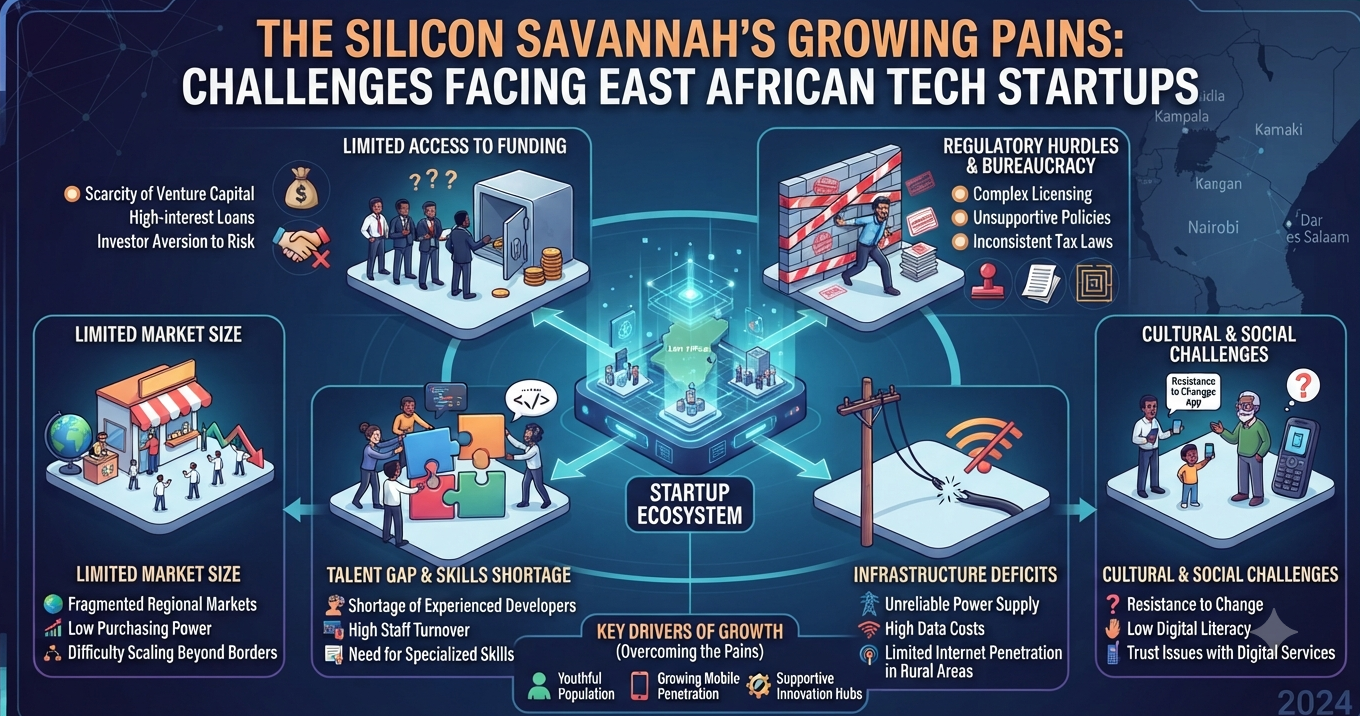
1. The Funding Gap: Survival of the Fittest
The most cited challenge for any startup is capital. While investment in African tech is growing, it is often skewed toward a few sectors (like fintech) and a few major hubs (like Kenya).
- The Problem: Most local startups struggle to bridge the “Valley of Death”—the gap between an initial idea and generating consistent revenue. Early-stage funding (seed and pre-seed) is particularly scarce. Many founders are forced to bootstrap, which limits their ability to scale rapidly.
- The Example: A budding agritech startup in rural Uganda might have a brilliant way to connect farmers to markets, but without access to venture capital, they cannot afford the logistics software or the marketing needed to grow beyond a single district.
- The Impact: Brilliant ideas die before they reach their potential because the founders run out of “personal runway.”
2. Infrastructure Deficits
Technology relies on a foundation. In the West, high-speed internet and reliable electricity are assumed. In many parts of East Africa, these are luxuries that must be managed.
- Power Connectivity: Frequent power outages can disrupt server operations and hardware-based startups.
- Internet Costs: While mobile data penetration is high, the cost of high-speed, reliable Wi-Fi for an office remains high compared to average local incomes.
- Logistics: E-commerce startups face the “last mile” problem. Delivering goods to customers becomes expensive and slow when addressing systems (like house numbers) are poorly mapped or non-existent.
3. The Talent War
Scaling a tech company requires specialized talent: software engineers, UX/UI designers, and data scientists. While East Africa produces thousands of graduates annually, there is a mismatch between academic curricula and industry needs.
- The Brain Drain: Many of the best developers often end up working remotely for companies in Europe or the US, where they can earn in Dollars or Euros. This makes it hard for local startups to compete on salary.
- The Gap: Companies end up spending significant time and money “re-training” new hires, which slows down development cycles.
4. Regulatory and Policy Hurdles
Governments in East Africa are still learning how to regulate the digital economy. Often, policies are either non-existent or outdated, creating confusion for entrepreneurs.
- Inconsistent Policies: A startup might operate successfully in one country, only to find that entering a neighboring market requires a completely different set of licenses, taxes, and compliance hurdles.
- The Cost of Compliance: For a small team, the administrative burden of registering a business, paying various taxes, and adhering to data protection laws can be overwhelming and costly.
Comparison of Key Challenges
| Challenge | Description | Impact on Startups |
|---|---|---|
| Funding | Lack of early-stage local capital. | High failure rate for early-stage ventures. |
| Infrastructure | Poor internet & erratic power. | Operational delays and high overheads. |
| Talent | Shortage of experienced senior devs. | Slow product development cycles. |
| Regulation | Red tape & lack of harmonized laws. | Barriers to regional expansion. |
| Market Size | Fragmented regional markets. | Limited growth without scaling cross-border. |
5. The “Fragmented Market” Dilemma
Africa is not one country; it is a collection of diverse markets. A startup launching in Kenya faces a wall when trying to expand into Tanzania or Ethiopia.
- Language and Culture: Different countries have different languages and cultural nuances that affect how products are marketed and used.
- Trade Barriers: Despite the existence of the African Continental Free Trade Area (AfCFTA), moving goods and services across borders remains a bureaucratic nightmare. A startup that works in Nairobi cannot simply “copy-paste” its model into Kigali without significant adjustments.
6. Access to Customers and Market Trust
Even when a great product is launched, startups face a “trust deficit.” Many consumers are skeptical of new tech solutions, preferring traditional ways of doing things.
- The Example: Fintech apps often struggle with user adoption because customers are wary of putting their money into a digital account instead of a physical bank or their “under-the-mattress” savings. Building brand trust requires heavy investment in customer education, which many startups cannot afford.
The Path Forward: How Do We Fix This?
While the list of problems is long, the East African tech scene is far from stagnant. To overcome these hurdles, several shifts are occurring:
- More Local Angel Investors: More successful African entrepreneurs are “paying it forward” by investing in the next generation. This reduces reliance on foreign capital.
- Increased Coding Bootcamps: Organizations like Andela, 365education, and local coding schools are bridging the skills gap, producing market-ready developers.
- Regional Policy Harmonization: Initiatives like the East African Community (EAC) are slowly working toward common standards, which will make it easier for startups to scale across borders.
- Community Hubs: Tech hubs like iHub in Nairobi provide more than just desk space; they provide community, mentorship, and access to networks that help startups survive.
Conclusion: A Marathon, Not a Sprint
The challenges facing East African tech startups are significant, but they are indicative of a region that is undergoing a rapid, albeit bumpy, transformation. The entrepreneurs in this region are some of the most resilient in the world. They are not just building businesses; they are building the infrastructure of the future.
For investors, policymakers, and supporters, the goal is clear: lower the barriers. By improving the regulatory environment, supporting local talent development, and increasing access to early-stage capital, East Africa can cement its place as a global leader in innovation.
Are you a founder navigating the East African ecosystem? Or an investor looking to support the next big thing? Understanding these challenges is the first step toward finding the solutions.
For further reading on African tech trends, check out TechCrunch Africa and Disrupt Africa.
About the Author