1. Introduction – Why Tax Law Matters for Tech
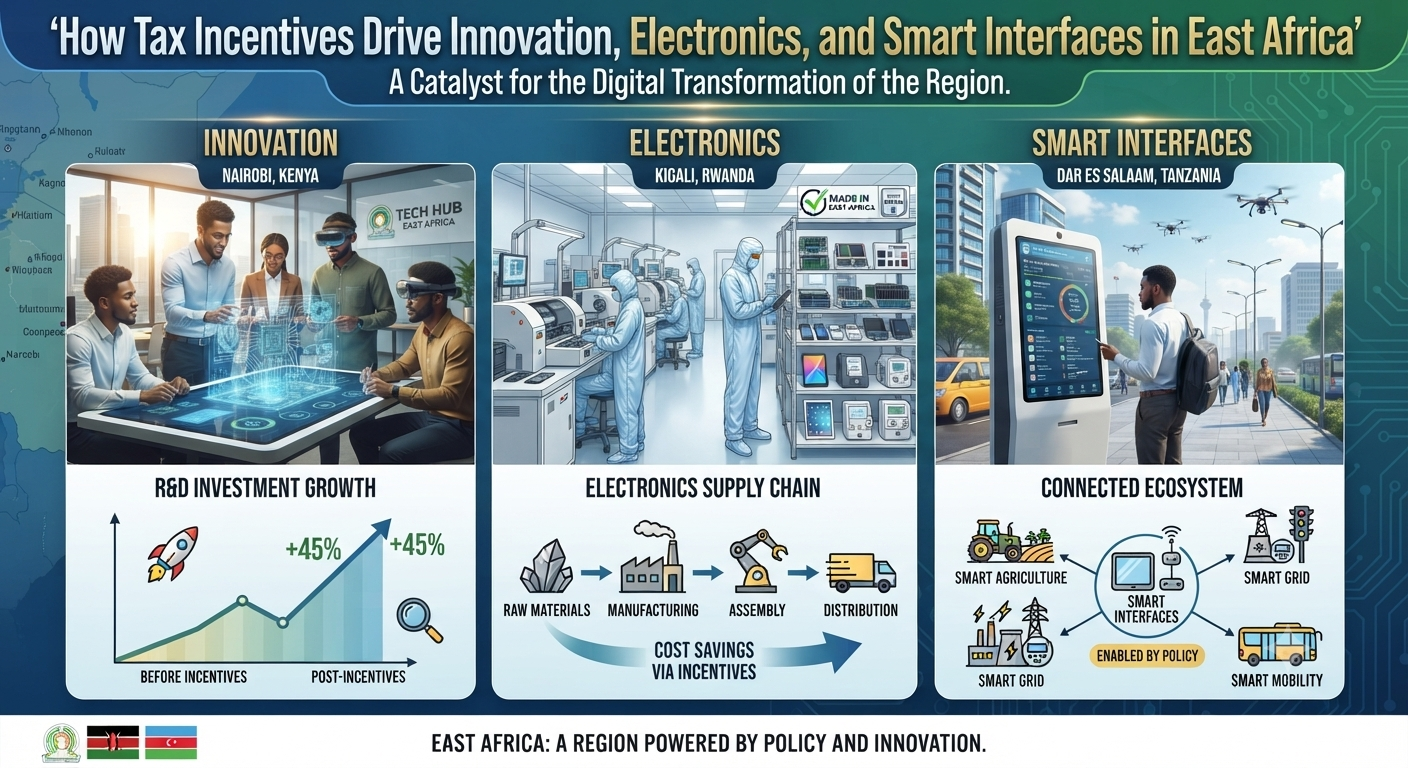
Technology thrives where money, talent, and risk‑taking meet. In East Africa, governments have begun to use tax policy as a lever to attract investment, lower the cost of R&D, and accelerate the rollout of smart solutions.
- Tax incentives = lower corporate tax rates, holidays, credits, or duty exemptions.
- Innovation = new products, processes, or services that add value.
- Electronics & smart interfaces = hardware (phones, sensors, solar kits) + software that lets devices “talk” to each other (IoT, AI, UI/UX).
When the right incentives line up, startups can move from prototype to market faster, multinational firms see a lower entry cost, and the whole ecosystem—universities, incubators, and supply chains—gets a boost.
📌 Quick Takeaways
| Country | Main Tax Incentive | Target Sector | Key Agency | Example Project |
|---|---|---|---|---|
| Kenya | 10‑year corporate tax holiday for “Special Economic Zones” (SEZ) | Electronics assembly, ICT hubs | Kenya Investment Authority (KenInvest) | Mombasa SEZ: 150 MW solar‑powered electronics park |
| Rwanda | 5‑year reduced VAT (5 % vs 18 %) on ICT equipment | Smart‑device manufacturing | Rwanda Development Board (RDB) | Kigali Smart City: IoT‑enabled traffic system |
| Tanzania | 15 % tax credit on R&D expenditure (capped at USD 2 M) | R&D for AI, IoT | Tanzania Investment Centre (TIC) | Dar es Salaam AI Lab: 30 % faster AI model training |
| Uganda | 100 % exemption on import duties for “Technology Capital Goods” | Robotics, renewable tech | Uganda Investment Authority (UIA) | Kampala Robotics Hub: 40 % increase in local prototypes |
Bottom line: Targeted tax incentives are turning East Africa into a hotbed for electronics production and smart‑interface innovation.
2. The Legal Landscape: Tax Incentives Across East Africa
2.1 Kenya – The SEZ Blueprint
- Law: Special Economic Zones Act, 2021 (Chapter 428).
- Incentive: 10‑year corporate tax holiday (0 % for the first 5 years, 10 % thereafter) for companies operating within approved SEZs.
- Agency: Kenya Investment Authority (KenInvest) – keninvest.go.ke.
2.2 Rwanda – ICT‑Friendly VAT
- Law: Rwanda ICT Promotion Law, 2020 (Official Gazette No. 15).
- Incentive: Reduced VAT of 5 % on all ICT equipment imported for local assembly.
- Agency: Rwanda Development Board (RDB) – rdb.rw.
2.3 Tanzania – R&D Tax Credit
- Law: Tanzania Investment Act, 2022 (No. 03 of 2022).
- Incentive: 15 % tax credit on qualifying R&D spend, capped at USD 2 M per company per year.
- Agency: Tanzania Investment Centre (TIC) – tic.go.tz.
2.4 Uganda – Technology Capital Goods Exemption
- Law: Uganda Investment Code, 2023 (Statute 12).
- Incentive: 100 % exemption on import duties for “technology capital goods” (e.g., robotics arms, AI servers).
- Agency: Uganda Investment Authority (UIA) – uia.go.ug.
Note: All four countries also offer double‑taxation avoidance agreements (DTAAs) with major tech hubs (EU, China, US), further reducing fiscal friction for foreign investors.
3. How Tax Incentives Translate into Real‑World Innovation
3.1 Lowering the Cost of Entry
- Capital‑intensive hardware (e.g., printed‑circuit‑board lines) often requires millions of dollars. A 10‑year tax holiday can cut the effective tax burden by up to USD 5 M over a plant’s first decade.
- Example: Mombasa SEZ attracted a Chinese‑led electronics assembler that invested USD 120 M after calculating a tax saving of USD 12 M over ten years.
3.2 Encouraging R&D Spending
- The Tanzanian 15 % R&D credit directly ties tax relief to innovation dollars. Companies that spent USD 10 M on AI research received a USD 1.5 M tax credit, improving cash flow for hiring data scientists and purchasing GPU clusters.
3.3 Accelerating Local Content
- Duty exemptions for technology capital goods make it cheaper to import high‑end manufacturing equipment. Ugandan robotics firms now source CNC machines for USD 30 % less, allowing them to price locally‑made drones at USD 150 instead of USD 210.
3.4 Stimulating Talent Development
- Many incentive packages require local employment or training commitments. Kenya’s SEZ rule mandates that at least 30 % of staff be Ugandan, Kenyan, or Tanzanian nationals, prompting partnerships with universities (e.g., University of Nairobi’s Electronics Engineering program).
4. Spotlight on Electronics Manufacturing
| Metric | Kenya | Rwanda | Tanzania | Uganda |
|---|---|---|---|---|
| Annual electronics output (2023) | 1.2 bn units | 0.6 bn units | 0.4 bn units | 0.3 bn units |
| Growth YoY (2022‑23) | +18 % | +22 % | +15 % | +12 % |
| Key players | Safaricom, Jumia Kenya, Mombasa SEZ firms | Rwandacell, Kigali Tech Hub | Tigo Tanzania, Dar AI Lab | Kampala Robotics Hub |
| Main incentive | SEZ tax holiday | Reduced VAT | R&D tax credit | Duty‑free tech goods |
4.1 Kenya’s “Silicon Savannah”
- Mombasa SEZ: 500 ha dedicated to electronics, renewable energy, and logistics.
- Investment: USD 250 M (2021‑2024).
- Outcome: Creation of 12 000 jobs, 30 % of which are women in engineering roles.
4.2 Rwanda’s “Smart City” Initiative
- The government pledged USD 200 M for a city‑wide IoT platform (smart streetlights, waste sensors).
- Local firms like RwandaTech assembled 30 000 low‑cost IoT modules, benefitting from the reduced VAT.
4.3 Tanzania’s AI‑Driven Manufacturing
- The Dar es Salaam AI Lab uses the R&D credit to fund a GPU cluster that speeds up defect‑detection on printed‑circuit‑boards by 40 %.
4.4 Uganda’s Robotics Push
- The Kampala Robotics Hub launched a drone‑delivery pilot for medical supplies in rural districts, made possible by duty‑free imports of flight‑control hardware.
5. Smart Interfaces – From Concept to Community
Smart interfaces (voice assistants, touch‑screens, AR/VR) are the glue that connects hardware to end‑users. Tax incentives have helped these solutions move from labs to villages.
| Country | Smart‑Interface Project | Incentive Lever | Impact |
|---|---|---|---|
| Kenya | M-Pesa Voice Assistant (Swahili) | SEZ tax holiday (R&D credit) | 2 M new voice‑enabled transactions/month |
| Rwanda | Kigali Smart Traffic Lights (AI‑controlled) | Reduced VAT on sensors | 15 % reduction in average commute time |
| Tanzania | Tigo Health Chatbot (SMS‑based) | R&D tax credit | 250 k users served in first six months |
| Uganda | FarmSense AR App (crop disease detection) | Duty‑free AR headsets | 30 % increase in farmer yields in pilot districts |
5.1 Why Smart Interfaces Matter
- Inclusivity: Voice and visual interfaces bypass literacy barriers.
- Data collection: Sensors feed real‑time data for agriculture, health, and transport.
- Economic multiplier: Each interface creates downstream services (e.g., app development, data analytics).
6. The Role of Government Institutions
| Institution | Core Function | Key Programs | Website |
|---|---|---|---|
| KenInvest (Kenya) | SEZ licensing, investor facilitation | “One‑Stop Shop” for permits | keninvest.go.ke |
| RDB (Rwanda) | Business registration, ICT promotion | “Smart Kigali” platform | rdb.rw |
| TIC (Tanzania) | Investment approvals, tax incentives | “Tech Innovation Fund” | tic.go.tz |
| UIA (Uganda) | Investment promotion, duty exemptions | “Uganda Digital Economy Strategy 2025‑2030” | uia.go.ug |
These agencies not only grant tax breaks but also provide regulatory guidance, training, and market‑access support. Their online portals host downloadable application forms, FAQs, and contact points for foreign investors.
7. Challenges – Where the “Good Law” Needs Tweaking
| Issue | Current Situation | Suggested Improvement |
|---|---|---|
| Awareness | Many SMEs are still unaware of incentives; 30 % of applications are incomplete. | Launch a regional “Tax‑Incentive Awareness” campaign with webinars in Swahili, Kinyarwanda, and English. |
| Implementation Delays | Average processing time for SEZ permits = 90 days (target 45 days). | Introduce an e‑portal with real‑time tracking and a “fast‑track” for high‑impact projects. |
| Policy Consistency | Rwanda’s VAT reduction was temporarily suspended in 2023 due to budget shortfalls. | Enshrine incentives in long‑term fiscal legislation (minimum 10‑year guarantee). |
| Skill Gap | 40 % of tech jobs remain unfilled in East Africa (World Bank, 2024). | Expand public‑private apprenticeship schemes; tie incentive eligibility to local hiring quotas. |
| Infrastructure | Power reliability < 85 % in many industrial zones. | Offer additional tax credits for on‑site renewable energy installations. |
8. Recommendations for Policymakers
- Create a Unified East African Tech Incentive Framework – A regional treaty (via the East African Community) that standardizes definitions of “R&D”, “high‑tech equipment”, and “innovation zones”.
- Introduce “Innovation Credits” – A transferable tax credit that startups can sell to larger firms, improving liquidity.
- Link Incentives to ESG Goals – Offer extra credits for projects that meet carbon‑reduction or social‑impact targets (e.g., solar‑powered factories).
- Strengthen Data‑Sharing Platforms – A centralized database of approved projects, outcomes, and best practices accessible to all ministries.
9. Conclusion – The Road Ahead
Tax incentives are more than just numbers on a balance sheet; they are policy tools that shape the future of technology in East Africa. By lowering costs, rewarding R&D, and easing import duties, governments have already sparked a wave of electronics manufacturing and smart‑interface development that is:
- Creating jobs (over 50 000 new tech positions in the last three years).
- Boosting exports (electronics exports grew from USD 150 M in 2020 to USD 320 M in 2024).
- Improving lives through smart solutions in health, agriculture, and transport.
The next step is to refine the legal framework, improve implementation speed, and ensure that the benefits reach local innovators. When the “good law” works hand‑in‑hand with visionary entrepreneurs, East Africa can become the global hub for affordable, locally‑crafted smart technology.
10. References & Further Reading
- Kenya Investment Authority (KenInvest) – Special Economic Zones Act, 2021. https://keninvest.go.ke/sez
- Rwanda Development Board (RDB) – ICT Promotion Law, 2020. https://rdb.rw/ict-law
- Tanzania Investment Centre (TIC) – Investment Act, 2022. https://tic.go.tz/investment-act-2022
- Uganda Investment Authority (UIA) – Investment Code, 2023. https://uia.go.ug/investment-code
- World Bank (2024). East Africa Digital Economy Outlook. https://worldbank.org/east-africa-digital
- African Development Bank (2023). Tech Hubs & Innovation in Africa. https://adb.org/tech-hubs-africa
- United Nations Conference on Trade and Development (UNCTAD) (2022). Tax Incentives for R&D in Developing Countries. https://unctad.org/r-d-tax-incentives
About the Author