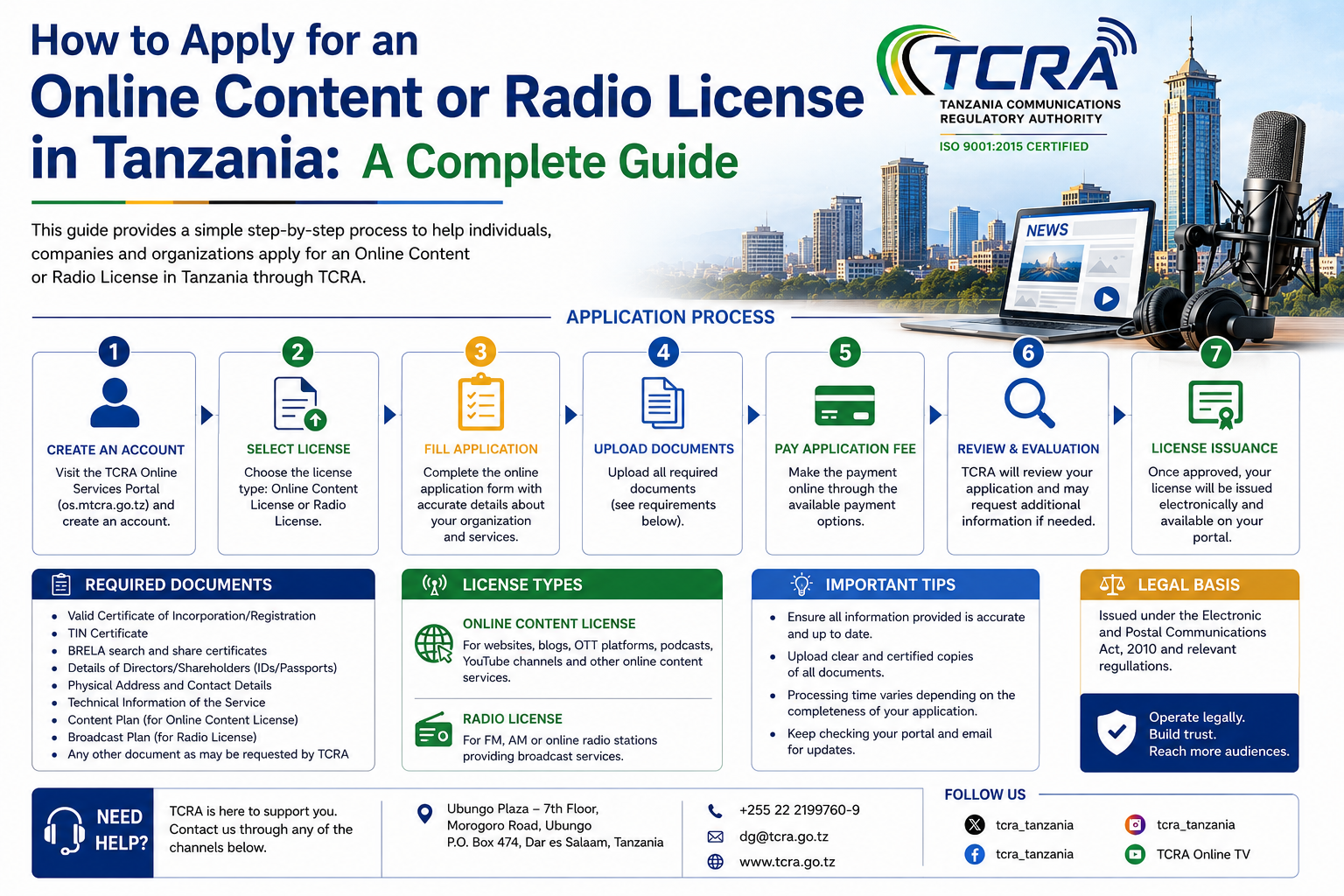
Looking to launch a podcast, YouTube channel, blog, or radio station in Tanzania? Our definitive, step-by-step guide explains exactly how to apply for an online content license or radio license, covering requirements, costs, and expert tips for success.
Why a License Is Your First and Most Important Step?
So, you have a brilliant idea for a podcast, a vibrant YouTube channel, a compelling news blog, or the dream of launching Tanzania’s next hit radio station. That’s fantastic! The digital and broadcast landscape in Tanzania is growing rapidly, offering immense opportunities for creators and entrepreneurs.
But before you hit “record” or “publish,” there’s one crucial, non-negotiable step you must take: obtaining the proper license.
In Tanzania, the Tanzania Communications Regulatory Authority (TCRA) is the government body responsible for regulating all communications services, including broadcasting and online content. Operating without a license isn’t just a minor oversight; it’s a breach of national law that can lead to fines, legal action, and the shutdown of your operation.
This guide is your roadmap. We’ll walk you through the entire process, from understanding which license you need to submitting your application and receiving that all-important certificate. We’ll use simple, clear English to demystify the jargon and provide direct links to the official resources you’ll need.
Remember: Getting licensed isn’t just about avoiding penalties. It builds credibility with your audience, advertisers, and partners, showing that you are a legitimate and professional operator.
Understanding the Two Main License Types
The TCRA has distinct categories for different types of media services. For this guide, we are focusing on the two most relevant for modern creators:
- Online Content Service Provider License: This is for anyone who publishes or distributes audio-visual or audio content via the internet. Think of this as the primary license for the digital age.
- Who needs it? YouTubers, podcasters, bloggers who run video/audio platforms, streaming services (like a local Netflix or Spotify alternative), online radio stations that do not use traditional airwaves, and social media influencers who monetize their content regularly.
- Key Regulation: This falls under the Electronic and Postal Communications (Online Content) Regulations, 2020.
- Radio Broadcast License: This is the traditional license for transmitting audio content via radio waves (FM/AM frequencies).
- Who needs it? Anyone starting a terrestrial radio station. This is a more complex, capital-intensive process.
- Key Regulation: This falls under the National Broadcasting Commission Act, 1993, and subsequent regulations.
Important Note: If you run an online-only radio station (via website or app), you typically fall under the Online Content Service Provider License. If you broadcast via both online streams and traditional FM/AM waves, you will likely need both licenses.
Step 1: Determine Your License Category
Before you fill out any forms, be sure which license applies to your venture. Ask yourself:
- How will my audience access my content?
- Only through websites, apps, and social media platforms? -> You likely need an Online Content License.
- Through a radio set (FM dial in a car, at home)? -> You need a Radio Broadcast License.
- What is the scale of my operation?
- Is it a personal blog/podcast I run as a hobby? The regulations may have thresholds, but it’s always safer to check with TCRA. Monetization often triggers the licensing requirement.
- Is it a planned commercial venture with multiple employees? -> You definitely need a license.
Pro Tip: When in doubt, start by contacting the TCRA. It’s better to clarify now than to invest time and money only to find you’re non-compliant.
Step 2: Gather Your Required Documents
The documentation is similar for both license types, though the Radio License requires more technical plans. Having these ready in digital and physical copies will speed up your process.
General Document Checklist:
- Application Form: Official forms are available on the TCRA website or at their offices.
- Company/Entity Registration:
- A Certificate of Incorporation (for a company) or Business License (for an individual or firm).
- TIN (Tax Identification Number) Certificate.
- BRELA registration documents (if it’s a company).
- Personal Identification of Key Personnel:
- Copies of National IDs (NIDA) or Passports for all directors/partners and the proposed chief executive.
- Proof of Premises:
- A copy of the lease agreement or title deed for your office/studio.
- Site layout plan or address details.
- Technical Plan (Crucial for Radio):
- A detailed document outlining your proposed frequency, transmission power, coverage area map, transmitter site, and equipment specifications.
- For online content, this is simpler: a description of your content delivery method (e.g., via a specific website, YouTube channel, podcast hosting platform).
- Financial Plan:
- A business plan that includes projected revenue streams, startup capital, and operational budget. This demonstrates your viability.
- Content Schedule/Programming Plan:
- A sample of what you plan to broadcast/publish. This should include details on news, entertainment, educational content, and the proportion of local vs. international content.
- Non-Refundable Application Fee Payment: Proof of payment of the initial application fee (see Fee schedule below).
Step 3: The Application Process for an Online Content License
This process is generally more straightforward than for a radio license.
1. Access the Forms: Visit the official TCRA website: https://www.tcra.go.tz. Look for the “Online Services” or “Downloads” section to find the “Application for Online Content Service Provider License” form. You can often find it under regulations for online content.
2. Complete the Application Form: Fill it out meticulously. Be clear and concise about your service. Describe your target audience, the nature of your content (entertainment, news, educational), and your proposed operating model.
3. Compile Your Document Package: Assemble all the documents from the checklist in Step 2. Ensure they are clear, certified copies where required.
4. Pay the Application Fee: The fee structure is set by the TCRA and can be updated. As of our last check, the non-refundable application fee for an online content license was approximately TZS 500,000. Always verify the current fee on the TCRA website or by calling them. Payments are typically made via bank slip to a TCRA account.
5. Submit Your Application: You can submit your complete application package:
- In-person: At the TCRA offices in Dar es Salaam or their regional offices.
- By Post/Courier: To the Director General, TCRA, P.O. Box 474, Dar es Salaam.
Keep a copy of everything and get a receipt or acknowledgment of submission.
6. Review and Compliance: The TCRA will review your application. They may contact you for clarifications or additional information. They will also ensure your content does not violate the laws of Tanzania, including incitement, hate speech, or content detrimental to national security or public order.
7. License Issuance: Once approved, you will receive an Online Content Service Provider License. This license is valid for a specific period (usually one year) and must be renewed. You are legally required to display your license details on your platform.
Step 4: The Application Process for a Radio Broadcast License
This is a more rigorous, multi-stage process due to the use of public airwaves and the need for spectrum management.
1. Pre-Application Consultation: It is highly recommended to have a pre-application consultation with the TCRA Frequency Management Department. This is to discuss the availability of your desired frequency in your target area. Broadcasting on an occupied or unsuitable frequency is impossible.
2. Submit a Formal Expression of Interest: You will formally apply to the TCRA and the Ministry of Information, Communications and Information Technology for a license to operate a broadcasting service. This initial application demonstrates your intent and qualifications.
3. The Public Competition Process: Radio frequencies are a scarce public resource. For new licenses, the government often holds a public competition or tender. Your application will need to stand out in terms of your business plan, programming quality, and technical feasibility.
4. Detailed Technical and Programming Submission: If shortlisted, you will submit the full documentation package, with a massive focus on:
- The Technical Plan: This is reviewed by TCRA frequency experts to ensure it meets all engineering standards and won’t cause interference.
- The Programming Proposal: Reviewed for compliance with Tanzanian content policies, including requirements for local content (often a high percentage of Tanzanian music and productions) and educational material.
5. License Issuance and Fee Payment: Upon successful evaluation and approval, you will be issued a Radio Broadcast License. You must then pay the full annual license fee, which is substantial and varies based on the broadcast area (local, regional, national) and service type. Fees can range from several million to tens of millions of Tanzanian Shillings.
6. Equipment Permit: You must also obtain a separate Permit for Importation and Operation of Broadcasting Equipment from the TCRA for all your transmission gear.
Step 5: Fees, Processing Times, and What to Expect
| License Type | Estimated Application Fee | Annual License Fee (Example) | Estimated Processing Time |
|---|---|---|---|
| Online Content Provider | ~TZS 500,000 (Non-refundable) | Varies (Can be based on revenue, ~TZS 500,000+) | 4 – 8 weeks |
| Radio Broadcast | ~TZS 1,000,000+ (Non-refundable) | Millions to Tens of Millions TZS (Varies greatly) | 3 – 12+ months |
Important Notes:
- Fees are subject to change. Always confirm with TCRA before making payments.
- Processing times are estimates. Complex applications or high volumes can cause delays.
- The annual license fee must be renewed promptly to avoid penalties.
- You may be required to pay other fees to different government bodies (e.g., BRELA, TANAPA for content-related levies).
Key Resources and Official Links
Bookmark these official sites. This is where you get your most accurate and up-to-date information.
- Tanzania Communications Regulatory Authority (TCRA): https://www.tcra.go.tz – Your primary source for all forms, regulations, and fee schedules.
- National e-Government Authority (NeGA): https://www.nega.go.tz – Some application processes may be integrated here for online submission.
- Business Registration and Licensing Agency (BRELA): https://www.brela.go.tz – For company registration.
- Ministry of Information, Communications and Information Technology: https://www.micit.go.tz – For policy directives and some radio license approvals.
- Tanzania Revenue Authority (TRA): https://www.tra.go.tz – For TIN registration and tax compliance.
Frequently Asked Questions (FAQ)
Q1: I just have a small personal podcast with no ads. Do I still need a license? A: The regulations apply to the distribution of content to the public via online platforms. While enforcement on very small hobbyist operations may vary, the law is clear. If your audience grows or you monetize, you are operating without a license. It’s safest to consult TCRA.
Q2: How long is the license valid, and how do I renew it? A: Licenses are typically valid for one year. TCRA will notify you of the renewal period. You must apply for renewal before expiry, submit updated documents (like a current business license), and pay the annual fee.
Q3: Can a foreigner own a media company in Tanzania and get a license? A: Tanzania allows foreign investment, but there are ownership caps in the media sector. Typically, a Tanzanian must hold a majority stake. You must check the latest Foreign Investment Act and TCRA regulations.
Q4: What happens if I operate without a license? A: TCRA enforcement officers can impose hefty fines, seize your equipment (computers, transmitters), and shut down your website or station. In serious cases, it can lead to prosecution and imprisonment.
Q5: Do I need separate licenses for each platform? A: Generally, no. An Online Content Service Provider License covers your service as a whole, whether you are on YouTube, your own website, or a podcast app. You must declare all platforms where your content is available.
Conclusion: Your Content, Legally Ready for Tanzania and the World
Navigating the licensing process might seem daunting, but it is a fundamental step to building a sustainable and respected media presence in Tanzania. It is the mark of a professional operator who is invested in contributing positively to the national information ecosystem.
By following this guide, you have a clear path: Determine your license type, gather your documents meticulously, engage with the TCRA, and submit a complete application.
Don’t let paperwork discourage you from sharing your voice, story, or service. The opportunity in Tanzania’s media space is vast. By securing your Online Content License or Radio License, you are not just complying with the law; you are building a foundation of trust and legitimacy for your brand.
Ready to start? Your first step is simple: Visit the TCRA Website and download the relevant application form. Your future audience is waiting.
Disclaimer: This guide is for informational purposes and is based on publicly available regulations as of late 2023/early 2024. Laws and procedures can change. Always verify all details directly with the relevant Tanzanian authorities, primarily the TCRA, before taking action.
About the Author