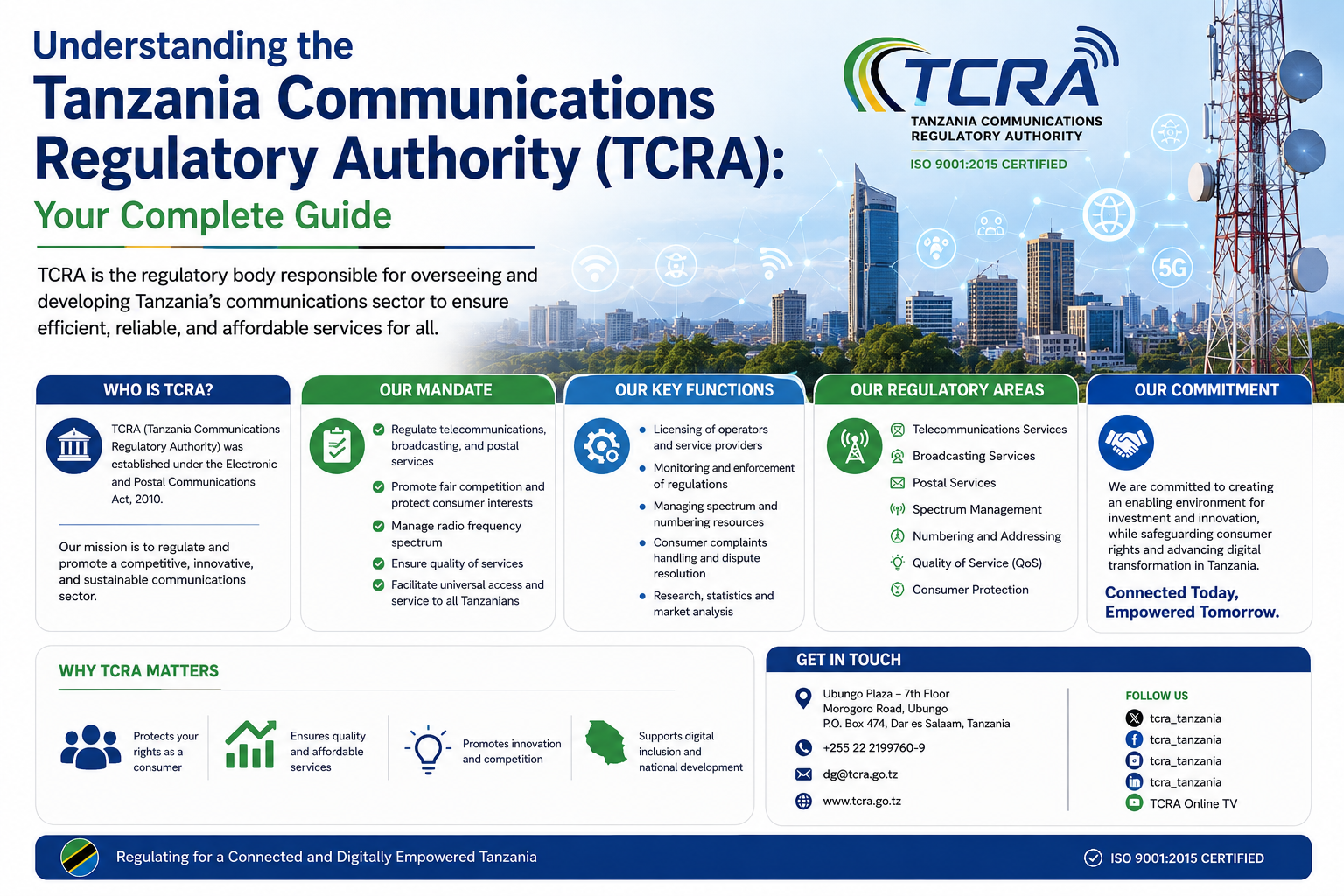
Navigating the world of telecommunications and broadcasting can be complex, but for individuals and businesses in Tanzania, one key organization helps make sense of it all: the Tanzania Communications Regulatory Authority (TCRA). Whether you’re a consumer wanting to understand your rights, a tech entrepreneur launching an app, or a media professional setting up a station, the TCRA plays a crucial role in your landscape.
This comprehensive guide will walk you through everything you need to know about the TCRA, from its core mission to the practical steps you can take to engage with it.
Who Exactly is the TCRA?
At its simplest, the Tanzania Communications Regulatory Authority (TCRA) is the national body responsible for overseeing and regulating the communications and broadcasting sectors in Tanzania. Think of it as the traffic controller and rulebook writer for the country’s digital and airwave highways.
Established by the TCRA Act No. 12 of 2010, it replaced several previous bodies to create a unified, independent regulator. Its headquarters are in Dar es Salaam, with zonal offices across the country to ensure nationwide coverage.
The Core Mission and Vision
To understand the TCRA’s work, it helps to know its guiding principles:
- Mission: To facilitate the development of a modern, efficient, and innovative communications sector that contributes significantly to the national economy while protecting the interests of all stakeholders.
- Vision: To be a leading regulatory authority that fosters a vibrant, inclusive, and sustainable communications ecosystem.
In practice, this means the TCRA has a dual focus: promoting growth and ensuring protection.
The Six Core Functions of the TCRA
The TCRA’s responsibilities are vast, but they can be grouped into six primary functions.
1. Licensing and Authorization
This is perhaps its most visible function. The TCRA is the sole authority for granting licenses to operate in the sector. This includes:
- Telecommunications Service Providers: Mobile network operators (like Vodacom, Airtel, Tigo), internet service providers (ISPs), and fixed-line operators.
- Broadcasting Services: Radio stations, television stations, and their content distributors (including cable and satellite TV).
- Postal Services: Operators of courier and postal services.
- Other Services: Providers of specialized services like satellite networks, call centers, and internet cafes.
Step-by-Step: How to Apply for a License
- Visit the TCRA Website: Start at the official TCRA website.
- Navigate to the Licensing Portal: Look for the “eServices” or “Licensing” section. The TCRA has largely moved to an online system.
- Identify the Correct License Category: There are different types of licenses (e.g., Unified License for telecom, Broadcasting License). Read the guidelines carefully.
- Prepare Your Documents: Typically, this includes your business registration documents, detailed business plan, technical specifications, proof of financial capacity, and details of key personnel.
- Pay the Application Fee: Fees vary by license type and are specified in the application guidelines.
- Submit Online and Wait: Upload your documents, submit the application, and await a response. The TCRA has a set timeline for reviewing applications.
2. Spectrum Management
Radio spectrum is a finite national resource. The TCRA manages and allocates it to prevent interference and ensure it’s used efficiently.
- It assigns specific frequency bands for different uses (mobile communications, TV broadcasting, emergency services, aviation, etc.).
- It issues frequency licenses to operators.
- It monitors the spectrum to identify and resolve illegal transmissions or interference.
3. Tariff Setting and Market Competition
To prevent monopolies and protect consumers, the TCRA:
- Monitors Prices: It ensures that call, data, and SMS rates are fair and reasonable.
- Promotes Competition: It studies the market to prevent anti-competitive behavior, such as price-fixing or predatory pricing by dominant players.
- Interconnection Regulation: It mandates that different networks can connect at fair rates, allowing you to call someone on a different network.
4. Quality of Service (QoS) Standards
The TCRA sets minimum performance standards for service providers. This covers:
- Network uptime and reliability.
- Call drop rates.
- Internet speed consistency.
- Customer service response times. The TCRA regularly publishes QoS reports for different operators, empowering consumers to make informed choices.
5. Consumer Protection
This is where the TCRA acts as the guardian of the public. Its consumer protection mandate includes:
- Handling Complaints: It operates a formal system for consumers to report issues with service providers (billing errors, poor service, fraud).
- Issuing Guidelines: For example, it has issued strict rules on unsolicited messages, premium services, and SIM card registration.
- Public Awareness: Educating consumers about their rights and how to use services safely.
6. Standardization and Equipment Approval
To ensure safety and interoperability, all telecommunications and broadcasting equipment imported into or used in Tanzania must be approved by the TCRA.
- This applies to mobile phones, routers, radio transmitters, TV sets, etc.
- Using unapproved equipment can lead to network interference, legal penalties, or safety hazards.
- The TCRA provides a list of approved equipment and a process for getting new devices certified.
How the TCRA Impacts Your Daily Life
You might not see the TCRA, but you experience its work constantly:
- As a Mobile Phone User: The rules that prevent your number from being spammed with ads, the requirement that your SIM card is registered, and the fact that your signal must meet a minimum quality standard are all enforced by the TCRA.
- As a TV or Radio Listener: The diverse array of channels you can access, the requirement that they broadcast a certain amount of local content, and the management of the frequencies they use are TCRA’s doing.
- As a Business Owner: If you use VoIP phones, run a Wi-Fi hotspot, or import tech gadgets, TCRA regulations affect your operations and costs.
- As a Concerned Citizen: The TCRA’s management of spectrum ensures emergency services (police, fire, medical) have clear, dedicated channels to operate during crises.
A Practical Guide: Filing a Consumer Complaint with the TCRA
If you’ve exhausted attempts to resolve an issue with your service provider directly, the TCRA is your next stop. Here’s how to do it:
Step 1: Gather Your Evidence. Collect all relevant information: your account details, billing statements, communication records with the provider (emails, chat logs), dates, and a clear description of the problem.
Step 2: Choose Your Channel.l The TCRA offers multiple ways to lodge a complaint:
- Online: The most efficient method is through the TCRA Consumer Complaints Portal. Create an account, fill out the form, and attach your evidence.
- Phone: You can call the TCRA consumer helpline.
- In-Person: Visit the nearest TCRA zonal office.
Step 3: Submit and Track.k Once submitted, you will receive a reference number. Use this to track the progress of your complaint through the online portal. The TCRA will acknowledge receipt and initiate an investigation, acting as a mediator between you and the service provider.
Step 4: Resolution The TCRA will review the case and provide a ruling. If the provider is found at fault, the TCRA can order them to provide compensation, a refund, or correct their service.
The Future of Regulation in Tanzania’s Digital Age
The TCRA isn’t static. It faces evolving challenges and opportunities:
- Digital Migration: The shift from analog to digital broadcasting is a massive project overseen by the TCRA.
- 5G and Next-Gen Networks: Preparing the spectrum and regulatory framework for 5G and IoT (Internet of Things).
- Cybersecurity: Developing frameworks to protect critical infrastructure and consumer data.
- Universal Access: Working to extend reliable communication services to rural and underserved areas.
Conclusion: The Bedrock of a Connected Tanzania
The Tanzania Communications Regulatory Authority is far more than a bureaucratic entity. It is the foundation upon which Tanzania’s digital future is being built. By managing scarce resources, fostering competition, setting fair rules, and standing up for consumer rights, the TCRA ensures that the benefits of modern communication—connectivity, information, entertainment, and economic opportunity—are accessible to all Tanzanians.
Understanding its role empowers you as a consumer, an entrepreneur, and a citizen. For the latest updates, regulations, and services, always refer to the official source: The Tanzania Communications Regulatory Authority (TCRA) Website.
Suggested Resources:
- TCRA Official Website: https://www.tcra.go.tz/
- Tanzania Government Portal: https://www.tanzania.go.tz/
- East African Communications Organizations (EACO): https://www.eacoorg.int/ (For regional context)
- International Telecommunication Union (ITU): https://www.itu.int/en/Pages/default.aspx (The UN agency for ICTs, a global counterpart)
About the Author