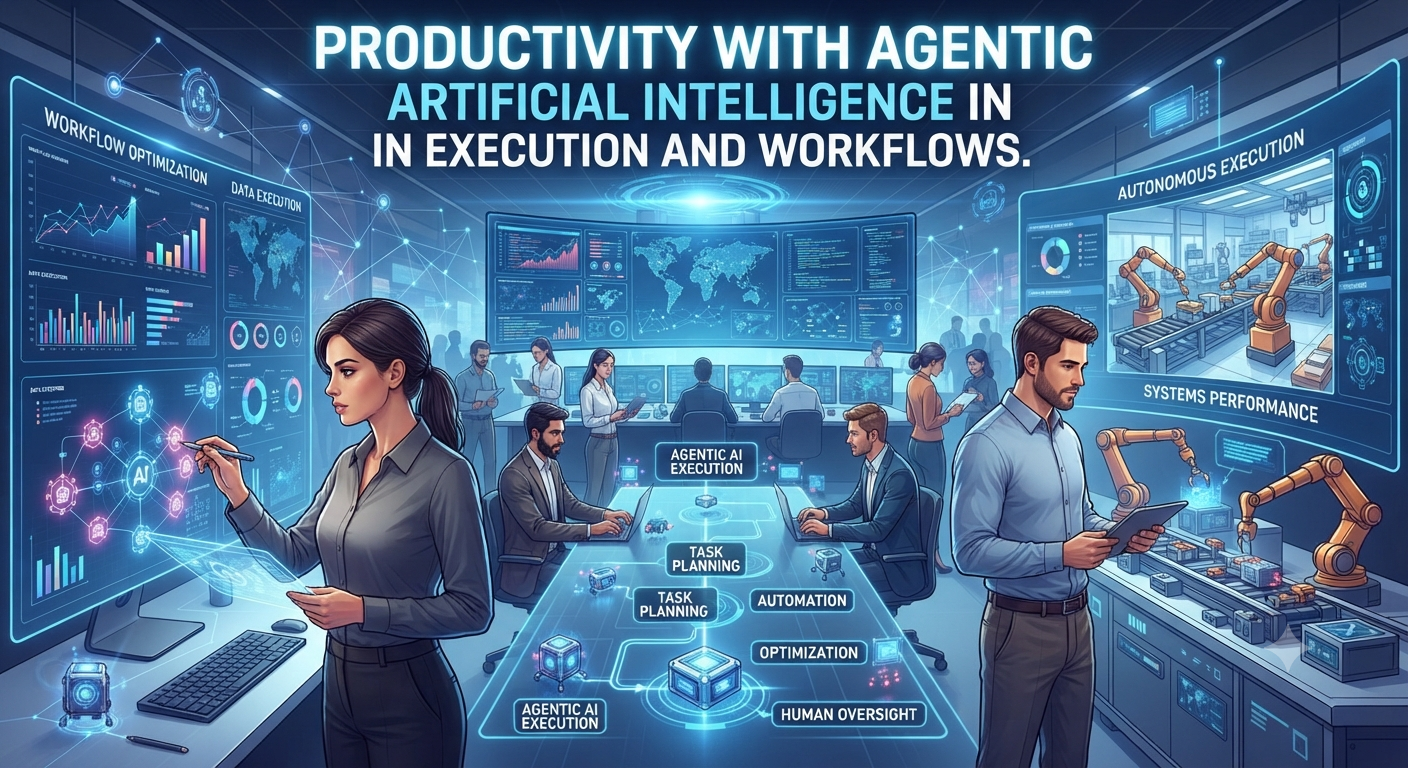
Productivity with agentic Artificial Intelligence in execution and workflows.
The discussion about Artificial Intelligence in companies has moved beyond the stage of curiosity and become a fixed topic in board meetings. Budgets exist, pilot projects are popping up everywhere, and presentations talk about advanced automation and intelligent agents. But when someone asks which workflows have materially improved because of AI agents, the atmosphere usually falls silent. The central point here is simple: the problem is not technology; it’s the operational model.
Agentic AI: It’s not a magic button you flip on top of the stack of systems you already have. It represents a shift in how work is defined, who does it, and how decisions are made daily. Instead of viewing agents as abstract software, it makes more sense to treat them as a well-managed team: each agent with a specific role, clear boundaries, a supervisor, a set of tools at their disposal, and a continuous, data-driven improvement cycle.
This practical vision is being tested at scale by initiatives such as the AWS Generative AI Innovation Center, which has already helped thousands of companies bring AI to production with measurable productivity gains. The accumulated experience shows a very consistent pattern: exciting pilot projects die when they run into poorly defined processes, messy data, non-existent governance, and a lack of alignment between technology, business, security, and compliance. Behind almost every stalled project lies a common problem: no one has properly defined what success means.
The real problem: an execution gap, not a technology gap.
If you ask in an executive meeting whether the company is investing enough in AI, the answer will likely be yes. Now, if the question is: which specific workflows are clearly improved by AI agents, and how do we measure that?, the answer is usually an awkward silence. What separates these two questions is not the absence of a language model, nor the lack of the right vendor. It’s the absence of an operational model for agents.
In organizations where Agentic AI truly works, three basic things tend to be present:
- The work is defined in painful detail. People can explain, step by step, what goes into the process, what happens at each stage, what it means to be completed, and how to handle exceptions.
- Autonomy is clearly defined. Each agent knows its limits, when it needs to escalate to humans, and where its actions can be reviewed, corrected, or blocked.
- Improvement is a habit, not a one-off project. There’s a routine for looking at what the agents did, where they helped, where they caused problems, and deciding what to adjust in the next iteration.
When these three pillars are absent, the symptoms repeat themselves: proof-of-concept projects that never leave the lab, pilot programs that work technically but don’t fit into real-world workflows, leadership frustration, and the feeling that too much is being spent on AI for a meager return.
What makes a job truly agency-friendly?
Many people still start with the wrong question: where can we use an agent? A much healthier approach is to reverse the logic and ask: what job already seems, in practice, like a role an agent could fill? In real life, this usually requires four characteristics.
1. Work with a well-defined beginning, end, and purpose.
A good candidate for an agent-friendly workflow always has a clear trigger and a verifiable end goal. A refund request arrives, an invoice is received, a support ticket is opened, a contract needs to be reviewed. The agent needs to be able to understand:
- when you have enough information to get started,
- What goal are you pursuing?
- At what point is the task completed or needs to be passed on to a human?
This goes beyond simply stating the beginning and the end. The team needs to be able to describe what is done with quality, including edge cases, exceptions, and ambiguous situations. If the team can’t explain what constitutes a well-finished project, the work isn’t yet mature enough for an agent to take over.
2. Need for judgment using multiple tools
A productive agent is not just an automation script that follows fixed steps. It reasons about what it needs to do, decides which systems to consult, interprets what it finds, and chooses the next action based on the context. The difference from traditional automation is that the path is not fully coded beforehand: the agent navigates, adapts, and recognizes when the situation is beyond its competence.
But for that, it needs well-defined tools. Stable APIs, secure integrations, mechanisms for reading and writing to critical systems, and a standardized way of triggering communications. If today the process depends on email exchanges, loose spreadsheets, and decisions made in informal conversations, there is a lot of work to be done in terms of process organization and tooling before agentic AI makes sense in that workflow.
3. Observable and measurable success
Another crucial point is the ability of anyone outside the team to look at the result and say whether it is correct or needs correction, without guessing intent. This can involve indicators such as:
- ticket resolution timeframe,
- completeness and consistency of a form,
- correct balance in a transaction,
- whether the response provided to the customer actually resolves the need.
But it’s not enough to just audit the results. In the context of Agentic AI, it is extremely important to understand how the agent arrived at that decision: what data it used, what tools it consulted, what alternatives it considered, and why it chose a specific path. Without this trail, it becomes difficult to improve the agent over time and almost impossible to defend its decisions in an audit or incident.
4. Fail-safe mode when something goes wrong.
Every real-world system makes mistakes, and AI agents are no different. The practical question isn’t whether the agent will fail, but what happens when it does. The best initial cases for Agentic AI involve tasks with errors:
- easily detectable,
- quickly correctable,
- without irreversible damage.
Simple examples: a poorly classified ticket can be redirected, a bad draft response can be edited before being sent, an incorrect prioritization can be adjusted by the team. However, approving a high-value payment, executing a critical financial operation, or triggering a legally binding communication is another risky conversation.
Practical tip: starting with workflows where the agent generates recommendations, and the human still guides the final action is usually a very healthy balance. Over time, as controls, tests, and metrics mature, it’s possible to move on to tasks where the agent closes the loop on its own in well-defined parts of the process.
Designing the agent’s job: from desire to job description
Before discussing models, frameworks, or providers, it’s worth doing an almost HR-like exercise: writing the agent’s job description. This simple step exposes a good portion of the alignment problems.
- What exactly does the agent do? Screening? Data enrichment? Response generation? Orchestration of steps between systems?
- What tools does he need permission to use? Internal systems, external APIs, communication tools, knowledge bases.
- How do we define success? Speed, quality, reduced manual effort, decreased rework, and improved user experience.
- What happens when he doesn’t know what to do? Clear escalation rules, fallback routes, visible logs for later analysis.
If this job description cannot be filled out objectively, the problem is not with the template, but with understanding the workflow. And this, however painful it may be in the short term, is valuable information: it shows that it’s still time to organize the work, not to automate it.
Measuring productivity in workflows with Agentic AI
Without metrics, productivity gains become mere impressions. In scenarios with agentic AI, measurement is even more important because many gains are distributed: small time savings at each stage, fewer interruptions, less invisible rework.
A practical way to start is to compare the before and after along three basic axes:
- Execution speed. How long does the workflow take from trigger to completion? Has there been a consistent reduction or only occasional variations?
- Quality of results. Have errors decreased? Have complaints decreased? Has adherence to rules and policies improved or worsened?
- Human workload. How many human interactions are needed to close a case? How much time does the team spend on repetitive tasks that the agent has taken over?
If theAgentic AIIf things are going well, the trend is to see faster cycles, fewer manual adjustments, and a measurable decrease in mechanical tasks performed by people. In parallel, it makes sense to link these operational metrics to the indicators that truly matter to the business: revenue, cost, risk, customer satisfaction, SLA compliance, and so on.
Another often-overlooked aspect is the effect on the experience of those operating the workflow. When agents remove tedious tasks – copying and pasting data, combining information from multiple screens, filling in redundant fields, creating drafts – mental space is freed up for what truly requires reasoning, creativity, or empathy. Even if this doesn’t always show up in a formal graph, the team’s morale changes. And this change, in practice, sustains the adoption of AI in the long term.
Autonomy with responsibility: limits, supervision, and continuous improvement.
Putting agents to work on critical processes without governance is asking for trouble. The healthy approach is to treat agents as digital colleagues: they have autonomy, but that autonomy is limited by policies, monitored by metrics, and periodically reviewed based on evidence.
Some important elements of this governance:
- Clear limits of authority. What can the agent approve alone? Up to what value? In which scenarios do they always need to consult a human?
- Detailed audit trails. Records of what data was accessed, what tools were used, what decisions were made, and in what context.
- Structured review routine. A weekly or bi-weekly cadence in which the team looks at errors, edge cases, opportunities for improvement, and fine-tunes configurations.
This discipline transforms the operation into something alive: the agent gets better over time, the team learns to use the resources with more confidence, and leadership begins to see AI as a stable part of the machine, not as an isolated experiment.
Aligning C-level executives, process owners, and digital agents.
No single technical architecture can solve misalignment between areas. In projects with agentic Artificial Intelligence, three groups need to be connected at all times: executive leadership, process owners, and the teams that design and operate the agents.
Leadership has the role of treating AI as a matter of business execution, not just innovation. This implies:
- Define workflow priorities where the impact will be most visible.
- To ensure that IT, data, security, and business areas work together,
- to demand not only experiments, but concrete results in productivity and quality.
Process owners are the link between theory and practice. They are the ones who know the shortcuts, the workarounds, the exceptions that don’t appear in the pretty diagram. When they are left out, agents are built on an idealized version of the work, and quickly come into conflict with reality. When they participate from the beginning, they help to choose the right place to start, where to place human checkpoints, and how to translate business rules into agent behaviors.
Finally, the agents themselves become part of an operational ecosystem. Instead of a single all-powerful agent, the healthiest scenario is to have several specialized agents, each with a well-defined mission within the flow. This modular approach facilitates evolution, reduces the risk of widespread failures, and allows testing new ideas without destabilizing processes that already work.
Ultimately, operationalizingAgentic AIIt’s not about having the most sophisticated architecture or the most famous model on the market. It’s about transforming how work happens, aligning technology, people, processes, and governance around a simple question: which workflows are materially better today because of AI agents – and how do we know this without relying on opinion?
About the Author