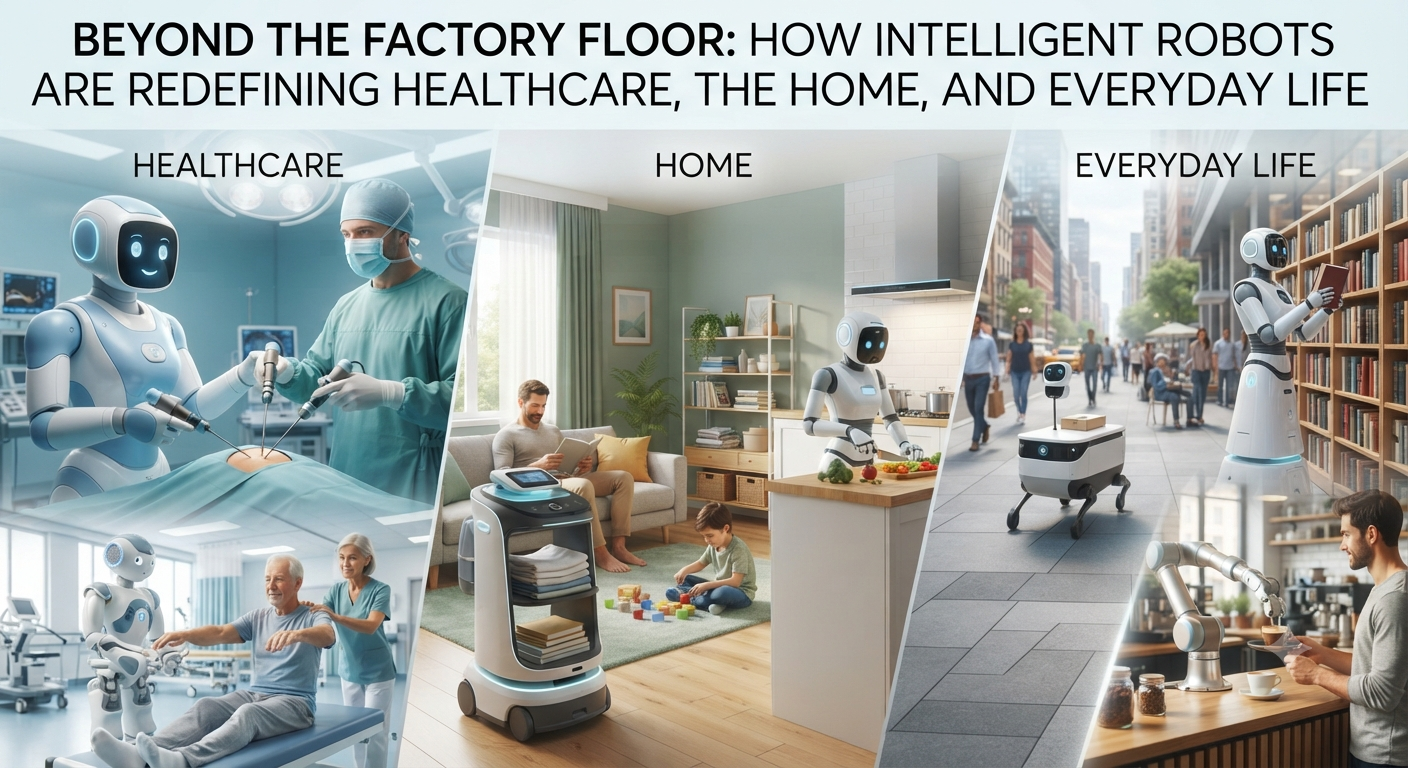
Discover how intelligent robots are evolving beyond industrial automation to transform healthcare, domestic tasks, agriculture, and service industries. Explore the AI-driven future of robotics.
1. The Evolution of the Machine
For decades, the public perception of robotics was anchored in the heavy manufacturing hubs of the mid-to-late 20th century. Mention the word “robot,” and most people envisioned massive, orange mechanical arms enclosed behind safety cages, rhythmically welding automotive frames, stamping sheet metal, or moving heavy pallets. These early industrial machines were triumphs of mechanical engineering, but they were essentially blind, deaf, and rigid. They executed pre-programmed sequences with high speed and high repetition, yet possessed zero awareness of their surroundings. If a human stepped into their path, the machine would not adapt; it had to be shut down completely to prevent catastrophe.
Today, that paradigm is fundamentally shattered.
We are experiencing a historical transition: the shift from industrial automation to intelligent autonomy. Driven by rapid breakthroughs in artificial intelligence (AI), computer vision, advanced sensor fusion, and high-density power systems, robots are leaving the factory cage. They are moving into our operating rooms, navigating busy municipal sidewalks, caring for the elderly, maintaining agricultural fields, and taking up residence in our kitchens and living rooms.
This transition is not merely about mechanical execution; it is about cognition. Intelligent robots no longer just act—they perceive, reason, learn, and adapt to non-deterministic environments. They are transforming from specialized industrial tools into pervasive multi-domain collaborators that are quietly altering the structure of daily life, global labor dynamics, and individual human capabilities.
2. From Automation to Autonomy: The AI Paradigm Shift
To understand why intelligent robots are breaking out of traditional industrial boundaries, one must first look at the technological architecture powering them.
Historical automation relied on scripted routines. An engineer programmed every joint movement using explicit coordinate geometry. If an object moved by a fraction of a millimeter, the robot failed.
Modern robotics, by contrast, operates at the intersection of mechanical design and embodied artificial intelligence.
+-----------------------------------------------------------------+
|                    EMBODIED AI ARCHITECTURE                     |
+-----------------------------------------------------------------+
|  SENSING             | LiDAR, Cameras, Haptic Feedback, Radar    |
|  PERCEPTION          | Computer Vision, Spatial Mapping (SLAM)  |
|  COGNITION           | Neural Networks, Machine Learning, LLMs  |
|  ACTION/EXECUTION    | Inverse Kinematics, Adaptive Motors     |
+-----------------------------------------------------------------+
The Core Pillars of Modern Intelligent Robotics
- Simultaneous Localization and Mapping (SLAM): Enables a robot to enter an unknown, dynamic environment, map it in real-time, and determine its own position within that map.
- Edge Computing and Computer Vision: Deep learning algorithms analyze high-definition video streams instantaneously, allowing machines to differentiate between a piece of furniture, a household pet, a surgical tool, or a human limb.
- Advanced Sensor Fusion: Combining inputs from light detection and ranging (LiDAR), ultrasonic sensors, infrared cameras, and tactile haptic feedback gives machines a multi-layered perception of physical space far superior to basic human eyesight.
- Reinforcement Learning (RL): Instead of requiring millions of lines of custom code for every physical movement, robots now learn motor skills in high-speed digital simulations before executing them in the real world.
Because of these advances, robots are no longer static assets restricted to structured, controlled environments. They are dynamic agents capable of operating alongside humans within the unpredictable, unstructured spaces of real life.
3. Robotics in Modern Medicine: Precision, Care, and Rehabilitation
Perhaps no sector illustrates the profound impact of intelligent robotics more clearly than modern healthcare. Where industrial robots prioritize brute strength, medical robots emphasize micro-precision, adaptability, and spatial sensitivity.
                  +-----------------------------------+
                  |   ROBOTICS IN MODERN HEALTHCARE   |
                  +-----------------------------------+
                                    |
         +--------------------------+--------------------------+
         |                          |                          |
         v                          v                          v
+------------------+       +------------------+       +------------------+
| Surgical Systems |       | Rehabilitation   |       | Patient Care &   |
| (Micro-Precision |       | (Exoskeletons &  |       | Clinical Support |
|  & Tele-surgery) |       |  Smart Prosthetics)      |  (Elder Care &   |
+------------------+       +------------------+       |   Disinfection)  |
                                                      +------------------+
Surgical Robotics and Hyper-Precision
Minimally invasive surgery has been reshaped by robotic platforms like the da Vinci Surgical System and newer entrants such as the Hugo™ RAS system. These units do not perform surgeries autonomously; rather, they act as ultra-precise robotic extensions of the surgeon’s hands.
- Tremor Filtration: Computer algorithms filter out the natural human hand tremors of a surgeon, translating high-level motor inputs into microscopic movements.
- Enhanced Kinematics: Robotic micro-instruments provide a range of motion far exceeding the human wrist, allowing complex tissue manipulation through incisions less than an inch long.
- 3D Visualization: High-definition, stereoscopic vision systems allow surgeons to view tissue structures with deep spatial perception and high magnification.
Looking forward, autonomous microsurgery is on the horizon. Experimental systems are beginning to independently perform soft-tissue suturing and complex intestinal anastomoses under human supervision, delivering consistency that reduces surgical error rates.
Rehabilitation and Advanced Prosthetics
Intelligent robotics is also restoring mobility to thousands of individuals living with physical disabilities or neurodegenerative conditions.
- Robotic Exoskeletons: Wearable devices equipped with intelligent joint actuators and torque sensors allow patients recovering from stroke, spinal cord injuries, or traumatic brain injury to regain movement. Systems like EksoNR and ReWalk analyze a patient’s micro-movements and provide dynamic structural assistance, gradually teaching the nervous system how to walk again.
- Mind-Controlled Prosthetics: By combining machine learning algorithms with electromyographic (EMG) sensors—and in some cutting-edge cases, direct neuro-interface arrays—modern prosthetics allow users to move individual mechanical fingers simply by thinking about the movement. The neural network decodes intent in real time, transforming biological signals into fluid mechanical motions.
Elderly Care and Nursing Support
The global population is aging rapidly. According to data from the United Nations, by 2050, one in six people in the world will be over age 65. The resulting shortage of healthcare personnel is driving the deployment of caregiving robots.
| Healthcare Robot Category | Key Features | Primary Impact |
|---|---|---|
| Physical Transfer Robots | High-load actuators, soft-touch padding, force feedback | Safely transfers mobility-impaired patients from bed to wheelchair without injuring staff. |
| Social Companion Robots | Natural Language Processing (NLP), facial expression recognition | Mitigates cognitive decline, tracks medication schedules, alerts emergency services upon fall detection. |
| Autonomous Disinfection Bots | UV-C radiation, autonomous spatial routing | Eliminates up to 99.9% of hospital-acquired pathogens without exposing human staff to harsh chemicals. |
4. The Domestic Revolution: Intelligent Robots at Home
While healthcare represents high-stakes engineering, the residential market represents the highest volume of consumer interaction with physical AI. Household robotics is progressing far beyond basic automatic vacuum cleaners.
From Simple Cleaners to Spatial Stewards
First-generation domestic robots relied on rudimentary bump sensors—changing direction only when hitting an obstacle. Today’s domestic floor cleaners and lawn mowers leverage spatial intelligence.
- LiDAR and AI Vision Integration: Modern vacuums do not just clean floor space; they build precise dynamic 3D maps of a home. They recognize temporary obstacles (e.g., shoes, electrical cables, pet waste) and dynamically recalculate their path.
- Multi-Functional Home Logistics: Outdoor lawn-care robots operate without complex perimeter boundary wires, using Real-Time Kinematic (RTK) GPS systems and optical sensors to maintain precise lawns while avoiding local wildlife.
Traditional Vacuum (1st Gen):  [Move] -> [Bump Object] -> [Random Pivot] -> [Move]
Modern AI Robot (Current Gen): [Scan LiDAR/Vision] -> [Identify Object] -> [Reroute Path]
Household Companions and LLM Integration
The sudden maturity of Large Language Models (LLMs) like GPT-4 and Claude is accelerating the cognitive capabilities of home service robots. By combining physical hardware with generative AI language models, robots are shifting from execution units to interactive partners.
Instead of needing a complex series of commands:
“Navigate to room B, activate arm, search for plastic cylinder, pick up object…”
A user can simply issue a natural language request:
“Can you bring me the water bottle off the kitchen counter?”
The robot’s cognitive model translates high-level natural language into low-level mechanical steps:
- Translates “water bottle” into a visual search target via computer vision.
- Identifies the “kitchen counter” within its internal 3D map of the residence.
- Computes the required inverse kinematics to grasp the bottle without crushing it.
- Executes real-time obstacle avoidance while returning to the user.
Humanoid prototypes—such as the Tesla Optimus, Figure 01, and Unitree G1—are explicitly designed to operate within human-centric residential spaces, aiming to tackle complex household chores like folding laundry, loading dishwashers, and preparing simple meals.
Privacy and Security Concerns in the Smart Home
As intelligent robots populate private homes, they gather massive amounts of sensitive data: spatial topographies, daily human routines, interior video streams, and audio logs.
To ensure public trust, the industry must tackle several key security risks:
- Unencrypted Telemetry Streams: Video feeds transmitted via unsecured clouds expose homes to unauthorized third-party monitoring.
- Physical Safety Hazards: As domestic robots become stronger, software bugs or malicious exploits pose physical safety threats to children and pets.
- Data Monetization Concerns: Consumer advocates caution against business models where companies sell user residential mapping data to third-party advertisers.
5. Field and Service Robotics: Transforming Outdoor Work
Away from operating rooms and homes, intelligent robotics is quietly revolutionizing open-air industries—including agriculture, supply chain logistics, and public safety.
                      +---------------------------------------+
                      |       FIELD AND SERVICE ROBOTICS      |
                      +---------------------------------------+
                                          |
         +--------------------------------+--------------------------------+
         |                                |                                |
         v                                v                                v
+------------------+             +------------------+             +------------------+
| Precision        |             | Supply Chain     |             | Public Safety    |
| Agriculture      |             | & Logistics      |             | & Disaster       |
| (Autonomous      |             | (Autonomous      |             | Response         |
|  Tractors/Drones)|             |  Fleet Delivery) |             | (Exploration)    |
+------------------+             +------------------+             +------------------+
Precision Agriculture and Farming
Modern agriculture faces unprecedented pressures: a shrinking global workforce, soil degradation, severe weather disruptions, and the urgent need to increase food yields. Intelligent agricultural robotics addresses these structural bottlenecks through precision operations.
- Selective Herbicide Application: Autonomous weed-control robots use high-speed optical camera arrays to spot weeds among row crops. Rather than spraying an entire field with herbicides, micro-dosing actuators target individual weed leaves. This reduces chemical application by up to 90%, preserving soil health and slashing input costs.
- Automated Selective Harvesting: Delicate crops like soft fruits, strawberries, and tomatoes have historically resisted mechanical harvesting. Today’s soft-robotics grippers, guided by RGB-D (red-green-blue-depth) cameras, gauge fruit ripeness using spectral color analysis and harvest soft produce without causing damage.
- Autonomous Swarms: Drone swarms systematically map crop fields via multispectral imaging, identifying early signs of nutrient deficiency, insect infestation, or irrigation failures weeks before they become visible to the naked human eye.
Last-Mile Delivery and Supply Chain Logistics
Global e-commerce reliance has placed immense stress on global supply chains. Autonomous Mobile Robots (AMRs) are fixing bottlenecks in distribution hubs and city environments alike.
                     +----------------------------------+
                     |    AMR vs traditional AGV        |
+--------------------+----------------------------------+----------------------------------+
| Feature            | Traditional AGVs                 | Intelligent AMRs                 |
+--------------------+----------------------------------+----------------------------------+
| Path Navigation    | Magnetic tape / floor wires      | Dynamic SLAM / Computer Vision   |
| Adaptability       | Fixed, immobile routes           | Dynamic re-routing around assets |
| Installation       | Expensive floor infrastructure   | Zero facility modification       |
| Deployment Time    | Months                           | Days                             |
+--------------------+----------------------------------+----------------------------------+
On public streets, compact six-wheeled delivery robots—developed by companies like Starship Technologies—are delivering groceries and takeaway food across college campuses and suburban neighborhoods. They navigate sidewalks, adjust to pedestrian foot traffic, and cross busy intersections entirely on their own.
Hazardous Environment Operations and Disaster Response
Intelligent machines step in where human presence poses unacceptable safety risks. Quadrupedal robots (such as Boston Dynamics’ Spot) and specialized tracked units are actively deployed in high-risk zones:
- Nuclear Decommissioning: Mapping radioactive levels inside damaged power plants without risking human radiation poisoning.
- Disaster Search and Rescue: Navigating unstable rubble after earthquakes, searching for structural voids, and using thermal imaging sensors to locate survivors.
- Industrial Infrastructure Inspection: Climbing remote offshore oil rigs, toxic chemical vats, and high-voltage electrical substations to identify structural fatigue, leaks, or thermal hot spots.
6. Human-Robot Collaboration: The Rise of “Cobots”
Industrial manufacturing is not standing still; it is evolving through the deployment of Collaborative Robots, or “Cobots.”
Historically, traditional industrial robots operated behind safety fences. If a human breached the safety barrier, an emergency cut-off killed power to the cell. Cobots break down these physical walls entirely.
TRADITIONAL INDUSTRIAL ROBOT                NEXT-GEN COLLABORATIVE ROBOT (COBOT)
+-------------------------------+           +-------------------------------+
|  [ DANGER ZONE ]              |           |  [ SHARED WORKSPACE ]         |
|  +--------+   Heavy Steel     |           |  +--------+    Soft-Skin      |
|  | Robot  |   Safety Cage     |           |  | Robot  |    Dynamic Torque  |
|  +--------+                   |           |  +--------+    Sensors        |
|                  (Worker)     |           |      (Worker)                 |
|  [NO ENTRY]     [OUTSIDE]     |           |    [SIDE-BY-SIDE WORKING]     |
+-------------------------------+           +-------------------------------+
Key Differences of Collaborative Systems:
- Force and Torque Feedback Limits: Integrated joint sensors measure resistance thousands of times per second. If a cobot nudges a human co-worker, it detects the unexpected force and stops movement instantly.
- Simplified Programming via Demonstration: Instead of writing code, factory workers teach a cobot a new task simply by moving its mechanical arm through the desired path. Internal sensors record the movements, converting physical guidance into execution paths within minutes.
- Ergonomic Support: Cobots perform monotonous, high-strain physical tasks—such as lifting heavy components, driving screws, or applying industrial adhesives—leaving high-level assembly tasks, quality control, and visual inspections to human operators.
This shift changes the narrative around automation: instead of replacing human operators, intelligent cobots act as physical multipliers that improve safety, reduce repetitive strain injuries, and boost output.
7. Ethical, Economic, and Social Implications
The rise of intelligent robotics brings structural challenges that extend far beyond technical mechanical execution.
Economic and Workforce Displacement
While cobots offer productive collaboration, autonomous systems across driving, retail, logistics, and agriculture will displace traditional labor roles.
- The Transition Gap: While automation creates high-value jobs in software engineering, robot maintenance, and data analysis, these roles require specialized skill sets. Retraining lower-skilled physical laborers remains a critical challenge for global economic policy.
- Shift in Capital vs. Labor: The economic gains of widespread automation run the risk of over-concentrating wealth among technology owners and corporate operators, amplifying income inequality if not accompanied by thoughtful economic interventions.
Algorithmic Bias and Deterministic Ethics
As autonomous units assume responsibility for physical actions in real-time environments, ethical choices must be encoded into their decision systems:
- Autonomous Vehicle Safety Dilemmas: If an autonomous vehicle faces an unavoidable collision, how does its AI model weigh the safety of vehicle occupants against surrounding pedestrians?
- Healthcare Resource Distribution: If semi-autonomous systems manage patient triage during medical crises, what variables determine how life-saving care is prioritized?
8. The Future Outlook: The Next Decade of Embodied AI
We are rapidly moving toward a future where intelligent, embodied AI units are integrated directly into the physical infrastructure of society. Over the coming decade, several core technological convergences will redefine what intelligent machines can accomplish:
+-----------------------------------------------------------------+
|               NEXT-DECADE ROBOTICS CONVERGENCES                 |
+-----------------------------------------------------------------+
|  GENERALIST HUMANOID PLATFORMS                                  |
|  Bipedal designs running multi-modal foundation models.         |
|                                                                 |
|  TACTILE SENSORY EVOLUTION                                      |
|  Artificial skin arrays with high-density pressure feedback.    |
|                                                                 |
|  SOLID-STATE BATTERIES & MATERIAL SCIENCE                       |
|  Higher energy-to-weight ratios for multi-day operating limits. |
|                                                                 |
|  CLONE-AND-DISTRIBUTE SWARM LEARNING                            |
|  Global neural networks updating instances across fleets.       |
+-----------------------------------------------------------------+
- General-Purpose Humanoid Forms: Moving away from single-task specialized machinery toward flexible humanoid forms that easily operate within physical infrastructure designed for human bodies (e.g., stairs, door handles, light switches, standard toolsets).
- Artificial Tactile Skins: Advances in soft-matter electronics will grant robots sensory feedback comparable to human fingertips—allowing machines to safely grip delicate glassware, assemble fragile micro-electronics, or treat human skin with sensitivity.
- Swarm Intelligence and Federated Learning: When a single intelligent robot learns to navigate a dynamic physical obstacle, that learning experience can be vectorized and deployed instantly across an entire global fleet via cloud updates.
- Solid-State Energy Densities: Next-generation battery technologies will allow lightweight mobile platforms to operate continuously for 12 to 24 hours on a single charge, removing the operational limitations of frequent docking stops.
9. Frequently Asked Questions (FAQs)
What makes an “intelligent robot” different from traditional automation?
Traditional automation relies on fixed, pre-programmed code executed in controlled environments. Intelligent robots leverage AI, advanced computer vision, and continuous sensor feedback to analyze their surroundings, adapt to unexpected disruptions, learn through real-world experience, and operate safely alongside humans in unstructured spaces.
Will intelligent robots take away human jobs?
While robots will automate repetitive, physically intensive, or hazardous tasks, they also alter the job market rather than simply shrinking it. Automation creates demand for system designers, robotics technicians, maintenance crews, and software engineers, while shifting human workers toward high-level strategy, creative problem-solving, and empathetic caregiving roles.
Are humanoid robots really practical for household chores?
Yes, humanoid formats are gaining real traction because our entire physical world—from counter heights and door handles to staircases—was engineered explicitly for human bodies. A general-purpose humanoid robot can adapt to diverse human environments without requiring homes or businesses to be retrofitted with specialized infrastructure.
How safe are surgical robots?
Surgical robots are extremely safe and operate under strict oversight. In current clinical setups, the robot does not act autonomously; it serves as a hyper-precise mechanical interface directed directly by a surgeon. It enhances accuracy by eliminating natural hand tremors and providing magnified, stereoscopic 3D visualization.
What are the main privacy concerns with domestic home robots?
Domestic robots use LiDAR, cameras, and audio arrays to map their environments and interpret commands. If security protocols are weak, this spatial data, home layout details, or interior footage could be vulnerable to cyberattacks, unauthorized surveillance, or intrusive corporate tracking.
10. Conclusion
The transformation of robotics from industrial machinery to intelligent partners marks a pivotal shift in how human beings interact with the physical world.
By leaving the factory floor, intelligent robots are stepping up to tackle some of society’s most pressing structural crises: mitigating care shortages for aging populations, expanding access to hyper-precise surgical procedures, lifting manual burdens in the home, boosting agricultural yields sustainably, and keeping humans out of dangerous operational environments.
The path forward requires balancing innovation with responsible governance. As engineers push the limits of embodied artificial intelligence, business leaders, ethicists, and policymakers must work together to ensure these physical machines remain safe, accessible, and aligned with human well-being. Intelligent robots are no longer just an intriguing sci-fi trope—they are active partners helping build a safer, more productive world.
About the Author