If you look back just two or three years, the digital marketing ecosystem feels almost unrecognizable. What was once heralded as “futuristic technology”—generative AI tools, immersive spatial experiences, and hyper-personalized consumer journeys—is now simply the price of entry.
We have officially moved past the initial chaos of the AI boom into a period of strategic integration. Marketers are no longer asking, “Should we use AI?” Instead, they are asking, “How do we stand out in a world where everyone is using AI?”
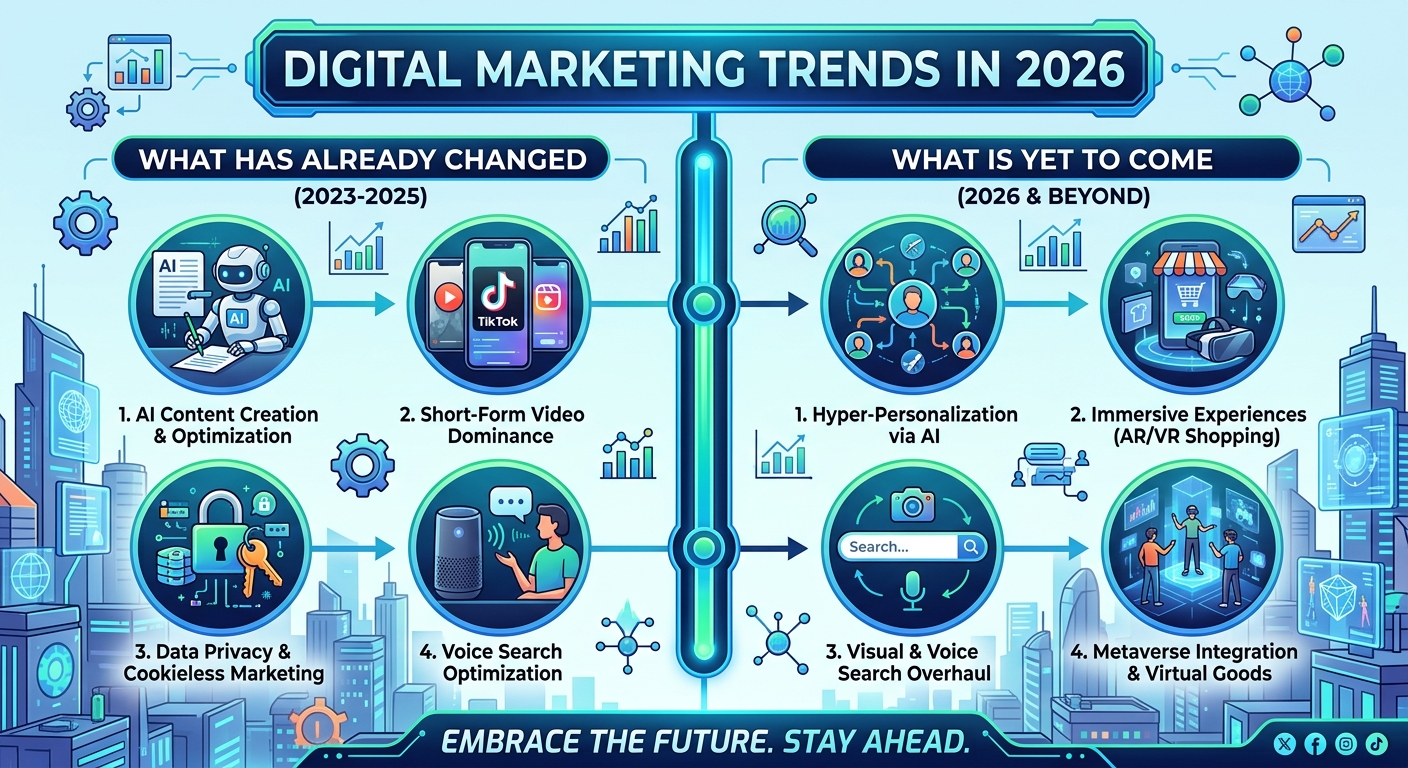
To help you navigate this rapidly shifting landscape, let’s break down the digital marketing trends in 2026 into two critical categories: what has already changed (the new baseline) and what is yet to come (the next wave of disruption).
Part 1: The New Baseline — What Has Already Changed by 2026
If your marketing strategy is still relying on 2023 or 2024 playbooks, you are already falling behind. Here are the core shifts that have permanently restructured the industry.
1. The Shift from SEO to GEO (Generative Engine Optimization)
Traditional Search Engine Optimization isn’t dead, but its rules have been completely rewritten. Search engines are no longer just lists of links; they are conversational answer engines powered by advanced AI.
With the dominance of zero-click searches, users expect detailed, direct answers within search interfaces like OpenAI’s SearchGPT, Google’s Gemini-powered search, and Perplexity.
- The Old Way: Optimizing for target keywords, backlinks, and meta tags to win a blue link ranking.
- The 2026 Reality: Optimizing for Generative Engine Optimization (GEO). Brands now focus on becoming the foundational source material that AI models cite when synthesizing answers. Authoritative brand mentions, structured data, and high-value expert insights (E-E-A-T) dictate visibility today.
2. The Cookie-Free Era and the Power of Zero-Party Data
After years of delays, third-party tracking cookies are officially a relic of the past. Data privacy laws across the globe have tightened, forcing brands to overhaul how they gather customer intelligence.
Marketers have shifted entirely to first-party and zero-party data strategies.
- Brands now rely on interactive quizzes, gamified experiences, preference centers, and loyalty programs to entice customers into voluntarily sharing their preferences, intents, and values.
- Data Clean Rooms have become standard for enterprise brands, allowing secure, privacy-compliant data collaboration between media buyers and publishers.
3. Hyper-Personalization at Scale Is No Longer Optional
Sending an email with a customer’s first name in the subject line used to pass for personalization. In 2026, consumers view that as basic mechanics.
Today’s marketing engines deliver real-time contextual personalization. Web pages dynamically adjust their layouts, copy, and product offers based on a visitor’s real-time intent, local environment, and historical interaction across channels. If a user browsed rain gear on their phone during a rainy commute, your homepage reflects that context the moment they open their laptop at work.
4. Interactive and Shoppable Video Dominance
Short-form video continues to hold the attention economy, but static short-form video is quickly losing ground to shoppable, interactive content.
Platforms like TikTok, YouTube Shorts, and Instagram Reels operate as full-funnel e-commerce engines. Viewers can click a product tagged inside a video, customize their selection via augmented reality (AR) overlays, and complete checkout using biometric authentication—all without pausing the video for more than a few seconds.
Part 2: The Next Wave — What Is Yet to Come in Late 2026 and Beyond
Now that we’ve established the current baseline, where is the industry heading next? The second half of 2026 and the years immediately following will be defined by autonomous technology, spatial environments, and a deep human counter-reaction.
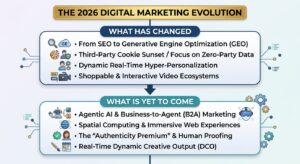
1. Agentic AI & “B2A” (Business-to-Agent) Marketing
We are transitioning from assistive AI (tools that help humans write or design) to Agentic AI (autonomous agents that take action on behalf of humans).
By late 2026, consumers will increasingly rely on personal AI agents to handle research, negotiations, and routine purchasing decisions.
- Instead of a consumer searching for “best lightweight running shoes under $150,” their personal AI agent will scan the web, evaluate store return policies, check live inventory, negotiate available discounts, and make the purchase automatically.
- The Strategic Shift: Marketers will no longer just create campaigns targeted at human consumer psychology. They must simultaneously market to AI software agents. “Business-to-Agent” (B2A) marketing strategies will focus on machine-readable pricing APIs, algorithmic value propositions, and trust metrics that AI agents favor.
2. Spatial Computing Hits Mainstream Marketing
With the iteration and adoption of lightweight spatial hardware—such as Apple Vision Pro, Meta Quest, and smart AR glasses—web experiences are moving from flat 2D screens to 3D spatial environments.
- Brands are moving past basic “try-it-on” AR filters to creating Spatial Web Stores.
- Imagine a furniture brand where a customer can step virtually into a fully decorated room, manipulate lighting, swap out fabrics in real time, and invite a friend’s avatar to join them in the shopping experience—regardless of physical location.
3. The “Authenticity Premium” and Human-Made Branding
As the internet becomes inundated with infinitely scalable, AI-generated content, a strong counter-trend is emerging: The Authenticity Premium.
Consumers are developing “AI fatigue.” In response, brands that visibly highlight human craft, behind-the-scenes authenticity, raw storytelling, and real human community will command a massive trust advantage.
- Expect to see the rise of “Proof of Human” content badges and verification signals.
- Founder-led storytelling, unscripted podcasts, live community events, and user-generated content (UGC) will become the most valuable assets in a brand’s creative library.
4. Real-Time Synthetic Ad Generation
While human authenticity will win on emotional brand-building, performance marketing will become entirely autonomous.
We are approaching a point where ad platforms will not run predefined static imagery or pre-shot video ads. Instead, ad systems will construct real-time synthetic ad creative tailored to the exact individual viewing it.
- The system will render a unique video background, voiceover accent, product color combination, and call-to-action on the fly based on the user’s immediate emotional state, location, and demographic profile.
Actionable Playbook: How Brands Can Win Right Now
To stay ahead of these trends throughout 2026 and prepare for what’s next, focus on three strategic priorities:
- Audit for GEO Visibility: Query leading AI models (Perplexity, ChatGPT, Gemini, Copilot) with questions your target audience asks. Are your brand, products, or leaders cited in the responses? If not, build a digital PR strategy focused on getting featured in high-authority, indexable publications.
- Build Your Zero-Party Data Engine: Stop relying on passive tracking. Design interactive, value-driven touchpoints (quizzes, interactive calculators, membership perks) that give customers a compelling reason to share their data directly with you.
- Double Down on Human Connections: Use AI to optimize operational efficiency, backend logistics, and data analysis—and reallocate those saved resources into high-touch human experiences, community building, and authentic story-led media creation.
Final Thoughts
The pace of change in 2026 can feel overwhelming, but the core objective of digital marketing remains unchanged: building trust and delivering real value to human beings.
Technology, interfaces, and algorithms will continue to evolve, but brands that blend technological efficiency with genuine human authenticity will be the ones that dominate the market in 2026 and beyond.
What digital marketing shifts have you noticed most in your industry this year? Are you ready for the rise of AI agents? Let’s discuss in the comments below!
Related story
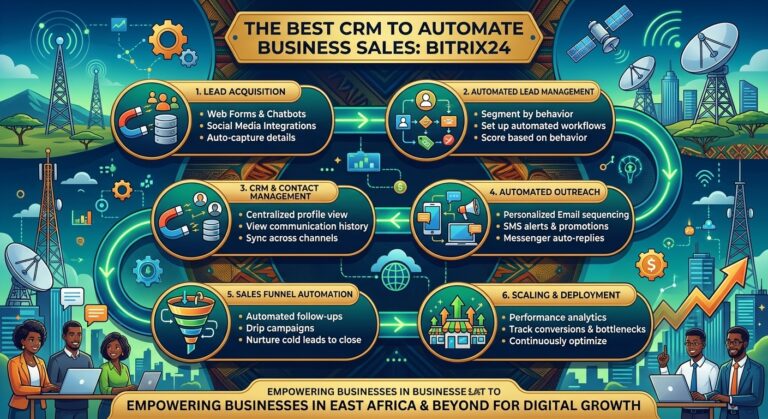
The best CRM to automate business sales: Bitrix24
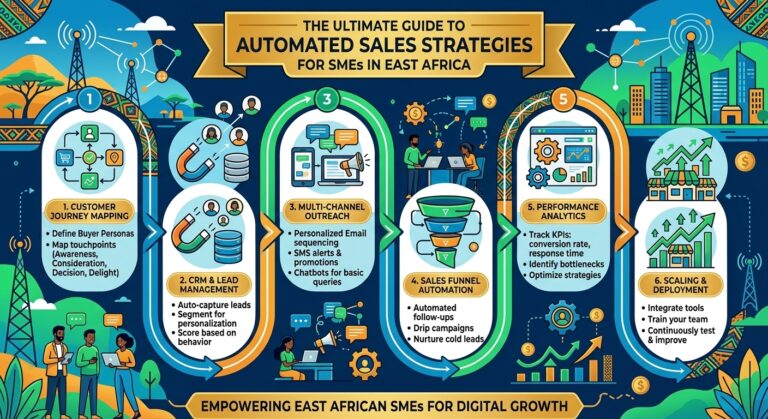
The Ultimate Guide to Automated Sales Strategies for SMEs in East Africa
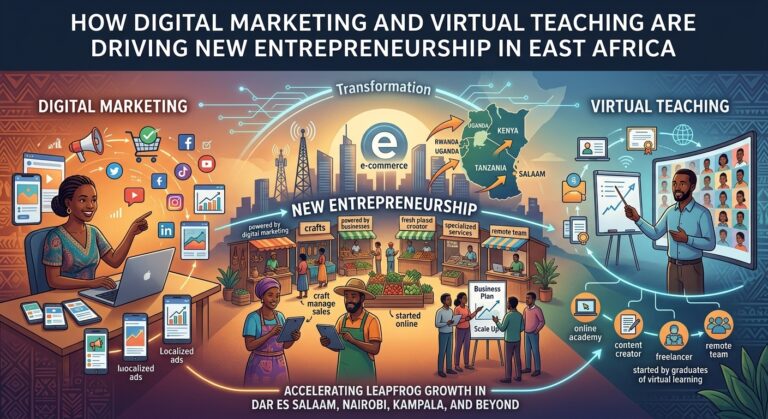
How Digital Marketing and Virtual Teaching are Driving New Entrepreneurship in East Africa
About the Author