Over the past decade, East Africa has emerged as one of the most dynamic regions for technological innovation in the world. From the bustling tech hubs of Nairobi—often called the “Silicon Savannah”—to the fast-growing business centers of Kampala, Dar es Salaam, Kigali, and Addis Ababa, a massive economic shift is happening.
This transformation is not just being led by huge corporations. Instead, it is being driven by ordinary individuals: young professionals, former school teachers, small-scale traders, and creative freelancers.
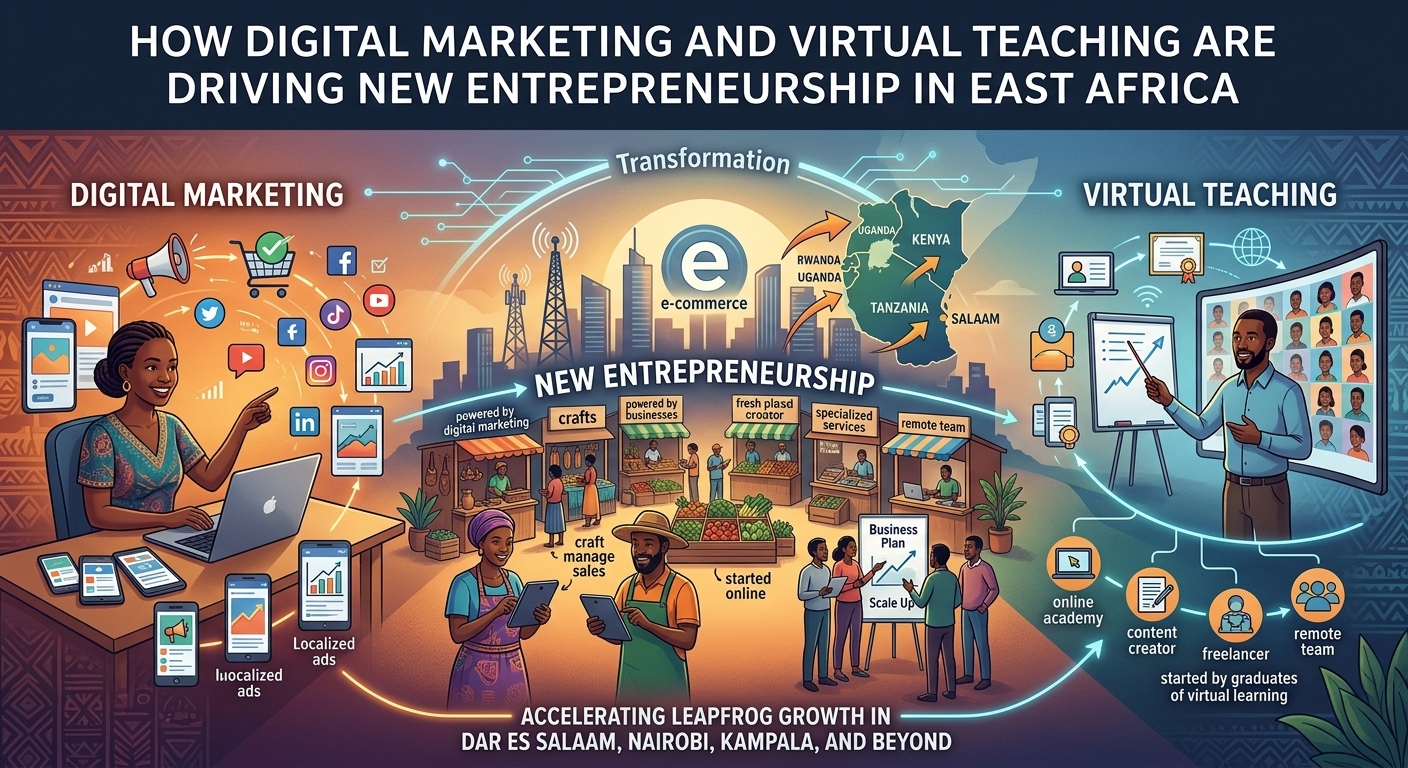
Two main forces are powering this new movement: digital marketing and virtual teaching.
Together, these two tools have lowered the cost of starting a business. They allow anyone with a smartphone, an internet connection, and a valuable skill to launch a business, find customers across borders, and generate income.
In this comprehensive guide, we will break down how digital marketing and online education are reshaping East African entrepreneurship, the exact strategies driving success today, the innovative concepts emerging in the region, and what the future of the digital economy in East Africa looks like.
1. The Landscape: Why East Africa is Fertile Ground for Digital Businesses
To understand why digital marketing in East Africa and virtual teaching are exploding, we must look at the foundation built over the last fifteen years. Three main factors created this fertile environment:
[Mobile Money Adoption (M-Pesa, MTN Mobile Money)]
                     +
[Widespread Smartphone & Mobile Internet Growth]
                     +
[A Young, Tech-Savvy, Entrepreneurial Population]
                     =
  The East African Digital Entrepreneurship Boom
A. Mobile Money Integration
East Africa is the global leader in mobile money. Innovations like M-Pesa in Kenya and Tanzania, alongside MTN Mobile Money and Airtel Money in Uganda and Rwanda, solved the biggest problem for small digital businesses: getting paid. Entrepreneurs no longer need expensive bank merchant accounts or credit cards to accept payments. Customers can buy digital services or online classes directly using their mobile phones in seconds.
B. High Mobile Internet Penetration
While desktop computers remain relatively expensive, affordable smartphones have given millions of East Africans access to high-speed internet. 3G, 4G, and now 5G networks cover major urban areas and continue to expand into rural towns.
C. A Young, Dynamic Workforce
East Africa has one of the youngest populations in the world. Facing formal job shortages, young people have turned to self-employment. Armed with digital skills, they view internet tools not just as social entertainment, but as vital business machinery.
2. Digital Marketing: The Engine of New East African Businesses
In the past, starting a business meant renting a physical store, printing flyers, and placing expensive radio or newspaper ads. Today, online business growth in East Africa is fueled by digital channels that cost a fraction of traditional advertising.
| Marketing Type | Cost Structure | Core Focus / Channels | Audience Reach |
| Traditional Marketing | High rent & expensive print/radio ads | Physical locations & traditional media | Local reach |
| Digital Marketing | Low startup cost | Social media & online platforms | Global reach |
How Digital Marketing Empowers Local Entrepreneurs
Digital marketing levels the playing field. A small fashion boutique in Kampala or a local honey producer in Eldoret can compete with international brands by directly reaching customers on their mobile devices.
Here is how digital marketing drives small businesses across the region:
1. Social Commerce (Selling Without a Website)
In Western markets, digital marketing often directs users to a formal website or e-commerce store (like Shopify or Amazon). In East Africa, social media platforms are the marketplace.
- WhatsApp Business: Acts as the primary tool for customer service, catalog browsing, and sales closing.
- Instagram & TikTok: Serve as visual storefronts where entrepreneurs showcase clothing, skincare products, electronics, and food services.
- Facebook Groups: Function as hyper-local community boards where goods and services are bought and sold every minute.
2. Direct-to-Consumer (D2C) Relationships
Digital marketing allows founders to tell their stories directly. A farmer selling organic passion fruit can post a video on TikTok showing how the fruit is grown. This builds trust, eliminates middlemen, and lets the farmer charge a fair price directly to retail consumers.
3. Hyper-Targeted Local Ads
With Facebook Ads, Instagram Ads, and Google Ads, small businesses can run marketing campaigns targeted precisely at specific neighborhoods, age groups, and interest categories. A salon in Kigali can run a $5-a-day ad targeted specifically to women living within 5 kilometers of their shop, ensuring zero wasted spend.
3. The Virtual Teaching Revolution: Monetizing Knowledge Beyond Boundaries
While digital marketing helps sell physical products and services, virtual teaching in East Africa has opened up an entirely new industry: the knowledge economy.
+------------------------------------------------------------------+
|                  THE KNOWLEDGE ECONOMY PIPELINE                  |
|                                                                  |
|   Expertise  --->  Digital Content  --->  Virtual Platform  ---> |
|   (Teacher)        (Video / Audio)        (WhatsApp / Zoom)      |
|                                                                  |
|   ---> Monetization (Mobile Money) ---> Regional Student Reach   |
+------------------------------------------------------------------+
Why Online Education is Exploding in East Africa
The demand for practical, job-ready skills in East Africa far outpaces what traditional academic institutions can supply. People want to learn coding, digital marketing, English/Swahili fluency, photography, graphic design, and agricultural techniques quickly.
Virtual teaching allows experts to turn their personal knowledge into scalable online businesses.
The Key Pillars of Virtual Teaching in the Region
A. Micro-Learning via Social Apps
Virtual teaching in East Africa does not always look like traditional Western platforms like Udemy or Coursera. Because internet data can be expensive, many micro-entrepreneurs deliver courses using low-data platforms:
- WhatsApp & Telegram Classes: Instructors create private groups where they deliver lessons via short voice notes, PDFs, and text messages. Students pay a registration fee via mobile money to gain access.
- YouTube Tutorials: Free educational channels build trust and authority, which creators then monetize through brand sponsorships or by up-selling private coaching.
B. Professional Upskilling Bootcamps
Tech academies and independent instructors run live cohort-based classes using Zoom and Google Meet. They teach in-demand skills such as web development, data analysis, and digital advertising to young professionals looking for remote international work.
C. Language and Cultural Instruction
East Africa’s unique linguistic landscape—specifically the spread of Swahili as a regional trade language—has created a global market for online language tutors. Native speakers in Kenya and Tanzania now earn income by teaching Swahili virtually to diaspora populations, tourists, and international researchers.
4. Key Strategies Used by East African Digital Entrepreneurs
To succeed in this region, successful founders adapt traditional marketing and teaching tactics to local market realities. Here are the core strategies driving results today:
+-------------------------------------------------------------------+
|               CORE STRATEGIES FOR REGIONAL SUCCESS                |
+-------------------------------------------------------------------+
|  1. Mobile-First & Low-Data Content Design                        |
|  2. Localization & Cultural Storytelling (e.g., Sheng, Swahili)   |
|  3. Hybrid Payment Models (Mobile Money + Cash-on-Delivery)       |
|  4. Micro-Influencer Partnerships & Community Building            |
+-------------------------------------------------------------------+
Strategy 1: The “Mobile-First and Low-Data” Approach
High data costs can prevent users from downloading heavy files or streaming long HD videos. Smart digital entrepreneurs design their content specifically for mobile consumption:
- They compress images and produce short, high-impact video reels (15–60 seconds).
- Virtual teachers provide downloadable audio files or text summaries alongside live video calls so students with slow connections don’t miss out.
Strategy 2: Localization and Cultural Storytelling
Generic, Western-style advertising often fails in East Africa. The most successful marketing campaigns speak directly to local lifestyle, humor, and language nuances:
- Code-switching: Mixing English with Swahili, Sheng (Nairobi urban slang), or Luganda makes brand messaging feel authentic and relatable.
- Problem-centric messaging: Highlighting practical solutions to daily challenges (e.g., power outages, logistics hassles, affordable payment terms) builds trust quickly.
Strategy 3: Trust-Building Through Micro-Influencers
Traditional celebrity endorsements are expensive and often feel disconnected from daily reality. Instead, East African digital brands partner with micro-influencers (content creators with 5,000 to 50,000 engaged followers). These creators hold deep trust within specific niches—such as local fashion, technology reviews, fitness, or cooking—delivering much higher conversion rates for every marketing dollar spent.
Strategy 4: Frictionless Payment Solutions
Successful online businesses make payment as easy as possible. They embed direct M-Pesa or Mobile Money payment links inside WhatsApp chats, social media bio links, and digital invoices. Many e-commerce businesses offer pay-on-delivery or flexible micro-installment payments to lower the barrier for first-time buyers.
5. Innovative Concepts Transforming the Regional Market
As digital marketing and virtual teaching continue to overlap, creative founders are inventing entirely new business models tailored specifically for East Africa.
+-------------------------------------------------------------------+
|               INNOVATIVE BUSINESS MODELS EMERGING                 |
+-------------------------------------------------------------------+
|  • Social Commerce Hubs (Combining video, chat, & instant pay)     |
|  • EdTech Micro-Academies (Bite-sized, affordable learning)       |
|  • Remote Agency Networks (Youth-led digital service teams)       |
|  • Farm-to-Consumer Platforms (Bypassing traditional brokers)     |
+-------------------------------------------------------------------+
1. Social Commerce Hubs
Instead of building traditional online stores, innovative entrepreneurs create “virtual boutiques” built on top of social platforms. They livestream product demos on TikTok or Instagram, handle customer questions instantly via automated WhatsApp bots, and collect payments using mobile money prompts—completing the entire sales journey inside social apps.
2. EdTech Micro-Academies
Rather than enrolling in long university programs, learners buy access to short, focused learning tracks. For example, a virtual academy might offer a 2-week course titled “How to Run Facebook Ads for Real Estate in Nairobi” or “Mastering Poultry Farming Management via Mobile.” These hyper-focused, low-cost courses offer immediate practical value to students.
3. Remote Agency Networks Run by Local Youth
Young marketers, copywriters, graphic designers, and video editors are pooling their talents to form digital agencies. Operating remotely out of hubs like Co-Creation Hub (iHub) in Kenya or Innovation Village in Uganda, these teams provide affordable digital marketing services to local businesses while servicing international clients in Europe and North America.
4. Agri-Marketing Platforms
Agriculture forms the backbone of East Africa’s economy. Digital marketers are now building platforms that connect smallholder farmers directly with urban consumers, restaurants, and hotels. By using digital media to showcase produce and mobile tools to coordinate deliveries, these platforms remove predatory middlemen and increase farmer profits.
6. Real-World Case Examples: Success in Action
To see how these concepts function in real life, consider these simplified examples based on real trends in the region:
Case Study A: The WhatsApp Virtual Language School
- The Entrepreneur: A university graduate in Dar es Salaam, Tanzania.
- The Business Model: Teaching conversational Swahili to international tourists, expats, and business leaders.
- The Strategy: The founder shares short 30-second Swahili lesson videos on TikTok and InstagramReelss to attract an audience. Interested followers are directed to a WhatsApp link where they can purchase a 4-week structured audio course.
- The Result: By taking payments through international mobile transfer channels, the founder earns a sustainable income while keeping overhead costs near zero.
Case Study B: The Local Beauty Brand Powered by TikTok
- The Entrepreneur: A boutique cosmetics formulator in Kampala, Uganda.
- The Business Model: Organic skincare products made using locally sourced ingredients like shea butter.
- The Strategy: Instead of buying expensive billboard ads, the founder posts behind-the-scenes videos showing how products are made, alongside real customer reviews. She uses Instagram Direct Messages and WhatsApp to answer queries and take orders.
- The Result: The brand reaches customers across Uganda, Kenya, and Rwanda, shipping orders through regional courier networks—all managed from a home office.
7. Challenges Facing East African Digital Entrepreneurs
While the opportunities are vast, running a digital business in East Africa comes with distinct challenges. Understanding these hurdles is critical for anyone entering the market:
                  +-----------------------------------+
                  |   KEY CHALLENGES IN THE REGION    |
                  +-----------------------------------+
                  | • High Data Costs & Network Blips |
                  | • Delivery & Logistics Hurdles    |
                  | • Digital Literacy Disparities    |
                  | • Shifting Platform Algorithms    |
                  +-----------------------------------+
- High Cost of Data: Internet access remains relatively expensive relative to average incomes in several parts of the region. High data tariffs can limit how often potential customers watch long videos or join live video classes.
- Logistics and Delivery Gaps: Selling a physical product online is easy; delivering it quickly across towns with unmapped addresses can be difficult. Businesses rely heavily on informal motorcycle couriers (boda-bodas) and local bus networks to move goods.
- Platform Dependence: Relying entirely on platforms like Facebook, Instagram, or WhatsApp leaves small businesses vulnerable to algorithm changes or account suspensions. Building independent customer email or SMS lists is vital for long-term stability.
- Digital Literacy Gaps: While urban youth are comfortable navigating digital spaces, older demographics and rural populations may still struggle with digital transactions, requiring businesses to spend time educating their users.
8. The Future of the Digital Economy in East Africa
The momentum behind East African entrepreneurship is set to accelerate even further over the coming decade. Key trends shaping the future of this digital market include:
+-------------------------------------------------------------------+
|               FUTURE TRENDS TO WATCH (2026 AND BEYOND)            |
+-------------------------------------------------------------------+
|  1. Integration of Artificial Intelligence (AI) for Content & Ads |
|  2. Regional Cross-Border E-Commerce (AfCFTA Expansion)          |
|  3. Localized Ad Networks Built specifically for Africa           |
|  4. Micro-Credentialing & Mobile-Based Educational Certification  |
+-------------------------------------------------------------------+
A. Artificial Intelligence (AI) Adoption
Artificial Intelligence tools are enabling small, one-person teams to operate at the scale of larger companies. East African entrepreneurs are using AI for:
- Writing ad copy in multiple languages.
- Generating graphics and promotional materials cheaply.
- Automating WhatsApp customer support using localized AI chatbots that understand regional dialects and slang.
B. Pan-African Cross-Border Digital Trade
The expansion of the African Continental Free Trade Area (AfCFTA), combined with regional integration efforts within the East African Community (EAC), will make cross-border digital trade much easier. A digital marketer in Nairobi will be able to sell digital products or services to customers in Kigali, Dodoma, or Kampala with zero customs hassle and instant cross-border mobile payments.
C. Evolution of Localized Ad Networks and Super-Apps
While global platforms like Meta and Google dominate advertising today, regional “super-apps” that combine messaging, payments, ride-hailing, and shopping into a single platform are expanding. Marketers will increasingly run ads directly within these integrated ecosystems.
D. Formalization of Virtual Learning Credentials
As online teaching expands, accredited short-course certificates issued via blockchain or mobile-verified badges will gain respect among employers, making virtual education just as valuable as traditional college diplomas for getting hired.
9. Actionable Step-by-Step Guide: How to Start Your Digital Business in East Africa Today
If you are an aspiring founder looking to leverage digital marketing or virtual teaching, here is a clear roadmap to launch your idea:
+--------------------------------------------------------------------+
|                      YOUR 5-STEP LAUNCH ROADMAP                    |
+--------------------------------------------------------------------+
|  Step 1: Identify a High-Demand Local Problem                      |
|  Step 2: Choose Your Core Channel (TikTok, Instagram, WhatsApp)    |
|  Step 3: Create Simple, Value-First Mobile Content                 |
|  Step 4: Set Up Direct Mobile Payments (M-Pesa, MTN MoMo, Airtel)  |
|  Step 5: Gather Customer Testimonials and Scale Gradually         |
+--------------------------------------------------------------------+
Step 1: Identify a Specific Problem
Focus on a clear demand in your community or industry. Are people struggling to pass professional exams? Are local fashion shoppers looking for affordable, tailor-made clothes? Do small farmers need reliable advice on pest control?
Step 2: Master One Primary Channel
Do not try to be everywhere at once. Pick the platform where your audience already spends their time:
- Choose TikTok/Instagram for visual, lifestyle, and consumer goods.
- Choose WhatsApp/Telegram for direct sales, consultancy, and community-based teaching.
- Choose LinkedIn for business-to-business (B2B) services and high-end consulting.
Step 3: Publish Helpful Content Consistently
Share practical tips, clear product demonstrations, or helpful micro-lessons daily. Focus on solving your audience’s problems before asking them to buy anything. Trust comes first; sales follow naturally.
Step 4: Streamline Your Payment and Delivery Process
Make buying frictionless. Display your mobile money payment numbers clearly, use quick links to start WhatsApp chats, and partner with reliable local courier services (boda-bodas or bus parcel services) to handle fulfillment.
Step 5: Collect Reviews and Build Community
Satisfied customers are your best marketing tool. Ask buyers for quick screenshot reviews or video testimonials. Post these reviews on your social profiles to build social proof and attract your next wave of clients.
Final Thoughts
The convergence of digital marketing and virtual teaching is doing something remarkable: it is democratizing opportunity across East Africa.
You no longer need massive capital, physical storefronts, or corporate backing to launch a thriving company. By combining local storytelling, mobile technology, and practical knowledge, a new generation of entrepreneurs is taking control of their financial futures and reshaping the regional economy.
Whether you are looking to start your own online store, offer digital services, or teach your skills to thousands of eager students across the continent, the tools are already in your hands. The digital door is open—the best time to start building is right now.
Key Takeaways for Quick Reference
- Mobile-First Infrastructure: East Africa’s mobile money network (M-Pesa, MTN MoMo) makes online monetization fast and reliable without bank accounts.
- Social Commerce Dominance: WhatsApp, Instagram, and TikTok serve as primary storefronts for local businesses.
- Knowledge as a Product: Virtual teaching via audio, short videos, and messaging apps allows individuals to monetize specialized skills with minimal overhead.
- Localization Matters: Authentic storytelling using local languages and code-switching converts customers faster than generic international ad templates.
- Bright Horizons: AI integration, cross-border digital trade policies, and super-apps will drive the next wave of growth in the future of the digital economy in East Africa.
About the Author