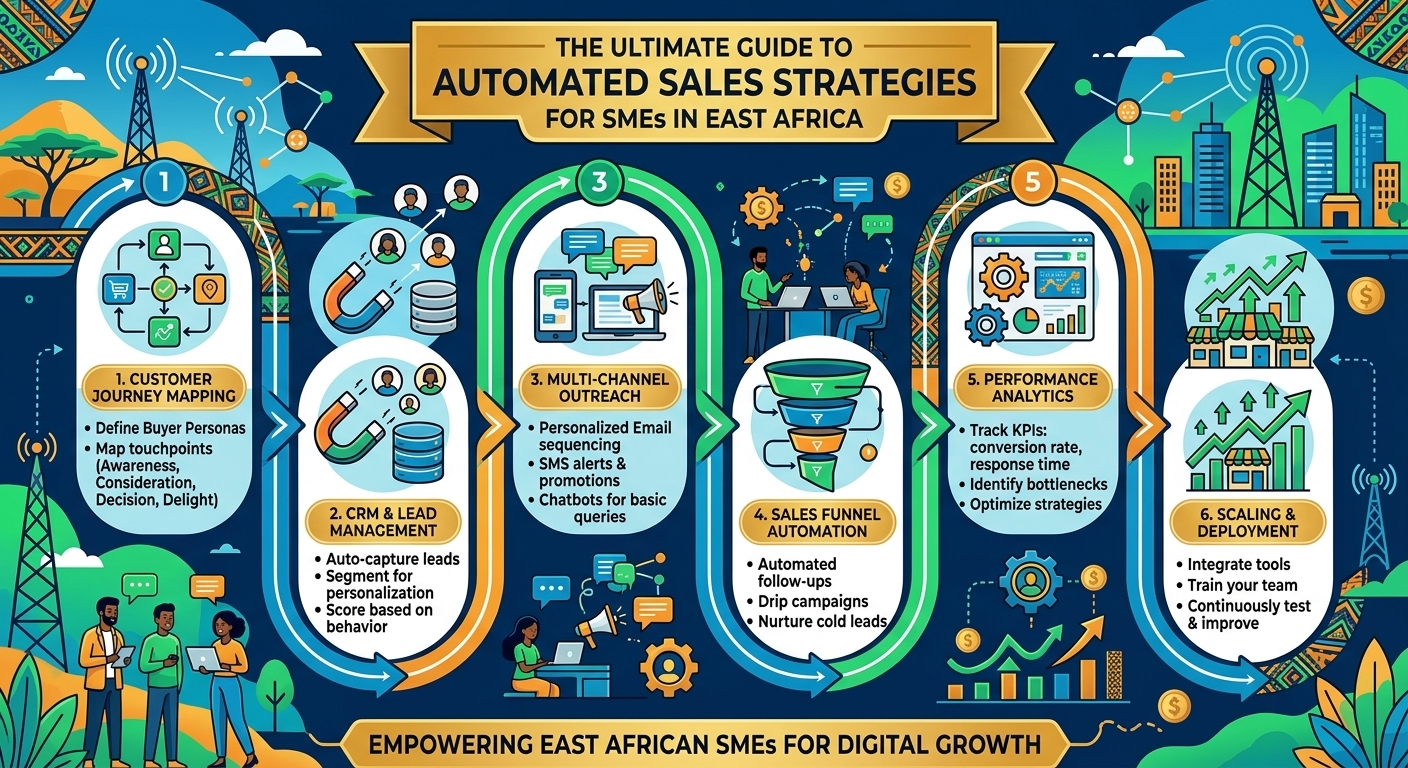
In the bustling markets of Nairobi, the vibrant commercial hubs of Dar es Salaam, the fast-growing streets of Kampala, and the tech-forward avenues of Kigali, Small and Medium Enterprises (SMEs) are the lifeblood of the East African economy. In fact, according to the East African Community (EAC), SMEs account for over 90% of all registered businesses and contribute to more than 60% of employment.
However, running a small business in East Africa comes with unique challenges. Business owners often find themselves playing multiple roles at once: they are the accountant, the customer service agent, the delivery coordinator, and the sales representative. This constant multitasking leaves little time for strategic planning and scaling.
This is where automated sales strategies for SMEs come in.
Imagine having a virtual salesperson who never sleeps, instantly answers customer inquiries on WhatsApp, automatically sends payment reminders, updates your inventory, and nurtures leads while you sleep. This is not science fiction; it is a reality that is transforming businesses across our region today.
In this comprehensive guide, we will break down how sales automation works, why it is crucial for East African businesses, practical strategies you can implement right away, and what the future holds for digital commerce in our region.
What is Sales Automation? (A Simplified Explanation)
Before we dive into strategies, let us simplify what we mean by “sales automation.”
At its core, sales automation is the process of using digital tools, software, and smart technologies to handle repetitive, manual sales tasks. Instead of a human being doing these tasks step-by-step every single time, a software program is set up to do them automatically based on specific triggers.
Think of it like a modern washing machine. Instead of washing every cloth by hand (which takes time, energy, and constant attention), you put the clothes in the machine, press a button, and let it do the work.
In business, sales automation does the same thing. For example:
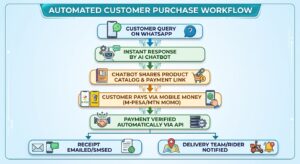
- Manual Process: A customer sends a Facebook message asking, “How much is this shoe?” You see the message three hours later, reply, wait for them to respond, send your phone number for payment, check your mobile money account manually, and then write down their delivery details on a piece of paper.
- Automated Process: The customer clicks on your product. An automated chatbot instantly replies with the price, size options, and a payment link. The customer pays via mobile money, the payment is automatically verified, a receipt is generated, and a delivery order is instantly sent to your dispatch rider. All of this happens in less than two minutes without you lifting a finger!
Why East African SMEs Must Automate Sales Today
The business landscape in East Africa is unique. We are a mobile-first economy, driven heavily by mobile money platforms like M-Pesa, MTN Mobile Money, Airtel Money, and Tigopesa.
1. The “Always-On” Customer Culture
East African consumers are highly connected. They browse social media late at night and expect instant responses. If a potential customer sends an inquiry at 10:00 PM and you do not reply until 8:00 AM the next morning, they have likely already bought from a competitor who replied faster. Automation ensures you are open 24/7.
2. Overcoming the Talent and Resource Gap
Many SMEs in the region cannot afford to hire large sales and marketing teams. By using affordable business automation tools in East Africa, a team of two people can achieve the output of a ten-person department.
3. Streamlining Mobile Money Transactions
While mobile money has made payments easier, manual reconciliation is a nightmare. Checking your phone for SMS alerts, matching them with ledger books, and verifying transactions manually is slow and prone to errors. Automation connects your payment systems directly to your sales records.
4. Scalability
If your business depends on manual labor for every sale, your growth is limited by the number of hours in a day. Automation unlocks infinite scalability. Whether you have 10 customers a day or 1,000, your system handles them with the same efficiency.
5 Innovative Automated Sales Strategies for East African SMEs
Now, let’s explore practical, step-by-step strategies that your business can implement using accessible tools.
Strategy 1: WhatsApp Business API & Conversational Chatbots
In East Africa, WhatsApp is not just a messaging app; it is the virtual marketplace. Millions of customers prefer to communicate, negotiate, and buy through WhatsApp.
However, relying on a basic WhatsApp Business app on a single phone can lead to missed opportunities when volume increases.
How it works:
By upgrading to the WhatsApp Business API and integrating it with chatbot platforms (like ManyChat, ChatFuel, or local solutions like Wasoko or Twiga-style systems), you can build an automated conversational sales agent.
- The Trigger: A customer clicks a “Send Message” ad on Facebook or Instagram.
- The Automation: A WhatsApp window opens, and a friendly chatbot greets them by name.
- The Interaction: The chatbot presents options (e.g., “1. View Catalog,” “2. Track Order,” “3. Talk to Agent”).
- The Sale: If they click “View Catalog,” the bot displays your products, takes their size/color preference, and provides a direct payment option.
This strategy is highly effective for retail, food delivery, beauty services, and professional consultancies.
Strategy 2: Automated Email Marketing Funnels
Many business owners believe email marketing is dead in Africa. This is a costly misconception. While B2C (business-to-consumer) retail relies heavily on social media, B2B (business-to-business) and high-value B2C sectors (like real estate, education, insurance, and professional services) rely heavily on email.
With digital marketing automation for SMEs, you can build a system that gently guides a stranger to becoming a loyal customer.
How it works:
You can use tools like Mailchimp, ConvertKit, or Sender (which is highly budget-friendly for startups) to build a funnel:
- Step 1 (The Hook): You offer a free valuable resource on your website (e.g., a free PDF guide on “How to register a business in Uganda” or “How to maintain your car in Kenya”). To download it, the user inputs their name and email address.
- Step 2 (The Welcome): The system automatically emails them the PDF file instantly.
- Step 3 (Nurturing): Three days later, the system automatically sends a second email sharing a helpful tip related to the guide.
- Step 4 (The Offer): Seven days later, the system sends a third email introducing your paid service or product, along with a discount code that expires in 48 hours.
This entire sequence is set up once. Whether 5 people or 5,000 people download your guide, the system nurtures them individually without any manual input from you.
Strategy 3: Integrating CRM Software with Local Payment Gateways
Customer Relationship Management (CRM) tools are clean, digital databases of your customers. For a long time, these tools were designed only for large corporations in the West. Today, there are many custom, affordable options for SMEs.
Using CRM software for East African businesses becomes incredibly powerful when integrated with local payment gateways like Pesapal, Flutterwave, DPO Group, Paystack, or Chapa.
How to automate sales in Kenya and East Africa using this setup:
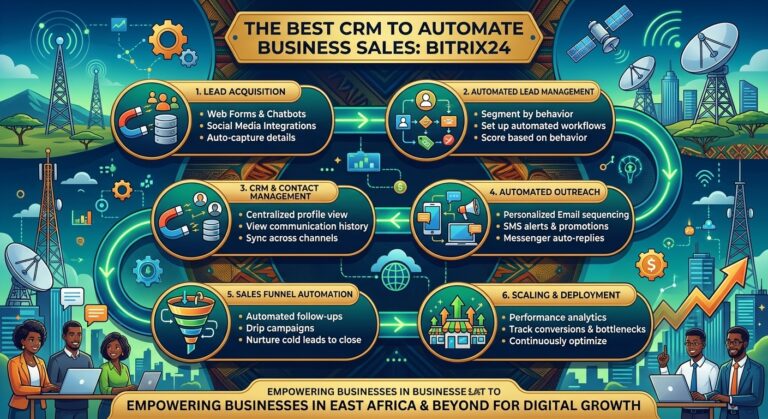
- When a client books a consultation or selects a product on your site, their details are instantly captured in your CRM (e.g., HubSpot Free, Zoho CRM, or Bitrix24).
- The CRM automatically triggers a digital invoice with a secure checkout link.
- The customer clicks the link and pays using M-Pesa, MTN MoMo, or a Visa Card.
- Once the payment gateway confirms receipt, it sends a digital signal (webhook) back to your CRM.
- The CRM automatically marks the deal as “Won” or “Paid,” moves it to the delivery stage, and sends a “Thank You” SMS to the client.
This eliminates human error, ensures accurate financial tracking, and builds immense trust with your customers.
Strategy 4: Social Commerce Auto-Responders
Social media platforms like Instagram and Facebook are the digital storefronts of East Africa. However, manual social media management is exhausting.
“Price?” is the most common comment on business pages, and typing out the same reply hundreds of times is an unproductive use of your time.
How it works:
Using social media automation tools like ManyChat (which is officially approved by Meta), you can create simple “Comment-to-DM” triggers.
- You post a picture of a product on Instagram with the caption: “Comment the word ‘SHOE’ to get the prices and order link!”
- A user comments: “SHOE”
- Within half a second, your automated system sends a direct message (DM) to that user with the full pricing, available sizes, and a quick-buy button.
- Simultaneously, the system replies to their public comment saying: “We have sent you a DM with all the details! Check your inbox.”
This strategy dramatically boosts your engagement rates because Instagram’s algorithm rewards posts that get rapid comments and quick DMs, pushing your content to even more potential customers.
Strategy 5: Automated Inventory and Sales Reconciliation
There is nothing more embarrassing than selling a product to a customer, accepting their payment, and then having to call them back to say, “I am sorry, we actually ran out of that item in our warehouse.”
It damages your brand reputation instantly.
How it works:
By using integrated Point of Sale (POS) and inventory tools (such as Loyverse, QuickBooks, Odoo, or local platforms like Kyosk/Lipa Later systems), you can connect your physical inventory to your online sales channels.
- When a sale is completed online, the system automatically subtracts that item from your digital stock records.
- If stock levels fall below a certain threshold (e.g., only 5 units left), the system automatically emails you a low-stock alert or automatically drafts a purchase order for your supplier.
- If a product goes completely out of stock, the website or WhatsApp catalog automatically updates to display “Out of Stock,” preventing customers from buying items you do not have.
Comparison of Leading Automation Tools for East African SMEs
To help you choose the right technologies, here is a quick breakdown of popular tools that work exceptionally well in the East African context:
| Tool Category | Recommended Software | Best For | Key Advantage in East Africa |
|---|---|---|---|
| Messaging Automation | ManyChat / WhatsApp Business API | Automated chats on IG, FB, and WhatsApp | Highly preferred by local customers who hate emails |
| CRM | HubSpot / Zoho CRM | Managing customer databases and leads | Excellent free versions; integrates well with local webhooks |
| Email Marketing | Sender / Mailchimp | Automated email sequences and newsletters | Sender offers highly affordable pricing tiers for small lists |
| Payment Gateways | Pesapal / Flutterwave / DPO Group | Collecting payments online and via mobile money | Native support for M-Pesa, MTN MoMo, Airtel Money, and local card networks |
| All-in-One Operations | Odoo (Community Edition) / Zoho One | Inventory, accounting, sales, and CRM | Highly customizable; allows open-source self-hosting to save costs |
Step-by-Step Guide: How to Start Automating Your Sales
Transitioning from manual operations to an automated system can feel overwhelming. However, you do not have to automate everything overnight. Follow this simple roadmap to scale your business safely and affordably.
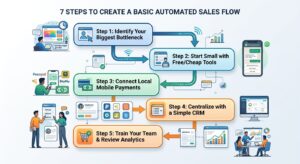
Step 1: Identify Your Biggest Bottleneck
Do not try to automate everything at once. Look at your daily operations and ask yourself: What manual task takes up most of my time or causes the most frustration?
- If you waste hours answering basic questions about prices and locations: Start with WhatsApp/Instagram chatbots.
- If you struggle with tracking who has paid and who hasn’t: Start with mobile money integration and automated invoicing.
- If you keep forgetting to follow up with leads: Start with an email or CRM automation system.
Step 2: Choose Affordable, Mobile-Friendly Tools
You do not need to spend thousands of dollars on expensive enterprise systems. Many modern solutions offer generous free tiers. Start with tools that are easy to configure, require zero coding knowledge, and offer mobile apps so you can monitor your business on your phone.
Step 3: Polish Your Database
Automation relies on clean information. Before setting up your systems, ensure your product catalogs, price lists, and customer contact details (especially with correct country codes like +254, +255, +256, +250) are organized in a clean spreadsheet.
Step 4: Map Out Your “Customer Journey”
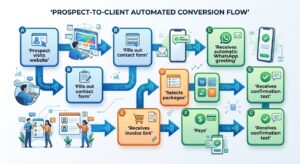
Having this physical map makes it incredibly easy to configure your software tools correctly.
Step 5: Test, Monitor, and Refine
Before launching your new automated systems to the public, run multiple tests. Act as a customer yourself: send messages, trigger the automated sequences, make test payments, and ensure everything flows smoothly. Once live, review the performance weekly. If customers are dropping off at a certain point in your chatbot flow, simplify the options.
The Future of Automated Sales Strategies in East Africa
The technological environment in East Africa is evolving at a breakneck speed. Here are some of the emerging trends that will shape automated commerce over the next few years:
1. Artificial Intelligence in Local Languages
Currently, most AI models struggle with local dialects, slang, and code-switching (such as Sheng in Kenya, or a mix of Luganda and English in Uganda). However, local tech startups and global firms are building localized Natural Language Processing (NLP) models.
In the near future, your conversational chatbots will be able to effortlessly interact with customer inquiries in fluent Sheng, Swahili, Luganda, or Kinyarwanda, making automated sales feel incredibly warm, human, and personal.
2. Deeper Integration of USSD and Smartphone Automation
While smartphone adoption is growing rapidly, feature phones (yam-phones) remain common in rural communities. The future will bring seamless cross-platform automation that links web and smartphone apps with USSD codes. An offline customer will be able to trigger an automated sales flow via a simple USSD string (e.g., *123#), which instantly syncs with the business’s cloud-based CRM.
3. Hyper-Local Logistics Automation
The final frontier of sales is delivery. In East Africa, address systems can be challenging. Innovative SMEs are beginning to integrate automated sales systems with smart logistics APIs (like Boda Boda dispatch networks).
As soon as a client pays online, the system automatically uses GPS coordinates to assign the closest delivery rider, calculate the exact fare, and send tracking links to both the merchant and the buyer without any human intervention.
Conclusion: Start Small, Automate Today, and Scale Tomorrow
The era of struggling with manual notebooks, losing customers due to slow response times, and spending endless hours on administrative tasks is coming to an end.
By implementing automated sales strategies for SMEs, you unlock the freedom to focus on what truly matters: improving your products, building strong customer relationships, and growing your business.
You do not need a massive IT budget to get started. By adopting a simple conversational chatbot, setting up basic CRM software for East African businesses, and integrating automated mobile money payments, you can instantly put your business on the path to automated, scalable success.
The digital revolution in East Africa is already here. Don’t let your business get left behind. Take your first step toward automation today!
Frequently Asked Questions (FAQs)
Q1: Is sales automation expensive for a small business?
A: Not at all. Many of the best business automation tools East Africa offers have free tiers (like HubSpot CRM or Mailchimp) or highly affordable packages starting at less than $15 per month. You only pay more as your sales grow.
Q2: Will automation make my business feel cold and robotic to my customers?
A: No, if done correctly. Good automation is designed to handle administrative tasks so that when you do talk to a customer, you can give them your full, undivided attention. You can also customize your messages with warm, friendly, localized language.
Q3: Do I need to know how to code to set up these automated sales strategies?
A: Absolutely not. Most modern automation tools use simple “drag-and-drop” builders. If you can use Facebook and send an email, you have all the technical skills required to build basic automated workflows.
About the Author